Budget · ₹ (approx ₹500-1500/night)
Zostel Hampi
Rustic hut-style backpacker hostel among the rice paddies

 1,600 surviving monuments👑 229y empire capital
Hampi is what remains of Vijayanagara, the capital of a South Indian empire whose monuments rose between 1336 and 1570: temples, bazaar colonnades, palace platforms and a stone chariot scattered across some 26 sq km of granite boulders on the Tungabhadra. Two full days cover the main ruins and a third takes in the far bank of the river. Come between November and February; trains and overnight buses arrive at Hosapete, 13 km away.
12 hand-picked stays from budget to luxury, the author's picks first.
Rustic hut-style backpacker hostel among the rice paddies
Full-service chain hotel beside Hosapete station
Eco resort of stone cottages on the Tungabhadra river
Palace-style luxury resort in the land of Kishkinda
Simple Hampi Bazaar rooms with a temple-view rooftop
Comfortable Kamalapur hotel opposite the ASI Museum
Government-run hotel inside the Hampi heritage zone
Restored heritage village homes in Anegundi, run by a local trust
Cottage resort with Vijayanagara-style sculpture and gardens
Vijayanagara-inspired villas on a green organic estate
Restored royal palace-hotel of the Sandur rulers
Contemporary international-chain hotel with plunge pools
Ad · Affiliate links: if you book, we earn a commission at no extra cost to you.




Best time to visit Hampi · Hampi weather · How to reach Hampi · Hampi airport to city · Hampi railway station · How to get around Hampi · Bike rental in Hampi · Is Hampi safe · Language spoken in Hampi · Hampi trip cost · Interesting facts about Hampi · Places to visit near Hampi
Safari near Hampi · Boat ride Hampi · Adventure activities in Hampi
Where to stay in Hampi · Budget hotels in Hampi · Luxury hotels in Hampi · Boutique hotels in Hampi
 35 places · the full map is in the app
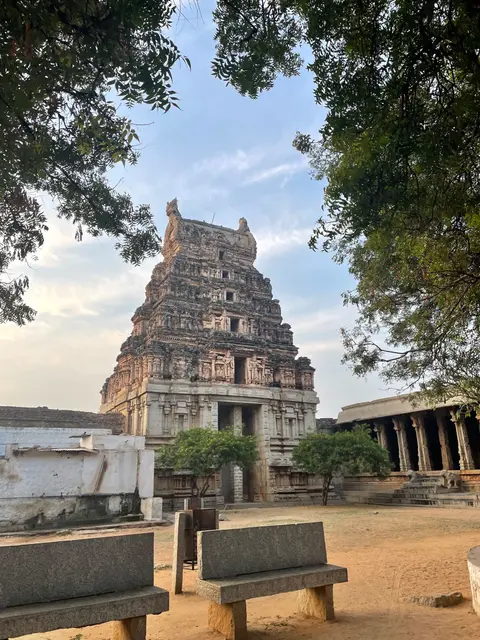
Hampi was the seat of the Vijayanagara empire. Its monuments were built between 1336 and 1570, and many of the great royal buildings date from Krishnadeva Raya (1509–30), the dynasty's most celebrated ruler. The Portuguese chronicler Domingo Paes wrote around 1520 that it seemed to him "as large as Rome". After the defeat at Talikota in 1565 the city was looted and abandoned, and in 1986 its monuments became a UNESCO World Heritage Site.
The setting is part of the site: granite boulders piled into hills, banana groves and paddy between them, the river running through. And one temple never stopped: Virupaksha has been in worship since about the seventh century, and its morning puja still opens the day in a village that is otherwise a field of broken stone.
Sacred Centre (Hampi village and the bazaar): the working Virupaksha Temple, the kilometre-long colonnade of the old bazaar ending at the Monolithic Bull, and Hemakuta Hill above it, with the Kadalekalu Ganesha on its slope. South of it stand the 6.7 m Lakshmi Narasimha monolith, the Badavi Linga, and the Krishna Temple. Matanga Hill gives the widest view over the whole site.
Vittala and the riverside: the Vittala temple with the Stone Chariot, the one on the ₹50 note, and the pillars that ring when struck (tapping them is no longer allowed). The chariot is assembled from granite blocks; the single-stone story is a popular myth.
Royal Centre: the administrative core of the empire, with the Lotus Mahal, the elephant stables, the Queen's Bath, the Mahanavami Dibba platform, the Stepped Tank and the Underground Shiva Temple. There is little shade: go in the morning and allow half a day.
Kamalapura: the Archaeological Museum, worth an hour first for its scale model of the site, and the Pattabhirama Temple, large and usually empty.
The north bank: across the river lie Virupapur Gaddi with its guesthouses among the paddies, Anegundi, older than the imperial city, Anjanadri Hill with the Hanuman temple, Pampa Sarovar and Sanapur Lake. This side is greener and slower.
One day covers the essentials if you start early: Virupaksha and Hemakuta in the morning, the Royal Centre before the heat builds, and Vittala in the late afternoon, when the stone turns gold.
Two days is the comfortable minimum. Give the first to the Sacred Centre, Hemakuta and the river path to Vittala, the second to the museum, the Royal Centre and the quiet temples around Kamalapura such as Pattabhirama.
Three days add the north bank: the climb to the Hanuman temple on Anjanadri (about 462 steps by the district administration's count), Anegundi with its banana-fibre craft workshops, Pampa Sarovar and Sanapur Lake. A fourth day leaves time for the Daroji Sloth Bear Sanctuary, and more ideas are on the day trips page.
November to February is the season: dry, with days around 29–33°C and nights of 16–19°C. October and March are workable; from March see the ruins early and late and rest at midday. April and May are the hottest months, with highs around 38°C, and are best avoided. The rains from July to October are moderate here (September, the wettest month, averages about 150 mm), but when the river rises the boats to the north bank stop. Hampi Utsav, three nights of free concerts with the monuments lit up: 3–5 November 2026 (expected). See festivals in Hampi and the month-by-month weather page.
By train: Hampi has no station of its own. Everything arrives at Hosapete (Hospet) Junction, 13 km west. The nightly Hampi Express from Bengaluru leaves around 22:00 and pulls in about 07:30. From Goa the one direct train, the Amaravati Express, does not run every day.
By bus: most people come on the overnight sleeper from Bengaluru: some forty services a night cover the 289 km in about 6.5–8 hours, from about ₹450 without AC to about ₹1,800 for an AC sleeper.
By air: Vidyanagar (VDY), 32–40 km away, has few flights; Hubballi (HBX), 145 km and 3–3.5 hours by taxi, is the reliable option.
Hosapete to Hampi: buses run the 13 km all day (about ₹25), a rickshaw about ₹200–300.
Around the site: a scooter (about ₹400–700 a day) is what turns scattered ruins into one site; a bicycle (about ₹100–250) works for the Sacred Centre; a rickshaw for the day (about ₹1,000–1,500) is the sensible choice in the heat or with a family. At Vittala vehicles stop at the ticket office and the last kilometre is walked or covered by electric cart (about ₹20). A motorboat crosses the Tungabhadra to Virupapur Gaddi and Anegundi roughly 07:00–17:30. More on how to reach Hampi, the railway station and getting around.
For the ruins of Vijayanagara, a 14th–16th-century imperial capital, set among granite boulders on the Tungabhadra. It has been a UNESCO World Heritage Site since 1986.
Virupaksha Temple, Vittala with the Stone Chariot, the Royal Centre, Hemakuta or Matanga Hill for the view, and the Lakshmi Narasimha monolith.
Virupaksha and Hemakuta Hill early, the Royal Centre before the midday heat, Vittala in the late afternoon. Take a scooter or a rickshaw for the day.
In Karnataka, South India, on the southern bank of the Tungabhadra river. The nearest town and railhead is Hosapete (Hospet), 13 km away.
Overnight sleeper buses run from Goa to Hosapete in about 7–9 hours, from about ₹700. The one direct train, the Amaravati Express, does not run daily.
Facts checked: 15 October 2026. Prices and hours are approximate; check locally.
Ad · affiliate links: if you book, we earn a commission at no extra cost to you.
Sightseeing, food and walking tours with free cancellation from our partners.
The full catalogue, hidden spots and districts on the map, plus “nearby” mode.
Open in India GO
35 cities, one map with every place, the festival calendar, the 90/180 visa calculator and offline mode.