 India GO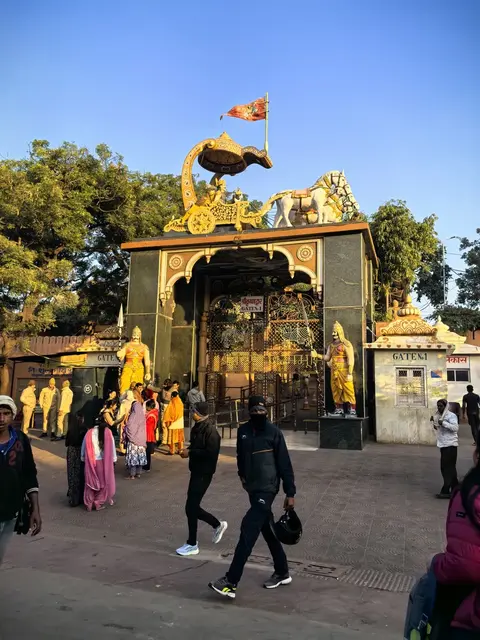
Places to visit in Mathura
Mathura is Krishna's birthplace on the Yamuna and one of the seven sacred cities of Hinduism: a warren of temples, ghats and bell-loud lanes at the heart of the Braj country. Start at Krishna Janmasthan, walk through the bazaar to Dwarkadhish and finish at Vishram Ghat for the evening aarti. One day covers the city; with Vrindavan, 12 km away, plan two. October to March is the comfortable season.
What to see 23





Everything about Mathura
 Practical
Best time to visit Mathura · Mathura weather · How to reach Mathura · Mathura airport to city · Mathura railway station · How to get around Mathura · Is Mathura safe · Language spoken in Mathura · Mathura trip cost · Interesting facts about Mathura · Places to visit near Mathura
 Food
Food Spiritual practices
 Where to stay
On the map
 23 places · the full map is in the app
What Mathura is like for a traveller
Mathura is not a sightseeing town in the usual sense. It is a working pilgrimage city of about 350,000 people, where temple bells carry through lanes too narrow for cars. The air smells of marigolds, incense and peda, the city's milk sweet of khoya cooked down with cardamom, sold by the box at the sweet shops around Holi Gate. Most visitors combine it with Vrindavan and Govardhan into one Braj trip, and that is the right way to see it.
Hindi and Braj Bhasha are spoken here, and English is scarce, so a translation app helps. The city is at its most intense on Janmashtami, Krishna's birthday, and during Holi, when Braj celebrates for weeks.
Top places to visit in Mathura
- [Krishna Janmasthan Temple](/en/mathura/krishna-janmasthan-temple/): the complex built over the prison chamber where, by tradition, Krishna was born to Devaki and Vasudeva. Security is tight: phones and bags are left outside.
- [Dwarkadhish Temple](/en/mathura/dwarkadhish-temple/): built in 1814 deep inside the bazaar, bright and musical, with darshan (the viewing of the deity) in short slots through the day.
- [Vishram Ghat](/en/mathura/vishram-ghat/): the main ghat, where Krishna is said to have rested after killing Kansa. The Yamuna aarti at sunset is smaller and calmer than in Varanasi: brass lamps, chanting and leaf boats with flames on the water.
- [Sati Burj](/en/mathura/sati-burj/): a red sandstone tower of 1570 in the lanes behind the ghat, among the oldest dated buildings in the city.
- [Potara Kund](/en/mathura/potara-kund/): a stepped tank two minutes from Janmasthan, where the infant Krishna's clothes are said to have been washed. Almost everyone walks past it.
- Government Museum: the best place in India to see Mathura-school sculpture from the 1st to 5th centuries, including Kushan-era Bodhisattvas. Closed on Mondays and the second Saturday.
- Holi Gate and the bazaar: the carved arch where the old town begins, and the lanes below it selling brass Krishnas, deity clothes and prayer beads.
Around Mathura: Gokul, Baldeo and the Braj villages
- [Raman Reti, Gokul](/en/mathura/raman-reti-gokul/): warm sand where Krishna and Balarama are said to have played as children, with an ashram, a tank and blackbuck. The most child-friendly stop in the area.
- [Dauji Temple, Baldeo](/en/mathura/dauji-temple-baldeo/): the temple of Balarama, Krishna's elder brother, and the courtyard where Braj's forty-day Holi season ends.
- Mahavan: the 84-pillar hall where Krishna is said to have been raised, and Brahmand Ghat, where Yashoda saw the universe in his mouth.
- Nandgaon and Barsana: Krishna's home village and Radha's, about 45–50 km out, best combined in one trip.
- [Vrindavan](/en/vrindavan/) (12 km) and [Govardhan](/en/govardhan/): the other two pillars of a Braj trip, with their own temples and the 21 km parikrama around Govardhan Hill.
How many days for Mathura and Vrindavan
Mathura alone: one day. Krishna Janmasthan in the morning, Potara Kund next door, then through the bazaar to Dwarkadhish (check the darshan slots), the Government Museum if it is open, and Vishram Ghat for the aarti at sunset.
Mathura and Vrindavan: two days is the comfortable minimum. One day can be done from Delhi, but it means rushing temples that open in short windows. A second day lets you see Vrindavan's evening aarti and morning darshan.
All of Braj: three to four days add Govardhan and its parikrama, Gokul and Baldeo, and Barsana with Nandgaon.
Best time to visit Mathura
October to March is the comfortable season, at its best in October, November, February and March. December and January are cool, with nights down to 8–9°C. May and June are best avoided: days reach 40–42°C. In the monsoon (July to September) the Yamuna can flood the ghats, as it did in July 2023. Holi and Janmashtami are the most spectacular times and also the most crowded: on Janmashtami vehicles are stopped about 3 km from the birthplace, and everyone walks the rest. Month-by-month figures are on the [weather page](/en/mathura/weather/).
How to get to Mathura and around it
By train: Mathura Junction (MTJ) is on the Delhi–Mumbai main line, with dozens of trains a day. From Delhi the Gatimaan Express (from Hazrat Nizamuddin) or Taj Express (from New Delhi) takes about 1 h 20 min to 1 h 40 min, from about ₹90; from Agra, 40–60 minutes. The station is 3–4 km from the temples, so take an e-rickshaw (about ₹100–150 for the whole vehicle).
By car: 2.5–3 hours from Delhi on the Yamuna Expressway; a sedan with driver costs about ₹2,900–3,500, and the car stays with you for Vrindavan and Govardhan.
By bus: UPSRTC and private coaches from Delhi's Sarai Kale Khan and Kashmiri Gate, 3–4 hours, from about ₹210.
By air: Noida International (DXN) at Jewar, opened in March 2026, is now the nearest airport, about 80 km away, with domestic flights. Delhi remains the international hub.
Around town: shared e-rickshaws run fixed lines for about ₹10–30 a seat; autos have no meters, so agree the price first. The temple core is best on foot. Shared rickshaws to Vrindavan cost ₹20–30 a seat. More on the pages about [getting here](/en/mathura/how-to-get-there/) and [getting around](/en/mathura/getting-around/).
✅ Practical tips
- Name the district, not the temple — Rickshaw drivers at the station quote newcomers two or three times the fare, and the word "temple" tells them you are new.
- Travel light to Janmasthan — Phones, bags and leather are left outside the main temples. Bring only what you can deposit easily.
- Book the fast train early — Gatimaan and Taj Express seats open 60 days ahead and sell out in season.
- Arrange rites in advance — If you plan ancestral rites at Vishram Ghat, agree on the panda (the officiating priest) beforehand, not on the steps.
❓ FAQ
What is Mathura famous for?
It is the birthplace of Krishna and one of the seven sacred cities (Sapta Puri) of Hinduism. It is also known for its peda sweets, its Holi and the Mathura school of ancient sculpture.
Where should I go first in Mathura?
Krishna Janmasthan, early in the day while the queues are short. From there walk to Potara Kund and through the bazaar to Dwarkadhish and Vishram Ghat.
Is one day enough for Mathura and Vrindavan?
It is possible from Delhi but rushed, because many temples open only in short darshan windows. Two days let you see both towns at their best times.
How far is Vrindavan from Mathura?
About 12 km, 20–30 minutes by shared rickshaw for ₹20–30 a seat from the Vrindavan stand.
How do I get to Mathura from Delhi?
By train in about 1 h 20 min to 1 h 40 min (Gatimaan or Taj Express), by car in 2.5–3 hours on the Yamuna Expressway, or by bus in 3–4 hours.
The full catalogue, hidden spots and districts on the map, plus “nearby” mode.
Open in India GO