 India GO
Ghats of Mathura
Mathura's riverfront has one centre: Vishram Ghat, where by tradition Krishna rested after killing Kansa. Twenty-four numbered ghats run along the Yamuna on either side of it, and pilgrims walk the whole line. Come at dusk for the Yamuna aarti, in the morning for rites, and take a separate trip to Brahmand Ghat at Mahavan, where the river is quieter.
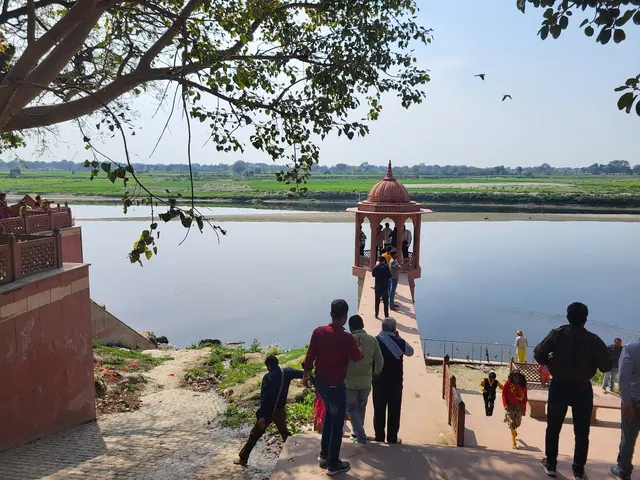
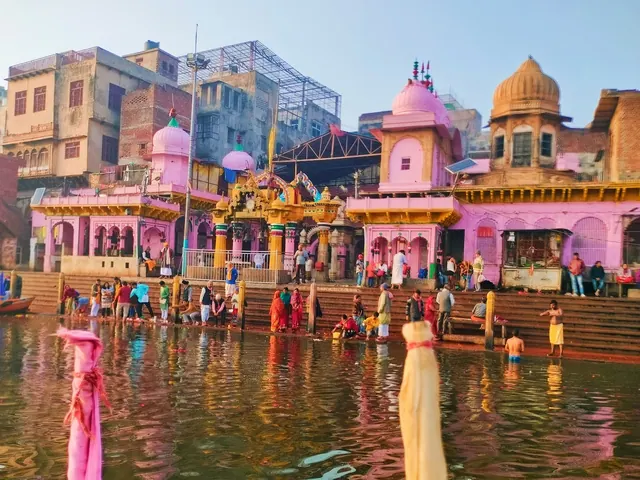
Vishram Ghat: the evening aarti
The aarti, an offering of light to the river, takes place every evening at dusk, so its hour moves through the year with sunset. Priests raise tiered brass lamps over the water from a stone platform, and people set leaf boats with small flames adrift on the current. It is smaller and less touristed than the aartis of Varanasi or Haridwar.
Arrive about 20 minutes early for a place near the front. Floating lamps are sold along the steps. The city's parikrama, the walk around Mathura, begins and ends here. More on the Vishram Ghat page.
Rites for the ancestors
Vishram Ghat is one of northern India's principal places for ancestral rites. They are done in the morning, on any day, in a fixed order. Arrange the panda (the priest who conducts the rite) in advance rather than agreeing terms with whoever approaches you on the steps.
- Bath
A bath in the Yamuna, or a sprinkling of its water.
- Sankalpa
Saying aloud what the rite is for.
- Tarpan and pind-daan
Water and rice-ball offerings for the ancestors, led by the panda.
- Then the temples
Only afterwards the temples of Dwarkadhish and Krishna Janmasthan.
Along the riverfront
The ghats are best seen on foot. A few steps behind Vishram Ghat stands Sati Burj, a four-storey tower raised in 1570 by Raja Bhagwant Das of Amber in memory of his mother; there is no signposted entrance, so look up from the lanes. Free. The Dwarkadhish Temple (1814) is right above the ghat, so pilgrims combine the two. Further along, on the north bank, what is left of Kans Qila, the fort tradition ties to Kansa, still shows an audience hall on red sandstone pillars.
Near the steps grows a tree believed to have healing power; visitors tie threads to its branches as they ask for recovery.
Two other ghats worth the trip
Brahmand Ghat, Mahavan
About 15 km south-east of Mathura, the bank where, in Braj tradition, Krishna was caught eating clay and showed Yashoda the universe in his mouth. Pilgrims still take a pinch of clay for good fortune. A stone stair, a few shrines, small lamp aartis morning and evening, and villagers rather than tour groups. Free and open at all hours; the bank stays muddy for a while after the monsoon. Pairs with Chaurasi Khamba and Raman Reti in Gokul.
Keshi Ghat, Vrindavan
The main ghat of Vrindavan, a town about 12 km from Mathura, where Krishna is said to have defeated the demon Keshi. People come in the evening to sit by the water and lay flowers on it. See Keshi Ghat.
Floods and festival crowds
The Yamuna can flood in the monsoon: in July 2023 the ghats were under water. October to March is the comfortable season. On Holi and Janmashtami the riverfront is packed; keep children close on the steps.
FAQ
Which ghat is famous in Mathura?
Vishram Ghat, where by tradition Krishna rested after killing Kansa. It holds the evening Yamuna aarti and is a main place for ancestral rites.
How many ghats are there in Mathura?
Twenty-four numbered ghats line the Yamuna on either side of Vishram Ghat, and pilgrims walk the whole line.
Can we bathe at Vishram Ghat?
Yes, pilgrims bathe here, and a bath or a sprinkling of Yamuna water opens the ancestral rites. Avoid the river when it is in flood in the monsoon.
What time is the aarti at Vishram Ghat?
Every evening at dusk; the time follows sunset through the year. Arrive about 20 minutes early.
What are the famous ghats in Vrindavan?
Keshi Ghat is the main one, where Krishna is said to have defeated the demon Keshi; it is liveliest in the evening.
Sources (1)
Facts checked: 8 October 2026. Prices and hours are approximate; check locally.
The full catalogue, hidden spots and districts on the map, plus “nearby” mode.
Open in India GO