Keshi Ghat is the main ghat of Vrindavan: stone steps running down to the Yamuna at the spot where, in the Bhagavata Purana, Krishna killed the horse-demon Keshi. Come at dusk, when the evening Yamuna aarti is offered and pilgrims set small lamps and flowers on the water. It is also where most people begin and end the parikrama, the walk around the town.
Ghats are stone steps descending to the Yamuna River. Here, people perform ablutions and pujas, make offerings, and light lamps. The main ghat, Keshi Ghat, is where Krishna defeated the demon Keshi. Simply being there, especially in the evening hours, is part of spiritual practice. Many come to sit in silence, observe the atmosphere, and turn inward.
Watch the water flow, feel the vibration of mantras in the air, see the pilgrims' hands gently laying flowers and petals on the waves.
To witness this is to absorb the spirit of a city that needs no loud words.
The blessing waters
The story of Keshi
Kamsa, the tyrant king of Mathura, knew he was destined to die at the hands of his sister's son, Krishna, and sent demon after demon to the cowherd villages of Braj to kill the child. One of them was Keshi, a monstrous horse whose neighing terrified the people and whose mane scattered the clouds. Krishna caught him by the legs and threw him; when Keshi charged again with open jaws, Krishna thrust his arm into the horse's mouth until the demon choked. The tale is told in the Bhagavata Purana, the Vishnu Purana and the Harivamsa, and it gives Krishna one of his names, Keshava, slayer of Keshi.
Tradition places that fight here, on the bank of the Yamuna, and the ghat carries the name. A ghat is simply a flight of steps down to a river, where people bathe, perform puja (worship), make offerings and light lamps.
Evening at Keshi Ghat
Evening is the hour to be here. As the light goes, the Yamuna aarti is offered from the steps, mantras carry over the water, and pilgrims bend down to set flowers, petals and small lamps on the current. Many people simply sit on the steps in silence and watch; in Vrindavan that is counted as part of practice, not idle time.
Look around as well as at the river. Peepal trees grow out of the old masonry of the ghat, squirrels run the parapets, and monkeys gather on the steps where food is offered to the river (keep a hand on your glasses and phone, since Vrindavan's monkeys are famous for taking them). When the water drops after the rains, pale sand flats appear below the steps, and birds work the sand and the banks.
A minute away stands the Jugal Kishore temple, completed in 1627 in red sandstone, so close to the river that locals call it the Keshi Ghat temple. It is usually almost empty and worth a few minutes on the way down.
 India GO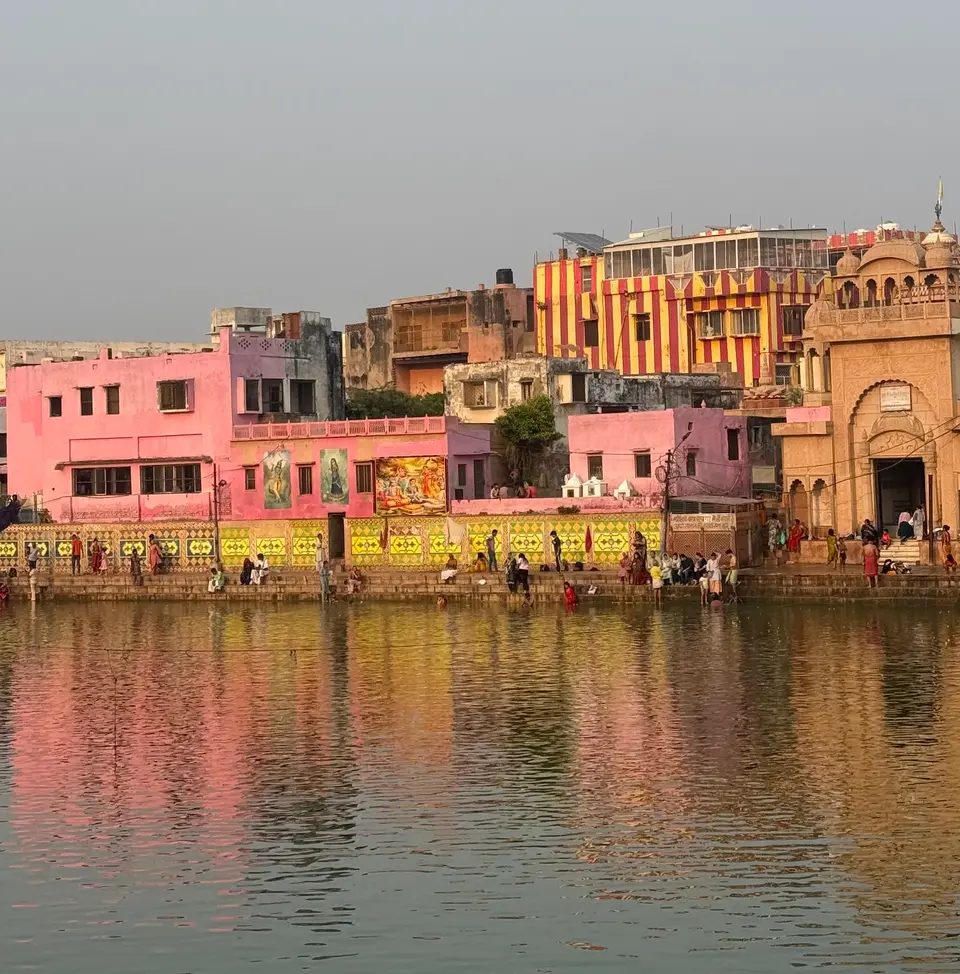
 Getting there