 India GO
Temples in Mumbai
Mumbai's most famous temples are young by Indian standards: Siddhivinayak was consecrated in 1801, Mahalakshmi built in 1831. The city's sacred roots go deeper, to Mumba Devi, the goddess of the Koli fishing community who gave Mumbai its name, and to the Banganga tank on Malabar Hill. Here is what each temple is for, when to go, and the other faiths' shrines worth the same respect.
The main temples
Darshan (seeing the deity) times below are from each temple's official site and can change on festival days.
Shree Siddhivinayak, Prabhadevi
Mumbai's most revered Ganesha temple was first consecrated on 19 November 1801. The black stone idol has its trunk turned to the right, four hands holding a lotus, an axe, prayer beads and a bowl of modaks (sweet dumplings), and Riddhi and Siddhi stand on either side. Tuesday is Ganesha's day, and it brings more than two hundred thousand people; many walk the last stretch from Dadar barefoot. On Tuesdays darshan starts at 3:15 and runs until about 23:30; on other days it runs from 6:00, after the kakad aarti (dawn prayer), until the last aarti at about 21:50.
Mahalakshmi, by the sea
The city's main Lakshmi temple was built in 1831 by the merchant Dhakji Dadaji on a rock at the water's edge. Its story belongs to the Hornby Vellard, the causeway that joined the islands: by legend the sea wall kept collapsing until an image of the goddess was recovered from the water and given a home here. In the sanctum stand Mahalakshmi, Mahakali and Mahasaraswati, dressed in gold. Darshan runs from 6:00 to 22:00, with the morning aarti at 6:45. Mornings are calm; during Navratri (11–19 October 2026, expected) and Diwali the queues are a serious commitment.
Mumba Devi, Bhuleshwar
The goddess the city is named for was the patron of the Koli fishermen and the Agri salt-workers, the first people of the seven islands. The temple explains her name as Maha and Amba, great mother. Her first shrine stood at Bori Bunder; the present temple was rebuilt in Bhuleshwar in 1737 and is now wedged between gold and cloth traders, so the noise of the lanes never quite stops at the door. The image has an orange face and no mouth. Entry is free; the first aarti is at 6:30 and the last, the shayan aarti, at 20:50. Zaveri Bazaar is next door.
Banganga and Walkeshwar, Malabar Hill
Behind the towers of Malabar Hill lies Banganga Tank, a stone tank of 1127 ringed by steps, lamp pillars and the small temples of the Walkeshwar cluster. By legend Rama shot an arrow into the ground here and Ganga water rose; the spring is in fact fresh, a few dozen metres from the sea. People call it Mumbai's own Varanasi: steps down to water, priests and funeral rites at the far end. Early morning is when the tank is used rather than looked at. On Dev Diwali, the full moon of Kartika, the rim is lit with lamps.
ISKCON Juhu
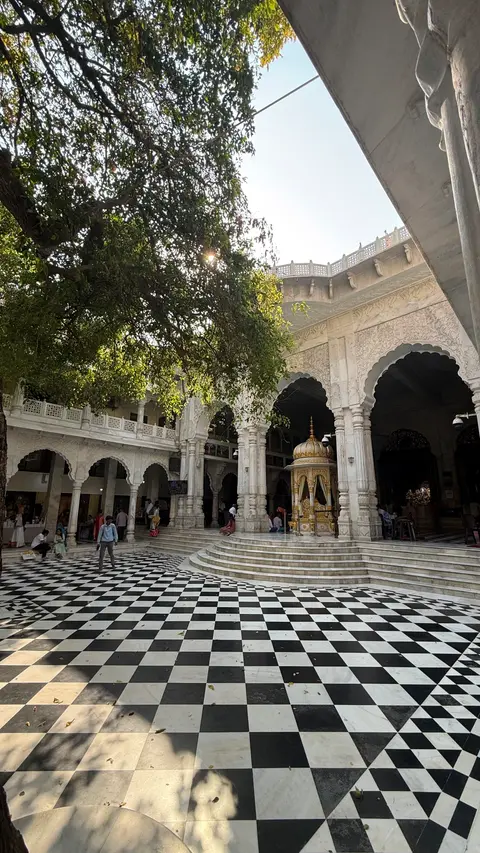
Hare Krishna Land, a short walk from Juhu beach, opened in 1978. Srila Prabhupada, the founder of ISKCON, acquired the land and installed the deities himself: Sri Sri Radha Rasabihari on a golden altar, with Gaura-Nitai and Sita-Rama, Lakshmana and Hanuman. The temple is open daily from 4:30 to 13:00 and from 16:00 to 21:00; the aarti, with singing and lamps, is the time to come.
Beyond the Hindu temples
Mumbai's sacred map is shared, and the same courtesy applies everywhere.
- Haji Ali Dargah: the tomb-shrine of the Sufi saint Pir Haji Ali Shah Bukhari on an islet in the bay, reached by a causeway that the sea covers at high tide. Check the tide table and set out two to three hours before high water. All faiths are welcome; Thursday and Friday are the most crowded, and qawwali (devotional singing) starts around dusk.
- Mount Mary Basilica: the Catholic basilica on a hill in Bandra, at its busiest during the week-long Bandra Fair (12–19 September 2027, expected).
- St Thomas' Cathedral: the city's oldest English church, by Horniman Circle in the Fort.
- Keneseth Eliyahoo Synagogue: the blue synagogue of Kala Ghoda, endowed by the Sassoon family in 1884. Carry ID and come outside service times.
- Global Vipassana Pagoda: a golden pagoda under one of the largest pillarless stone domes in the world. Anyone can learn ten minutes of Anapana (breath-watching meditation) for free in the north pagoda.
- Elephanta Caves: rock-cut Shiva temples of the 5th–8th centuries, an hour by ferry from the Gateway; the caves and boats rest on Mondays.
Temple etiquette in Mumbai
- Shoes come off before you enter a temple.
- Cover shoulders and knees. The details by place are on the temple dress code page.
- Plan around the crowds: Tuesday at Siddhivinayak, Navratri and Diwali at Mahalakshmi, Ganesh Chaturthi (4–14 September 2027) across the city.
- Banganga is a working place of worship and of funeral rites; keep your voice and camera low.
- At Haji Ali the tide, not the clock, decides whether you can walk out.
FAQ
Which is the most famous temple in Mumbai?
Shree Siddhivinayak at Prabhadevi, the city's most revered Ganesha temple, consecrated in 1801. On Tuesdays it receives more than two hundred thousand people.
What are the Siddhivinayak temple timings?
According to the temple trust, darshan runs from 6:00 to about 21:50 on most days. On Tuesdays it starts at 3:15 and continues until about 23:30.
When is the best time to visit Siddhivinayak?
Avoid Tuesday morning, when the queue is at its worst. Tuesday crowds ease late at night; on other days the temple is calmer.
Is Mumbai named after a goddess?
Yes. The city takes its name from Mumba Devi, patron goddess of the Koli fishermen; her temple stands in Bhuleshwar, next to Zaveri Bazaar.
What is the Banganga Tank?
A stone temple tank of 1127 on Malabar Hill, part of the Walkeshwar temple complex. By legend Rama's arrow brought Ganga water up here, and the spring is fresh despite the sea next to it.
Sources (9)
Facts checked: 15 October 2026. Prices and hours are approximate; check locally.
The full catalogue, hidden spots and districts on the map, plus “nearby” mode.
Open in India GO