 India GO
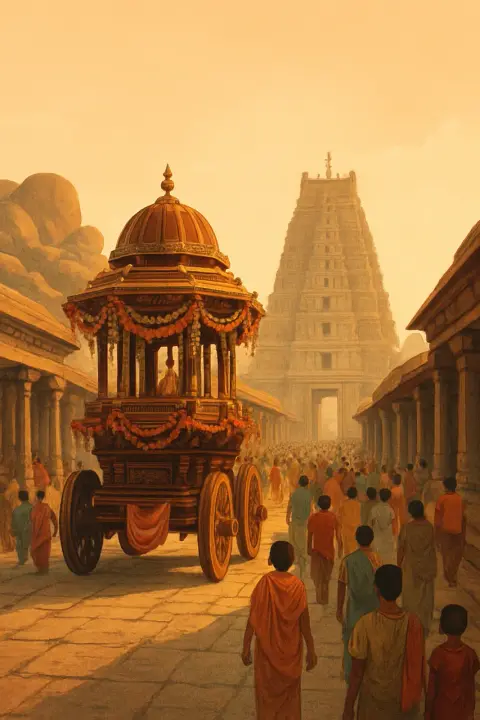
Virupaksha car festival: Hampi's chariot down the old bazaar
A temple chariot hauled by hand down a bazaar street of ruins
The Virupaksha car festival (Virupaksha Rathotsava) is the spring festival of Hampi's Virupaksha temple, the one temple among the ruins where worship has never stopped. It celebrates the yearly wedding of Shiva as Virupaksha and the goddess Pampa, and ends with the images of god and goddess riding a giant wooden chariot down the ancient market street, Hampi Bazaar. It falls in spring: hampi.in gives March or April by the local calendar, some references February; the temple fixes the day by its almanac.
The temple fixes the day by its almanac; local Kannada media report it on the day.
The legend
In legend, Parvati resolved to marry the ascetic Shiva. Indra sent Kama to wake him with an arrow of desire, but Shiva opened his third eye and burned him.

So Parvati took up austerities herself. Local tradition says she did her penance here, on Hemakuta Hill, under the name Pampa.
Shiva yielded and became Pampapati, husband of Pampa, and Kama came back to life after the wedding. Pampa named the river and the town: Pampa, Hampe, Hampi.

The Virupaksha temple holds this wedding every year: a betrothal in December, the marriage in spring, and at the end the chariot rolls out with god and goddess.
Meaning
A living temple
Virupaksha is the one Hampi temple where worship never stopped, even after the city fell in 1565: pilgrims kept coming through the centuries.
Customs
Phalapuja
In December the temple holds the betrothal of Virupaksha and Pampa, the Phalapuja, and draws large crowds.
Along the chariot road
The images of god and goddess ride a huge wooden chariot pulled down Hampi's main street: the town's biggest religious festival.
A bazaar for chariots
Before the temple runs a colonnaded ancient market almost a kilometre long, with a broad road for chariots and a monolithic Nandi at its east end.
A wedding overhead
The ceiling of the temple's open hall is painted with the same story: the wedding of Shiva and Parvati, with Kama and his arrow nearby.
Shivaratri night
The temple's other big festival is Maha Shivaratri, with worship at Virupaksha through the night.
Words of the festival
ವಿರೂಪಾಕ್ಷ
Virupaksha
the form of Shiva to whom Hampi's main temple is dedicated
ಪಂಪಾಪತಿ
Pampapati
"husband of Pampa", another name for Shiva and his Hampi temple
ಹಂಪೆ
Hampe
the Kannada name of Hampi, from Pampa, the old name of the Tungabhadra
ರಥೋತ್ಸವ
rathotsava
a chariot festival: the deity rides out on the temple car
ಹಂಪಿ ಬಜಾರ್
Hampi Bazaar
the ancient market street before the temple, the chariot's route
True or myth
❌ Myth. The Virupaksha-Pampa shrine stood here from the 7th century, long before the capital; the Vijayanagara kings greatly enlarged it.
✅ True. Krishnadevaraya commissioned the central pillared hall in 1510 to mark his accession, as a stone inscription beside it records.
✅ True. Some halls were stages for music, dance and drama before the gods, others were used for the wedding rites of deities.
The divine wedding and the chariot
The festival is one act of a ritual year. In December the temple holds Phalapuja, the betrothal of Virupaksha and Pampa, which also draws large crowds. In spring comes the wedding itself, and at its end the images of the divine couple are placed on the temple car, the huge wooden chariot at the centre of the procession, and pulled by hand down the main street. It is the largest religious festival in Hampi.
The route is Hampi Bazaar, the colonnaded market street that runs for about 750 m in front of the temple, with a broad road for chariots and a monolithic Nandi (Shiva's bull) at its east end. On chariot day the street is used for what it was laid out for.
The same story is painted on the ceiling of the temple's open hall: the wedding of Shiva and Parvati, with Kama, the god of love, shooting his arrow at Shiva. The paintings were renewed, probably in the 19th century. Look up when you visit the temple.
The legend of Pampa and Pampapati
In the legend told at Hampi, Parvati resolved to marry the ascetic Shiva. Indra sent Kama to wake him with an arrow of desire, but Shiva opened his third eye and burned Kama to ashes. Parvati then took up austerities herself, and local tradition places her penance here, on Hemakuta Hill, under the name Pampa. Shiva yielded and became Pampapati, husband of Pampa, and Kama was restored to life after the wedding. Pampa gave her name to the river, the old name of the Tungabhadra, and to the town: Pampa, Hampe, Hampi.
The temple is older than the Vijayanagara capital around it: its history is traced back to about the 7th century, and the kings enlarged it. Krishnadevaraya commissioned the central pillared hall in 1510 to mark his accession, as an inscription beside it records. When the city fell in 1565, worship at Virupaksha did not end, and pilgrims kept coming through the centuries.
Planning your visit
The festival is open to everyone; the chariot is watched from Hampi Bazaar.
- Confirm the day — The temple sets the day by its almanac and it is not published far ahead; local Kannada media report the chariot on the day. Ask at the temple once you are in Hampi.
- Getting to Hampi — Hampi Bazaar is about 13 km from Hosapete, the nearest railway town, and buses cover the distance all day. Routes and options: how to get to Hampi; where to sleep: where to stay in Hampi.
- Temple dress — The Virupaksha temple requires covered shoulders and knees, and shoes are left at the entrance. More in our Hampi temple dress code guide.
- In the crowd — Keep clear of the wheels and ropes and follow the instructions of the police and temple volunteers; FCDO notes that stampedes have occurred at some large religious gatherings in India. General advice: is India safe.
Other festivals at Hampi
Maha Shivaratri brings a night of worship at Virupaksha in February or March. The state's cultural festival, Hampi Utsav, stages music and dance among the monuments: 3–5 November 2026 (expected).
FAQ
When is the Virupaksha car festival?
In spring, at the end of the wedding festival of Virupaksha and Pampa: hampi.in gives March or April, some references February. The temple fixes the exact day by its almanac.
What is the story behind the Virupaksha temple?
Local tradition says Parvati did penance on Hemakuta Hill as Pampa until Shiva married her and became Pampapati, husband of Pampa. The festival re-enacts that wedding every year.
Where does the chariot go?
Down Hampi Bazaar, the ancient colonnaded market street that runs about 750 m east of the temple.
Is the car festival the same as Hampi Utsav?
No. The car festival is a temple festival in spring; Hampi Utsav is a separate state cultural festival: 3–5 November 2026 (expected).
Who built the Virupaksha temple?
The shrine predates the Vijayanagara capital and goes back to about the 7th century; the Vijayanagara kings greatly enlarged it.
Sources (4)
Facts checked: 22 October 2026. Prices and hours are approximate; check locally.