 India GO
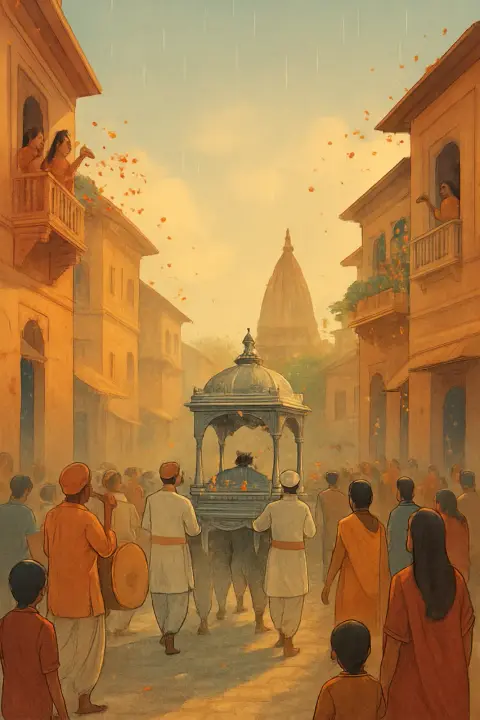
Mahakal Sawari: the Monday processions of Ujjain's king
Shiva's silver face floats above the old bazaars down to the Shipra
Mahakal Sawari is the procession in which Mahakaleshwar, the form of Shiva who rules Ujjain, is carried out of his temple and through the old city. It goes out on every Monday of the north Indian months of Shravan and Bhadrapada; this season: 19 July – 30 August 2027 (expected). At 4 pm the silver palanquin leaves the temple for Ram Ghat on the Shipra, where the god is worshipped with river water, and then returns to the temple. The last Monday is the Shahi Sawari, the royal procession, on a longer route: 30 August 2027 (expected). Watching is free and needs no ticket.
On every Monday from Shravan Krishna Pratipada to Bhadrapada Amavasya, Mahakaleshwar is taken out through the city in a silver palanquin in the form of the Rajat Mukharavind. The temple committee describes the palanquin leaving at 16:00 and travelling through Kot Mohalla, Gudri Square, Bakshi Bazaar Square, Kahar Wadi and Harsiddhipal to Ramghat, where worship and aarti are performed with Shipra water. The final Monday carries the Shahi Sawari, the grand royal procession, on a longer route.
The Mondays follow the lunar calendar; the Mahakal temple committee and the Ujjain administration announce the procession routes and times in the week before.
The legend

Legend says King Chandrasena of Ujjain prayed to Shiva day and night. A farmer's boy, Shrikhar, heard him and wanted to pray alongside.
The guards drove the boy out to the Shipra river. Meanwhile neighbouring kings attacked Ujjain together with the invisible demon Dushana.
Answering his devotees' pleas, Shiva appeared as Mahakala, Great Time, and destroyed the king's enemies.
At Shrikhar's request Shiva stayed on as the city's chief deity and protector. Ever since, Mahakal has been honoured as Ujjain's ruler.

And on the Mondays of Shravana and Bhadrapada the king goes out to his subjects: Mahakal's silver palanquin travels through the old city to the Shipra.
Customs
At four sharp
From three to four Chandramauleshwar is worshipped in the temple hall; at 16:00 the palanquin leaves the gate, saluted by an armed police guard.
Bath at Ram Ghat
Through Gudri and Bakshi Bazaar the procession reaches Ram Ghat, where the god is bathed in Shipra water and the aarti is performed.
Bhajans and damru
Ahead of the palanquin come bhajan groups, damru drums and jhanjh cymbals and a police band, and the crowd sings along.
Shahi Sawari
The season's last, royal procession is the biggest: Mahakal appears in seven forms, on Garuda and Nandi chariots and as silver faces.
God at the door
Folk belief holds that Mahakal comes out himself to those too old or ill to reach the temple.
Words of the festival
सवारी
sawari
"a ride": the deity's outing through the city
पालकी
palki
a palanquin; Mahakal's is silver
मुखारविंद
mukharavind
"lotus face": the god's cast face image carried in the procession
चंद्रमौलेश्वर
Chandramauleshwar
Shiva with the moon on his head, the form Mahakal takes in the silver palanquin
महाकाल
Mahakal
"Great Time": the form of Shiva who rules Ujjain
True or myth
❌ Myth. The procession goes out every Monday of Shravana and Bhadrapada; in 2026 there were six, the last being the Shahi Sawari.
❌ Myth. He is bathed in water from the Shipra, Ujjain's own river, on whose bank the ghat stands.
✅ True. Mahakal is Dakshinamurti, "facing south", and Nandi stands to the south.
Where to celebrate
How a Sawari Monday runs
In Ujjain the Sawari is the king of the city going out to see his subjects. At 4 pm the silver face-image, the mukharavind, of Chandramauleshwar, Shiva with the moon on his head, sets off in the silver palanquin, and at the temple gate armed police salute it. Bhajan groups and a police band go with the procession.
The outward route runs from the temple through Kot Mohalla, Gudri Square, Bakshi Bazaar and Kahar Wadi to Ram Ghat. On the riverbank the palanquin halts and the god is bathed in Shipra water and offered aarti. It then returns to the temple through Kartik Chowk, Gopal Mandir and Patni Bazaar.
The Sawari grows over the season. The temple's notices describe the god's silver and brass face-images being mounted on chariots and taken round the city, and on the royal Sawari of the last Monday Mahakal goes out in several forms, among them Chandramauleshwar in the palanquin and Manmahesh on an elephant.
The Shahi Sawari, the royal procession
The last Monday of the season (30 August 2027, expected) is the one most people come for. The temple calls it the Rajasi Sawari and takes it along its traditional, longer route. At Ram Ghat both Chandramauleshwar in the palanquin and Manmahesh on the elephant are worshipped with Shipra water. From the ghat the procession goes on through Gangaur Darwaza, Kamri Marg, Teliwada, Kanthal and Chhatri Chowk to the Gopal Mandir, where by tradition the Scindia house worships the god in the palanquin, and returns through Patni Bazaar and Gudri to the temple.
On this day the police close the main roads of the centre to vehicles from late morning until the procession ends and set up parking at the edge of town for visitors from Indore, Bhopal and Dewas. The temple committee has also arranged showers of flowers from drones along the main route. The crowd is the largest of the season.
Where to watch
The whole route is free to watch from the street. Pick one stretch and stay there. Where to stay and when to arrive: Mahakal Sawari in Ujjain.
Temple gate and Mahakal Lok
The 4 pm departure. Next to the Mahakal Lok corridor, the start of the route around the Mahakaleshwar temple.
Ram Ghat
The worship with Shipra water, the heart of every Sawari. Follow the police on where to stand. More on the ghats of Ujjain.
Gopal Mandir and Patni Bazaar
On the return leg, through the old city's central market. On the royal Monday the procession stops at the Gopal Mandir for worship.
Shravan in Ujjain beyond the Sawari
The Shravan and Bhadrapada Mondays are the best known Sawaris, but not the only ones. The temple's own calendar of important days also lists Sawaris on the Mondays of Kartik and Margashirsha (Agahan) in autumn, and processions on Vijayadashami and for Uma Mata.
Around the Sawaris the temple committee has held an All India Shravan Mahotsav of classical music and dance every year since 2004, and on Nag Panchami the Nagchandreshwar shrine on the temple's upper floor opens for its one day of the year. The dawn Bhasma Aarti is booked only on the temple's official website; see the aarti page. For a temple visit on a Sawari day, see the Ujjain temple dress code.
Weather, crowds and getting around
The Sawari season is the height of the monsoon.
- Rain — July brings about 330 mm of rain over a dozen rainy days and August about 250 mm. Take a raincoat rather than an umbrella, which blocks the view of the people behind you.
- Walk, do not drive — On Sawari days vehicles are kept off the route and much of the old city from late morning. Stay within walking distance or leave the car at the official parking.
- Crowd sense — The UK Foreign Office notes that stampedes have occurred at large religious gatherings in India and advises following the local authorities. Agree a meeting point, keep phone and cash in a front pocket and do not push towards the palanquin.
Getting to Ujjain
The nearest airport is Devi Ahilya Bai International Airport in Indore, about 55 km away. Ujjain's railway station is in the centre and has direct trains from across India. Indore is also the fallback for a room if Ujjain is full. Details: how to get to Ujjain and where to stay.
FAQ
When is Mahakal Sawari?
On every Monday of Shravan and Bhadrapada; this season: 19 July – 30 August 2027 (expected). The royal Shahi Sawari is on the last Monday, 30 August 2027 (expected). The temple committee and the Ujjain administration confirm the routes and times in the week before each procession.
What time does the Sawari leave the temple?
At 4 pm, by the temple's schedule. It reaches Ram Ghat for the worship with Shipra water and then returns to the temple; the royal Sawari takes a longer route back.
What is the Shahi Sawari?
The royal procession on the last Monday of the season, the largest of the year. It takes a longer route through the old city to Gopal Mandir, Mahakal goes out in several forms, and the police close the central roads to traffic.
Do I need a ticket to watch Mahakal Sawari?
No. The procession is watched free from the street anywhere along the route. Tickets apply only to some rituals inside the temple, such as the Bhasma Aarti.
What are Mahakal darshan and aarti timings?
The Bhasma Aarti is at 4 to 6 am. In the half of the year that includes Shravan, the temple lists the Sandhya Aarti at 7 to 7:45 pm and the Shayan Aarti, the last of the day, at 10:30 to 11 pm. The Sandhya and Shayan Aartis are booked only online on the temple's website.
Does Mahakal go out only in Shravan?
No. The temple also holds Sawaris on the Mondays of Kartik and Margashirsha and processions on Vijayadashami, but the Shravan and Bhadrapada series with the royal Sawari is the biggest.
Sources (7)
- Shri Mahakaleshwar Temple Management Committee: Important Days
- Shri Mahakaleshwar Temple Management Committee: News and Events
- Shri Mahakaleshwar Temple: Temple Timings
- MP Tourism: Experience the Grand Mahakal Sawari in Ujjain
- FCDO: India, safety and security
- MP Breaking News: royal Sawari route and road closures
- Asianet News Hindi: Shahi Sawari crowds
Facts checked: 21 October 2026. Prices and hours are approximate; check locally.