 India GO
Ghats in Ujjain
Ujjain stands on the east bank of the Shipra, and nearly every important thing the city does with its river happens at Ram Ghat: the sunset aarti, the halt of Mahakal's procession, the bathing of the Simhastha. Upstream and downstream the bank is quieter, with Siddhavat for ancestral rites, Triveni Ghat for the nine planets and a string of temples on the rises above the water.
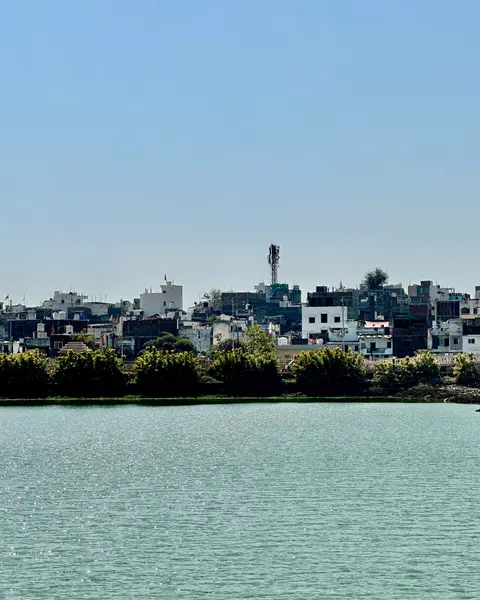
Ram Ghat: the main ghat
Shri Ram Ghat is a wide stepped embankment on the Shipra, and the name comes from a legend: Rama is said to have performed pind daan, the offering for departed parents, here. Large murtis of the gods stand along the shore, and small Shiva shrines sit right at the water. In the morning the ghat belongs to bathers and incense; in the evening to floating lamps, families and the aarti.
This is also the ghat of Ujjain's great occasions. During the Simhastha, Ujjain's turn of the Kumbh every twelve years, the akharas walk to Ram Ghat for the royal baths. On the Mondays of Shravan and Bhadrapada the silver face of Mahakal is carried here in a palanquin and bathed with Shipra water before the procession returns to the temple. Harsiddhi Temple stands a short way inland from the embankment.
The evening Shipra aarti
Yes, Ujjain has a ghat aarti. It is held at Ram Ghat every evening at sunset, so the time moves with the season, between about 6 and 7 pm, according to MP Tourism. Priests stand at the edge of the ghat with large flaming lamps, to bells, cymbals and the damru (the small hourglass drum of Shiva), and the ritual runs for about an hour. People take their places on the steps well before it starts. MP Tourism also mentions watching from the water by pedal boat. More on the city's rituals is on the aarti page.
Other ghats and riverside sites
Away from Ram Ghat the bank is a chain of separate sacred spots rather than one continuous promenade; an auto between them is the usual way.
Siddhavat
An immense old banyan on the bank, counted with the sacred banyans of Prayagraj and Gaya, with a small Pataleshwar Shiva shrine beneath it. Ujjain families come here for pind daan and tarpan, the rites for ancestors, and nothing is arranged for visitors. Early morning is the hour. More about Siddhavat.
Triveni Ghat
About 6 km from the city centre, by the temple committee's figure, with the Navagraha temple to the nine planets. The district administration notes that it draws large crowds on new-moon days that fall on a Saturday, and that its importance has grown in recent times rather than coming from the old texts.
Chakratirth
The stretch of bank where the domed Durgadas ki Chhatri stands, a Rajput cenotaph over the cremation place of Durgadas Rathore, who died in Ujjain in 1718. Quiet, and rarely visited.
Temples above the river
Kal Bhairav, the guardian of the city, sits on the bank; Mangalnath, birthplace of Mars in the Matsya Purana, stands on a rise with one of the widest views over the Shipra; the Bhartrihari Caves and Pir Matsyendranath are cut into and built on the high bank near Gadkalika.
Kaliadeh Palace
About 8 km north, a water palace of 1458 on an island in the Shipra, with the river led through tanks and channels around and under it. It is at its best just after the monsoon, when the river is full. About the palace.
When the ghats change
October to March is the comfortable season for the river. In the monsoon the Shipra rises and floods the ghats; in heavy years the small temples at Ram Ghat have gone under water and the lower steps disappear. From April to May the afternoon heat reaches about 40 °C and the stone steps have no shade: come early or at sunset.
Three occasions transform Ram Ghat. The Mahakal Sawari processions on the Mondays of Shravan and Bhadrapada (19 July – 30 August 2027, expected) close the old city to vehicles from late morning. The Simhastha (27 March – 27 May 2028, expected) fills every ghat for two months. And around Kartik Purnima the fair ground beside the river hosts the Kartik Mela.
On the ghats
The ghats are working places of worship and mourning; a few habits keep you on the right side of both.
- Ask before photographing rites — Pind daan and tarpan are family rites for the dead. Keep a respectful distance and ask before taking a picture of anyone.
- Shoes off at the shrines — Footwear comes off before the riverside temples, including Siddhavat, Kal Bhairav and Mangalnath.
- Bathe early in the hot months — Public ghats are open for bathing, but in April and May the sun on the steps is fierce by mid-morning. Carry water.
- Respect the water level — In the monsoon stay off submerged steps.
FAQ
Is there a ghat aarti in Ujjain?
Yes. The Shipra aarti is held at Ram Ghat every evening at sunset, roughly between 6 and 7 pm depending on the season, and lasts about an hour.
What river flows through Ujjain?
The Shipra (Kshipra), one of Hinduism's sacred rivers. It rises in Indore district and flows north to the Chambal; Ujjain lies on its east bank.
Which is the most famous ghat in Ujjain?
Ram Ghat. It holds the daily Shipra aarti, the halt of the Mahakal Sawari and the main baths of the Simhastha.
Where is Mahakaleshwar in relation to the ghats?
In the old city, inland from the river. The Sawari procession walks from the temple to Ram Ghat through Gudri Square and Bakshi Bazaar, which is also the natural walking route.
Can you bathe in the Shipra at Ujjain?
Yes, the public ghats are used for bathing every day, and during the Simhastha on any day of the mela. Avoid the steps when the river is in monsoon flood.
When is the best time to visit the ghats?
October to March. The monsoon floods the ghats, and April to June is very hot on the open steps.
Sources (4)
Facts checked: 15 October 2026. Prices and hours are approximate; check locally.
The full catalogue, hidden spots and districts on the map, plus “nearby” mode.
Open in India GO