 India GO
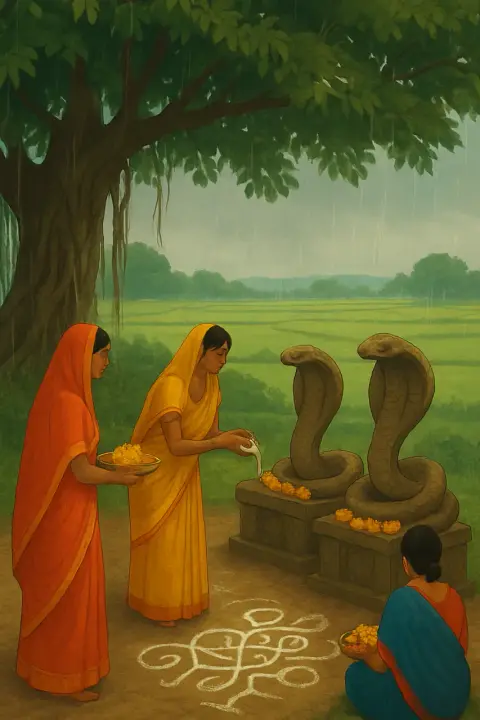
Nag Panchami: the day of the serpent deities
Milk for the stone serpents, so the living ones stay kind
Nag Panchami, “the fifth day of the serpents”, honours the naga deities with milk, water and flowers offered to their stone, metal and painted images. It falls on the fifth lunar day of the bright half of Shravana: 6 August 2027 (expected). Gujarat keeps its Nag Pancham about two weeks later. In Ujjain it is the only day of the year when the Nagchandreshwar shrine above the Mahakaleshwar Jyotirlinga opens: for 24 hours from midnight, while about a million people pass through.
The day follows the lunar calendar and is in the almanacs years ahead; in Ujjain the Nagchandreshwar shrine opens only on this day.
The legend
In the Mahabharata, King Janamejaya, avenging his father's death from the bite of the serpent king Takshaka, begins a fire rite against the whole serpent race.

The alarmed gods ask the serpent goddess Manasa to step in, and she sends her son, the sage Astika.

Astika so impresses the king with his learning that he is promised any boon, and the sage asks for the rite to be stopped.
The rite is halted on the fifth day of the bright half of Shravana: the serpents are saved, and the day is called Nag Panchami.
Meaning
Varanasi
The wrestling akharas are scrubbed for the day, their walls painted with snakes, and the gurus honoured along with the patrons.
Bengal
Here the serpent goddess Manasa is worshipped: a twig of the manasa plant, her emblem, is set in the ground.
Customs
Snakes on the door
Doorways and outer walls are painted with snakes and auspicious mantras.
Bathing the images
Naga images of stone, wood or silver, or painted ones, are bathed with water and milk.
Earth left alone
No one digs the earth that day, so as not to harm the snakes that live in it.
For brothers
It is also Bhratru Panchami, when women pray to the snakes to keep their brothers safe from snakebite.
What people eat
Patoleo
rice paste with coconut and jaggery, steamed in turmeric leaves
Words of the festival
नाग पंचमी
Nag Panchami
"the fifth day of the serpents"
नाग
naga
a serpent, the cobra above all, and the serpent deity of Indian lore
वासुकि
Vasuki
king of the nagas, worn by Shiva round his neck and used as the rope to churn the ocean
True or myth
✅ True. Tradition says the sage Vaisampayana first narrated the whole epic during Janamejaya's rite.
❌ Myth. Snake charming is banned in India under the Wildlife Protection Act of 1972, which forbids keeping snakes.
❌ Myth. Rajasthan, Bihar and Gujarat keep it in the dark half of the month, and Punjab honours the snakes at Guga Navami in Bhadra.
Where to celebrate
How the day is kept
The naga is a serpent, the cobra above all, and the serpent deity of Indian lore. The best known is Vasuki, king of the nagas, whom Shiva wears round his neck and who served as the rope when the gods and demons churned the ocean.
On Nag Panchami naga images of stone, wood or silver, or painted ones, are bathed with water and milk and offered flowers. Doorways and outer walls are painted with snakes and auspicious mantras. No one digs the earth that day, so as not to harm the snakes that live in it. The day is also Bhratru Panchami: women with brothers pray to the snakes to keep their brothers safe from snakebite. Among the dishes made for the day is patoleo, rice paste with coconut and jaggery steamed in turmeric leaves.
The legend of Astika
The story told for the day comes from the Mahabharata. King Janamejaya, avenging his father Parikshit’s death from the bite of the serpent king Takshaka, begins a fire rite to destroy the whole serpent race. The alarmed gods ask the serpent goddess Manasa to step in, and she sends her son, the sage Astika. Astika so impresses the king with his learning that he is promised any boon, and he asks for the rite to be stopped. It ends on the fifth day of the bright half of Shravana; the serpents are saved, and the day is called Nag Panchami.
Tradition adds that the sage Vaisampayana first narrated the whole Mahabharata during Janamejaya’s rite.
Not one day everywhere
Nag Panchami does not fall on the same day all over India, and each region has its own way of keeping it.
Gujarat, Rajasthan, Bihar
Kept in the dark half of the month. Gujarat’s Nag Pancham falls on the fifth day of the dark half after the Shravana full moon, about two weeks after the bright-half date.
Punjab
The snakes are honoured at Guga Navami, in Bhadra.
Bengal
The serpent goddess Manasa is worshipped; a twig of the manasa plant, her emblem, is set in the ground.
Varanasi
The wrestling akharas are scrubbed for the day, their walls painted with snakes, and the gurus honoured along with the patrons.
Ujjain: the 24-hour Nagchandreshwar darshan
The Nagchandreshwar shrine is on the third storey of the Mahakaleshwar complex, directly above the Jyotirlinga sanctum, and is sealed for the rest of the year. About ten lakh (a million) people came through in the 24 hours of a recent opening. Nag Panchami falls inside Shravan, when Ujjain is already at its fullest for the Monday processions, so plan for both crowds at once.
- Arrive the day before
The doors open at the midnight that begins Nag Panchami, straight after the shrine’s first puja (from about 23:30). Anyone arriving on the morning has already missed the opening and joins the day’s heaviest queue.
- The entry route
The designated route runs on foot from Harsiddhi Pal and Bada Ganesh Gali to Gate No. 5 of the complex, past the Harsiddhi temple; holding areas run back roughly three kilometres, and the Mahakal Lok corridor absorbs much of the waiting crowd.
- Free queue or paid slot
The general queue is free and is how most people enter. The temple has offered a paid fast-track slot, about ₹300 per person, booked online against a mobile number in fixed time slots, with a printed ticket required at entry.
- Bhasma Aarti and fake sites
Bhasma Aarti slots for Shravan Mondays and festival dates go first. Book only on the temple’s own portal, shrimahakaleshwar.mp.gov.in, with a printed permission; Ujjain Police have shut down fake sites that took payments for rooms in the temple’s Bhakt Niwas, which is booked only on the official portal.
- Where to stay
In the old city within walking distance of the temple, around Harsiddhi, Ram Ghat and Mahakal Lok, because the approach is pedestrian-only on the day. Indore, about 55 km away, is the fallback, but it adds a road leg on the worst night for road movement. When the queue is at its longest, Ram Ghat on the Shipra is a walk away.
Live snakes and crowds
Snake charming is no longer legal in India: the Wildlife Protection Act of 1972 forbids owning snakes, so showing live cobras with a pipe is not legal on Nag Panchami either. The FCDO reminds visitors that it is illegal to buy, sell, kill or capture any protected wild animal and that stampedes have occurred at large religious gatherings; in Ujjain keep to the marked queue and follow police instructions. General advice: Is India safe.
FAQ
When is Nag Panchami?
On the fifth lunar day of the bright half of Shravana: 6 August 2027 (expected). Gujarat keeps Nag Pancham about two weeks later, in the dark half of the month.
Why is Nag Panchami celebrated?
It honours the serpent deities. By the Mahabharata story, it is the day the sage Astika persuaded King Janamejaya to stop his rite to destroy the serpents.
What should not be done on Nag Panchami?
By custom no one digs the earth, so as not to harm the snakes that live in it. Showing or handling live snakes is illegal in any case.
When does the Nagchandreshwar temple in Ujjain open?
Only on Nag Panchami, for 24 hours from the midnight that begins the day. It is on the third storey of the Mahakaleshwar temple; the general queue is free.
Is Nag Panchami on the same day all over India?
No. Rajasthan, Bihar and Gujarat keep it in the dark half of the month, and Punjab honours the snakes at Guga Navami in Bhadra.
Which goddess is linked to Nag Panchami in Bengal?
Manasa, the serpent goddess, whose emblem is a twig of the manasa plant set in the ground.
Sources (10)
- Nag Panchami (Wikipedia)
- Ujjain district: Shri Mahakaleshwar temple
- Shri Mahakaleshwar temple committee (official site)
- Shri Mahakaleshwar temple: Bhasma Aarti booking
- Nagchandreshwar temple to open for 24 hours (Free Press Journal)
- Nagchandreshwar temple opening (The Sootr)
- Ujjain Police shut down 9 fake websites (Tribune)
- Drik Panchang: festivals in August (Ahmedabad), Nag Pancham
- FCDO: India safety and security
- Snake charming (Wikipedia)
Facts checked: 21 October 2026. Prices and hours are approximate; check locally.