 India GO
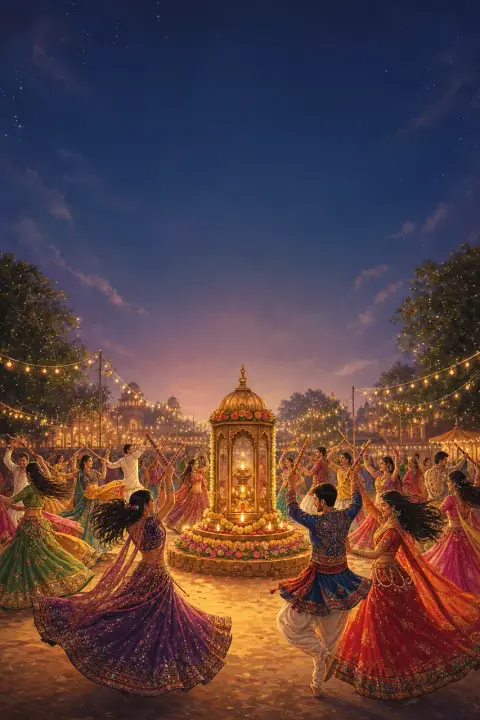
Navratri in Jaipur: the Amer goddess, effigy markets and Dussehra
Nine nights India dances until dawn
Besides garba and dandiya nights, Jaipur's Navratri centres on the goddess of its old rulers and the run-up to Dussehra. Through the nine nights devotees crowd the Shila Devi temple inside Amer Fort; in the last days bamboo Ravana effigies fill roadside markets, and on Dussehra evening giant figures burn on the city's grounds. Dates in Jaipur: 30 September – 9 October 2027 (expected), ending with Dussehra.
Jaipur's Navratri runs from the goddess of the Amer rulers to roadside camps building bamboo effigies, and ends on Dussehra with a Ravana some hundred feet tall burning on the Adarsh Nagar ground.
Where to watch
Shila Devi temple, Amer Fort: the goddess of the Kachhwaha rulers, installed by Raja Man Singh in 1604 and crowded through Navratri; about 11 km north of the city.
Ravana Mandi, Mansarovar: by Mansarovar metro station, bamboo artisans from Barmer, Pali and Banswara build effigies for sale in the days before Dussehra; smaller effigy markets line Tonk Road, Queens Road and Chomu Puliya.
Dussehra Maidan, Adarsh Nagar: the city's best-known Dussehra ground; in 2025 a 105-foot Ravana burned here at about 19:00, after an afternoon procession.
Vidhyadhar Nagar Stadium: a second big Dussehra ground, with fireworks and a Ramlila stage.
Free viewing
- The effigy markets by Mansarovar metro station and along Tonk Road in the days before Dussehra
- The Dussehra grounds on Dussehra evening: Adarsh Nagar and Vidhyadhar Nagar
Shila Devi, the goddess of Amer
Navratri is nine nights of the Goddess, and in Jaipur the goddess most bound up with the city's history is Shila Devi, the deity of the Kachhwaha rulers, in a small temple inside Amer Fort, about 11 km north of the city. The temple stands to the right of the stairway from Jalebi Chowk into the palace. Its entrance is a double door covered in embossed silver, and the image inside, a form of Durga as Mahishasuramardini, the slayer of the buffalo demon, is flanked by two silver lions.
Raja Man Singh installed the goddess in 1604, after his campaign against the Raja of Jessore in Bengal. Two legends explain how. In one, Kali came to him in a dream before the battle and told him to recover her image from the sea bed. In the other, he received a black stone slab after his victory and had the goddess carved from it. From then on the Jaipur rulers worshipped Shila Devi as their lineage deity. Animal sacrifices once offered here on the eighth day of Navratri were banned by law from 1975 and have since stopped; offerings are now vegetarian.
The last days: effigies and Dussehra
In the days before Dussehra the city builds its Ravanas. The biggest effigy market, the Ravana Mandi by Mansarovar metro station, is run by bamboo artisans who come from Barmer, Pali and Banswara and sell their figures to neighbourhood committees; smaller markets line Tonk Road, Queens Road and Chomu Puliya. Walking through them costs nothing.
On Dussehra, the tenth day, after an afternoon procession, the effigies burn after dark on the city's grounds. The best known is the Dussehra Maidan in Adarsh Nagar, where recent Ravanas have stood around 100 feet tall; Vidhyadhar Nagar Stadium is the second big ground, with fireworks and a Ramlila stage.
Practical notes
- Getting to Amer — The metro does not reach Amber Fort. City bus route AC1 runs past the fort for the price of a city ticket; an auto-rickshaw costs approx. ₹200–300. See getting around Jaipur.
- Temple dress — Dress modestly for Shila Devi and the city's other temples. The rules are in temple dress code in Jaipur.
- Fasting food — Many people keep the Navratri fast, without grains, onion or garlic.
- Crowds on Dussehra — The UK Foreign Office notes that stampedes have occurred at large religious gatherings in India and advises following the local authorities. On the grounds, stand back from the effigy and agree a meeting point.
- Stay on for Diwali — October opens Jaipur's tourist season, and Diwali in Jaipur follows about three weeks after Dussehra.
FAQ
When is Navratri in Jaipur?
Dates in Jaipur: 30 September – 9 October 2027 (expected). Navratri runs from the first to the ninth lunar day of the bright half of Ashvin, usually between mid-September and mid-October, and ends with Dussehra.
Which temple to visit in Jaipur during Navratri?
The Shila Devi temple inside Amer Fort, goddess of the Kachhwaha rulers, installed by Raja Man Singh in 1604. It is crowded through Navratri.
Where is Ravana burnt in Jaipur?
The best-known ground is the Dussehra Maidan in Adarsh Nagar; Vidhyadhar Nagar Stadium is the second big one. The effigies burn after dark on Dussehra.
Where can I see Ravana effigies being made?
At the Ravana Mandi by Mansarovar metro station in the days before Dussehra, and in smaller markets along Tonk Road, Queens Road and Chomu Puliya. Free to walk through.
Sources (4)
Facts checked: 22 October 2026. Prices and hours are approximate; check locally.