 India GO
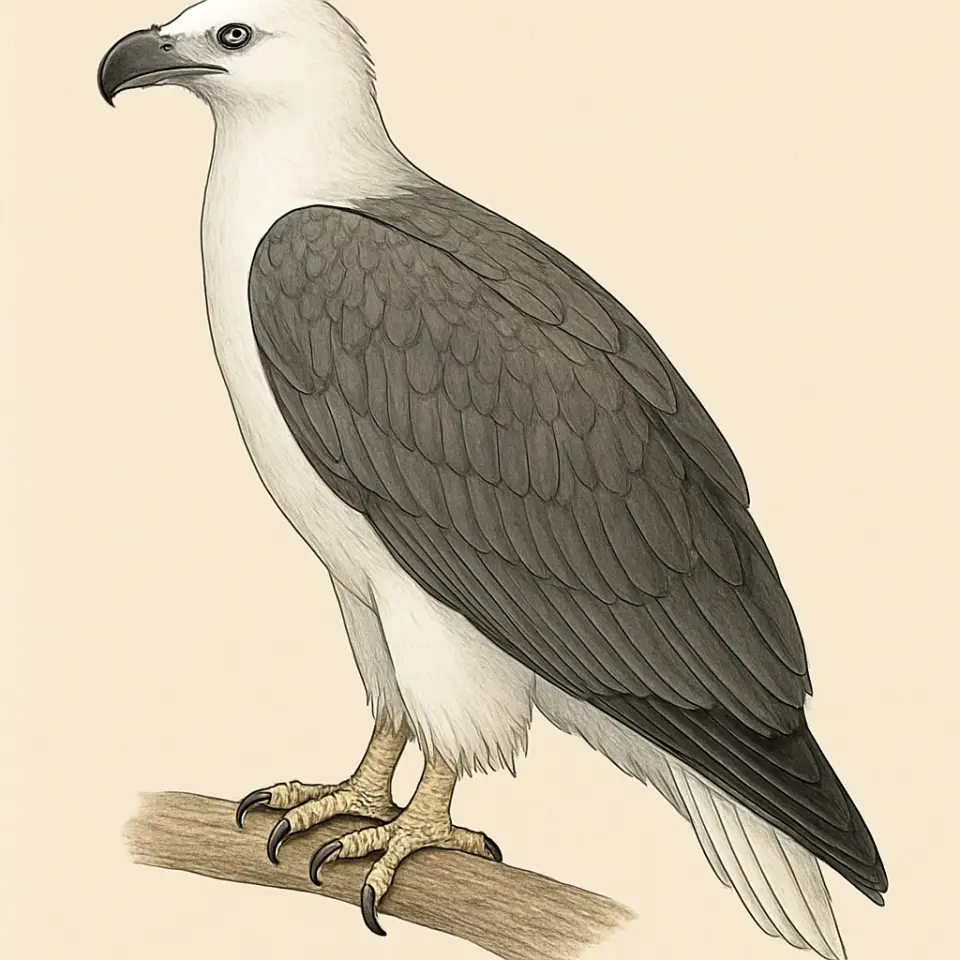
White-bellied sea eagle: the big white eagle of India's headlands
The white-bellied sea eagle is the big white-and-grey eagle that circles slowly over headlands on India's west and east coasts. Females reach 90 cm with a wingspan of up to 2.2 m, pairs hold the same stretch of shore for years, and the bird is protected under Schedule I of Indian wildlife law, the highest level.
A large white-and-grey eagle of the coast, hunting sea snakes and fish and nesting on headland trees above the beaches.
How to recognise it
Brilliant white head and underparts with grey wings and a short wedge-shaped white tail. Soars along the shoreline in slow circles.
Protection
Schedule I, Wildlife (Protection) Act 1972
Where to see it
Goa
Pairs hold the same headland for years and are known by name to fishing villages along the Goan and Konkan coast.
 Dona Paula Viewpoint (often) · Cola Beach & Lagoon (often) · Galgibaga (often)
Gokarna
The Aghanashini estuary was designated a Wetland of International Importance under the Ramsar Convention, one of the few Indian estuaries recognised that way, and this eagle is among its indicator species.
Aghanashini Estuary Backwaters (Ramsar site) (often) · Om Beach Viewpoint (in season) · Nirvana Beach (in season)
Udupi
It nests in the tallest tree on a headland and defends a large territory, so a single pair effectively marks a whole stretch of coast as its own.
St Mary's Island (in season) · Delta Beach, Kodi Bengre (in season)
Size, shape and voice
This is one of the largest raptors on the Indian coast. Females are 80–90 cm long and weigh 2.5–4.5 kg; males are smaller, 66–80 cm and 1.8–3 kg. Adults have a white head, breast and underparts and a dark or slate-grey back and wings, and from below the black flight feathers contrast sharply with the white wing coverts. The short white tail is wedge-shaped.
Young birds are mostly brown and take four to five years to turn white, so a large brown eagle over an estuary may still be this species. The voice is a loud goose-like honking, heard most in the breeding season; pairs often honk together.
The white head can cause confusion with the Brahminy kite, but the kite is much smaller and chestnut, not grey.
How it lives
Pairs stay together until one bird dies. They nest in tall trees, in India's case often the tallest tree on a headland, and sometimes on pylons, lay two eggs and defend a large territory, so a single pair effectively claims a whole stretch of coast. Along the Goan and Konkan coast, pairs hold the same headland for years. In Maharashtra, nest densities of about one per 3.6 km of coastline have been counted in Ratnagiri district.
Fish make up around half its diet, but the eagle is an opportunist: sea snakes, turtles, waterbirds and carrion are all taken. The species usually keeps to coasts and big rivers, yet it has reportedly been seen at Panna Tiger Reserve in central India, nearly 1,000 km from the sea.
Where to watch
Headlands and estuary mouths are the places. In Goa, the India GO list marks it as frequent over Dona Paula, Cola Beach and its lagoon and Galgibaga; see the Goa birds page for the rest. On the Karnataka coast, the Aghanashini estuary at Gokarna, designated a Ramsar Wetland of International Importance, and listed in the India GO notes with this eagle among its indicator species, is watched from the Tadri boat, where pairs use fixed headland perches; Om Beach viewpoint and Nirvana Beach are seasonal spots there. At Udupi the crossing to St Mary's Island and the river mouth at Kodi Bengre turn it up in season.
Scan the tallest trees on a headland first: a white shape sitting very still at the top is often an eagle on its usual perch.
Protected at the highest level
The white-bellied sea eagle is in Schedule I of the Wild Life (Protection) Act, a status kept after the 2022 amendment. Do not approach or disturb nest trees, and keep drones away from perched or nesting birds.
FAQ
Is the white-bellied sea eagle found in India?
Yes. It is resident along the coasts and major waterways from India and Sri Lanka through Southeast Asia to Australia.
How big is the white-bellied sea eagle?
Females are up to 90 cm long with a wingspan of up to 2.2 m; males are smaller, 66–80 cm.
What does the white-bellied sea eagle eat?
Mainly fish, but also sea snakes, turtles and waterbirds.
Is the white-bellied sea eagle protected in India?
Yes, it is in Schedule I of the Wild Life (Protection) Act, the highest category.
Where can I see a sea eagle in Goa?
Over headlands and lagoons such as Dona Paula, Cola and Galgibaga; pairs hold the same headland for years.
Sources (3)
Facts checked: 8 October 2026. Prices and hours are approximate; check locally.