 India GO
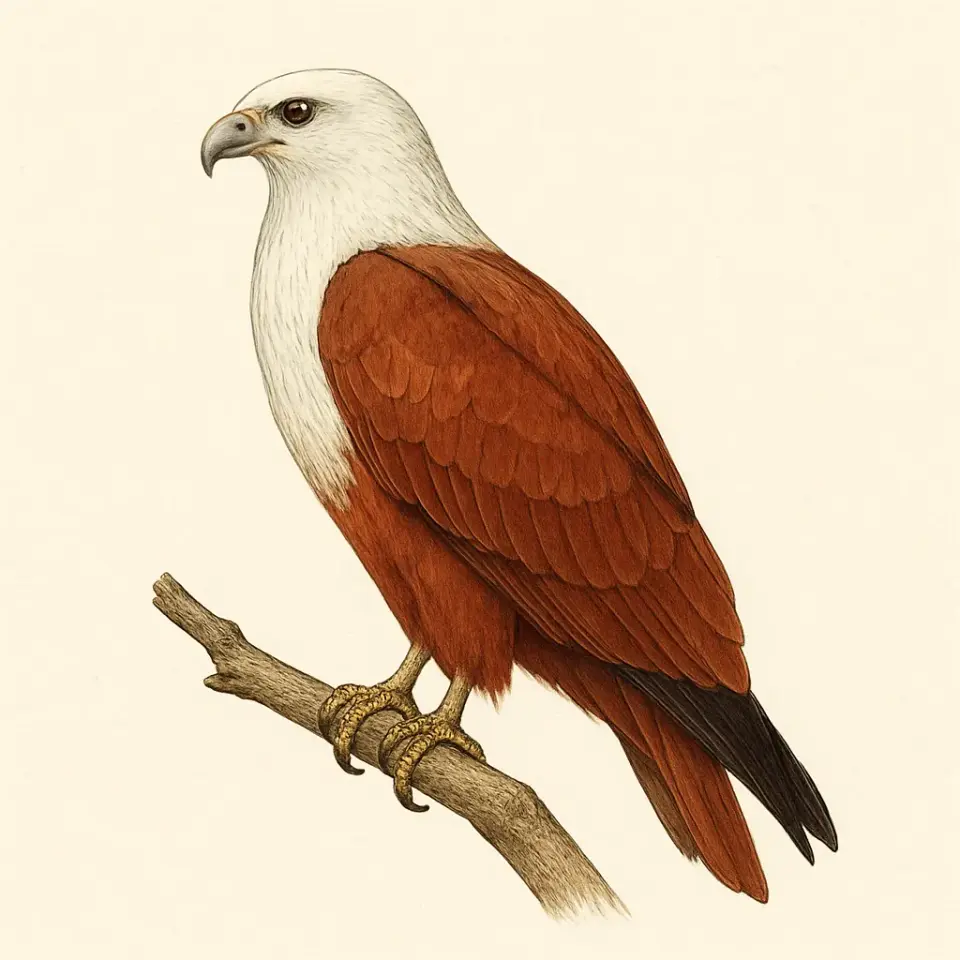
Brahminy kite (brahmani cheel): how to tell it apart and where to see it
ब्राह्मणी चील (brahmani cheel)
The Brahminy kite is the chestnut bird of prey with a white head that hangs over harbours, estuaries and fishing beaches from Mumbai to Udupi. In much of India it is identified with Garuda, the mount of Vishnu, and in Hindi it is ब्राह्मणी चील (brahmani cheel). It is common and, since the 2022 amendment, listed in Schedule I, the highest level of protection under Indian wildlife law.
A chestnut raptor with a clean white head and chest that hangs over harbours, estuaries and fishing beaches, picking dead fish off the surface.
How to recognise it
The white head against rust-brown wings is visible at a distance. It glides low over water with wings held flat, unlike the deeper V of a black kite.
Where to see it
Goa
Identified with Garuda, Vishnu's mount, along much of the Indian coast; the sight of one before a voyage is read as a good sign by fishing communities.
 Dr. Salim Ali Bird Sanctuary (Chorao) · Dona Paula Viewpoint · Palolem
Gokarna
On this coast it is identified with Garuda, and its English name, Brahminy kite, comes from the same association: the links here are religious, not ornithological.
Gokarna Beach Trek (five-beach coastal trail) · Aghanashini Estuary Backwaters (Ramsar site) · Gokarna Beach
Mumbai
Identified with Garuda, Vishnu's mount, along much of the Indian coast; the sight of one before a voyage is read as a good sign by fishing communities.
Elephanta Caves · Thane Creek Flamingo Sanctuary · Juhu Beach Neighborhood (often)
Murudeshwar
Identified with Garuda across South India, which is part of why fishing crews here treat it as a companion bird rather than a competitor.
Murudeshwar Beach · Sharavathi Kandla Mangrove Boardwalk · Ottinene Viewpoint
Udupi
In much of South India this is the bird identified with Garuda, the mount of Vishnu, which is why fishing communities on this coast treat its appearance over a boat as a good sign.
Malpe Beach · Delta Beach, Kodi Bengre · Kaup Beach & Lighthouse
Size and look-alikes
It is a medium-sized raptor, 45–51 cm long with a wingspan of 109–124 cm, about the same size as a black kite. Adults are hard to mistake: chestnut everywhere except the white head and breast, with black wingtips.
The confusion comes with young birds, which are browner and can pass for black kites at a distance. They look paler, with shorter wings, and the tail settles it: the black kite's is forked, the Brahminy's is rounded at the end. On the coast the white-bellied sea eagle also shows a white head, but it is far larger, grey above and white below.
How it lives
Mostly a scavenger. Around wetlands and harbours it feeds mainly on dead fish and crabs picked off the surface, and it readily steals food from other birds. Occasionally it takes live prey such as hares and bats, and in India it also eats rice or cooked food left as offerings. It roosts communally in large, isolated trees: as many as 600 have been seen at one site.
In South Asia it breeds from December to April. The nest is built of sticks and small branches in a tree, often a mangrove, with two eggs that hatch after 26–27 days.
Garuda, Jakarta and Langkawi
Along much of the Indian coast this kite is taken to be Vishnu's Garuda, and a sighting before a boat goes out is read as a good omen; the English name «Brahminy» comes from the same sacred association. Kannada and Telugu speakers call it simply ಗರುಡ ಪಕ್ಷಿ / గరుడ పక్షి (garuda pakshi), «the Garuda bird».
The bird is honoured further east too. In Indonesia it is the elang bondol, the official mascot of Jakarta, and the Malaysian island of Langkawi is named after it.
Where to watch
The India GO database records it at the places named here; harbours and estuaries suit it because that is where dead fish are. In Goa the mangroves of Dr. Salim Ali Bird Sanctuary on Chorao and the headland at Dona Paula are both listed, as is Palolem beach; more of Goa's birds are on the Goa birds page. Elsewhere the list includes Malpe Beach and Kaup Beach at Udupi, the Aghanashini estuary at Gokarna, Murudeshwar Beach, and Elephanta Caves and Thane Creek in Mumbai. No sighting is guaranteed.
FAQ
Is the Brahminy kite a protected bird in India?
Yes. Under the Wild Life (Protection) Act as amended in 2022 it is listed in Schedule I, Part B (birds), the highest level of protection; hunting it is an offence.
What is the Brahminy kite called in Hindi?
ब्राह्मणी चील (brahmani cheel). On the Karnataka coast it is ಗರುಡ ಪಕ್ಷಿ (garuda pakshi), the Garuda bird.
How do I tell a Brahminy kite from a black kite?
Adults are chestnut with a white head and breast; black kites are dark brown all over with a forked tail. Young Brahminy kites are browner, so check the rounded tail.
Why is it called Brahminy?
The name comes from its sacred status: across much of India it is identified with Garuda, Vishnu's mount.
Is the Brahminy kite dangerous?
No danger to people is recorded. It scavenges fish and crabs; do not feed it or approach a nest.
Sources (2)
Facts checked: 8 October 2026. Prices and hours are approximate; check locally.