 India GO
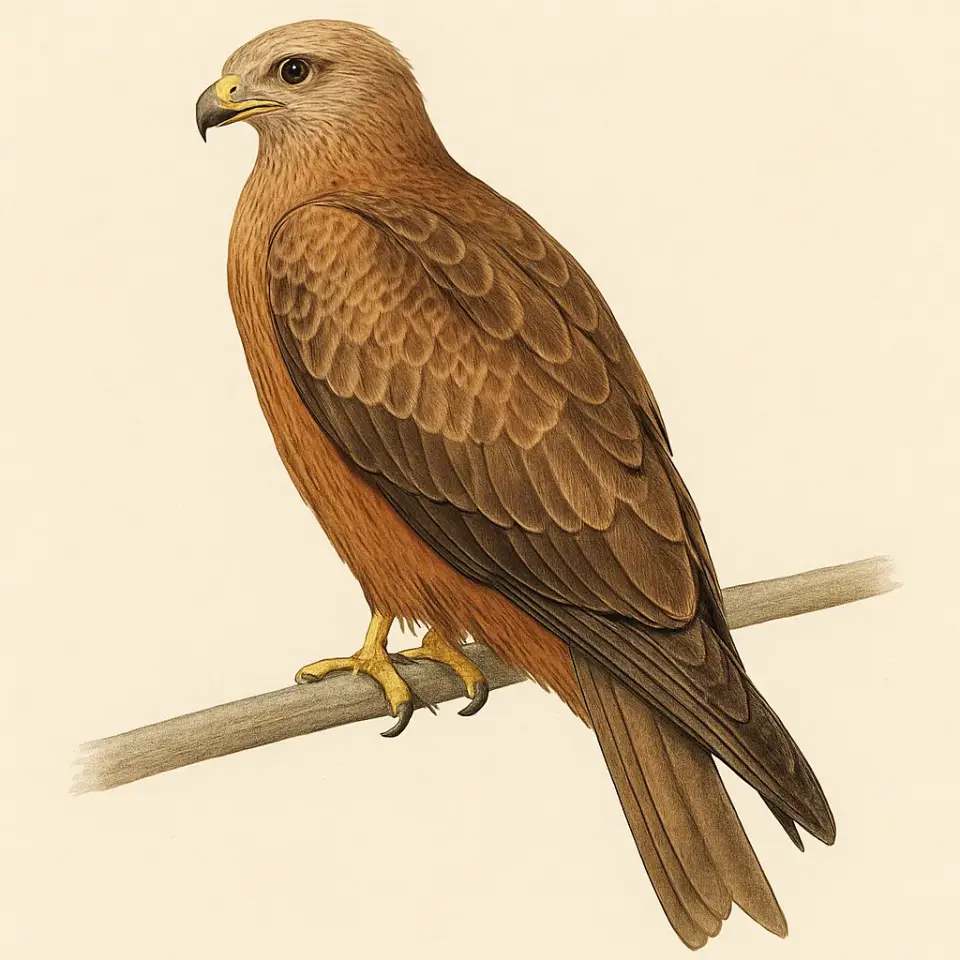
Black kite (cheel): India's city raptor
चील (cheel)
The black kite (Milvus migrans), cheel in Hindi, is the brown bird of prey wheeling over almost every large Indian city. It is a scavenger more than a hunter, and its shallow forked tail, twisting like a rudder, gives it away from a long way off. India's resident race, the small Indian kite, is well adapted to cities and is most numerous where people live most densely.
The raptor that circles over every large Indian city, riding thermals off hot roofs.
How to recognise it
A dark bird of prey with a shallowly forked tail that twists constantly as it steers. It tilts rather than flaps, and gathers in dozens over rubbish grounds and riverbanks.
Where to see it
Delhi
Delhi's kites are fed meat from rooftops around the old city, a practice with both Sufi and Hindu framings. The first year of the Delhi Bird Atlas, run by the Delhi Forest Department with Bird Count India from January 2025, recorded 221 species in the city. Delhi holds one of the densest urban kite populations anywhere.
 Shantivan & Parks Beyond Red Fort · Okhla Bird Sanctuary · Lodhi Garden
Haridwar
In several north Indian cities kites are deliberately fed meat from rooftops, a practice with both Sufi and Hindu framings; the birds have adapted their daily movements to it.
Har Ki Pauri
Mumbai
Kites adjust their daily movements to feeding, and in several Indian cities people deliberately throw them meat from rooftops, a practice with both Sufi and Hindu framings.
Juhu Beach · Rani Baug
Varanasi
In several north Indian cities kites are deliberately fed meat from rooftops, a practice with both Sufi and Hindu framings; the birds have adapted their daily movements to it.
Dashashwamedh Ghat · Sarnath Deer Park
What it looks like up close
An adult weighs about 735 g on average and spans roughly 150 cm across the wings. The plumage is dull brown with a paler head and neck, a darker patch behind the eye, black outer flight feathers and streaky underparts. The bill is black with a yellow base (the cere), and the legs are yellow. Males and females look alike; the female is a little larger.
The voice is a shrill whistle followed by a fast whinnying call.
Two look-alikes are worth knowing. The Brahminy kite is chestnut with a white head and a rounded tail. In winter South Asia also gets the black-eared kite, a migrant race that breeds from Siberia south around the Himalaya and has a larger pale patch at the bend of the wing; the database notes migrant birds joining Delhi's residents from October to March.
Where and when kites gather
Finding a black kite in India takes no effort: look up over any big city on the plains. The birds avoid dense forest and do best where people are thickest. A 1967 survey of New Delhi counted about 2,200 pairs over 150 square kilometres, around 15 pairs per square kilometre, and another survey, in 2013, estimated about 150 pairs per 10 square kilometres.
The Yamuna bank behind the Red Fort, Okhla Bird Sanctuary and Lodhi Garden are the database's Delhi spots; the full list for Delhi is on the city's bird page. The database also lists the ghats of Haridwar and Varanasi and, in Mumbai, Juhu Beach and Rani Baug. Numbers swell after the monsoon, from July to October, and in winter kites gather at large communal roosts, circling for a while before they settle.
The breeding season starts in winter, mainly January and February. The nest is a rough platform of sticks in a tree, often reused year after year, with two or three eggs; the young fly before the monsoon.
Meat thrown to the sky: kites and faith in Delhi
Around the old city, scraps of meat are tossed into the air from rooftops and the kites stoop to catch them mid-air. The practice has both Sufi and Hindu framings; in the Muslim families shown in the documentary below, the belief is that feeding the kites drives troubles away. The birds have adapted their daily movements to the feeding.
The same sky is the setting of All That Breathes (2022), Shaunak Sen's documentary about two brothers, Mohammad Saud and Nadeem Shehzad, who have treated injured kites for years at their bird clinic in Wazirabad, Delhi. The film won the World Cinema documentary Grand Jury Prize at Sundance and the Golden Eye at Cannes, and was nominated for the Academy Award for Best Documentary Feature.
Is the black kite dangerous?
Not in the way a large predator is, but it does take food out of hands. Where kites are fed, they swoop on anything that looks edible, and their sharp talons can cause serious cuts to people standing nearby. In the breeding season, which in India starts in winter (mainly January and February), parents guard the nest, dive at intruders and can single out a person they recognise.
Where kites are being fed, keep food out of sight, and keep your distance from a nest tree.
Protection and threats
The black kite is listed as Least Concern by the IUCN and is thought to be the most numerous bird of prey of its family in the world. In India it is protected: since the 2022 amendment of the Wild Life (Protection) Act, which came into force on 1 April 2023, it sits in Schedule II, so hunting it, which in the Act includes capturing or injuring, is an offence.
Recorded threats include electrocution on power lines it likes to perch on, collisions with vehicles while picking up roadkill, and poisoned prey. At some airports kites are a significant bird-strike hazard.
FAQ
What is the black kite called in Hindi?
Cheel (चील).
Where can I see black kites in Delhi?
Almost anywhere you look up. The densest gatherings are over the Yamuna bank behind the Red Fort and the old city rooftops; Okhla Bird Sanctuary and Lodhi Garden are easy places to watch them too.
Is a black kite dangerous to people?
It can snatch food from your hands, and its talons can cut badly when kites are being fed nearby. Near a nest in the breeding season, which starts in winter, parents dive at people, so keep your distance.
Is the black kite protected in India?
Yes. It is in Schedule II of the Wild Life (Protection) Act as amended in 2022. Globally the IUCN lists it as Least Concern.
How is a black kite different from a Brahminy kite?
The black kite is dull brown all over with a shallow forked tail. The Brahminy kite is chestnut with a white head and breast and a rounded tail.
Sources (4)
Facts checked: 8 October 2026. Prices and hours are approximate; check locally.