 India GO
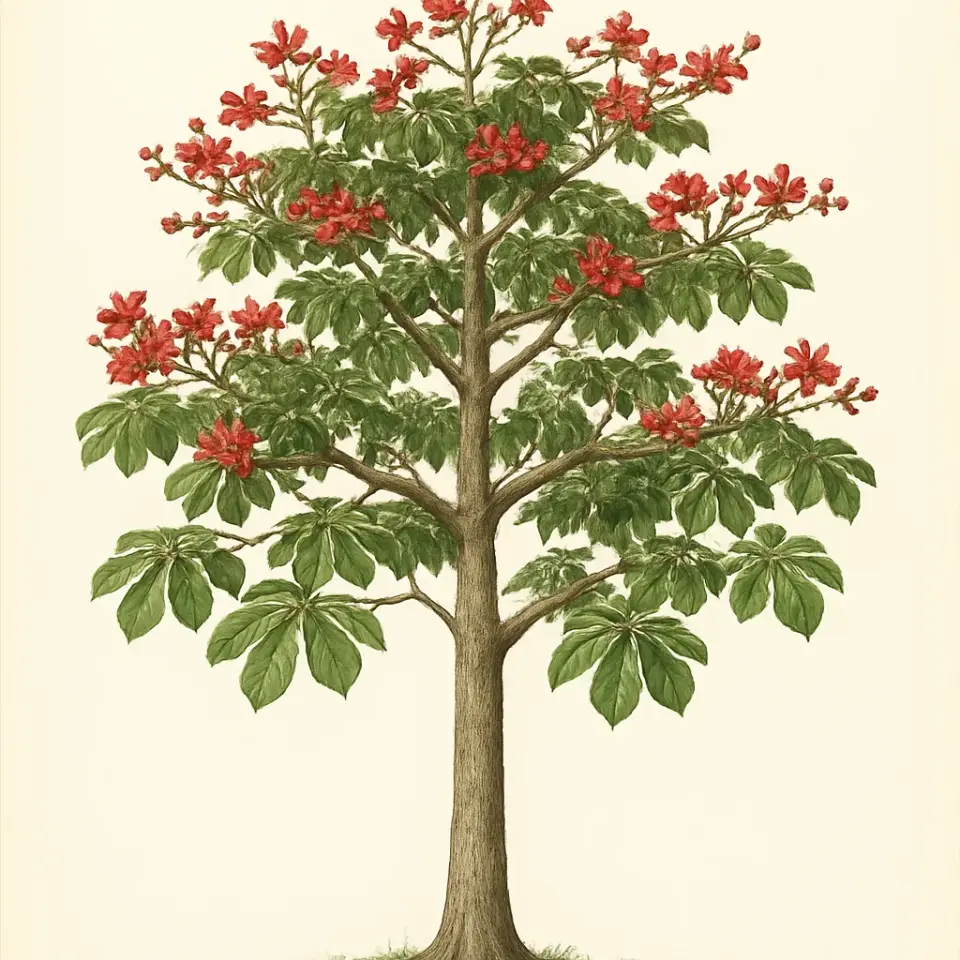
Red silk-cotton tree: semal, the scarlet tree of late winter
सेमल (semal)
The red silk-cotton tree (Bombax ceiba), semal in Hindi, is a tall, straight tree with a thorny grey trunk. In late winter and spring it drops its leaves and covers its bare branches in big, fleshy, cup-shaped red flowers full of nectar; then the fruit split and fill the air with white floss. It is native to India and planted in parks and along roads in many cities, and a single flowering tree can feed a dozen kinds of birds at once.
A tall straight tree with a thorny grey trunk that flowers scarlet on bare branches in late winter, then fills the air with cotton in April.
How to recognise it
Big cup-shaped red flowers, fleshy and full of nectar, on a leafless tree — and the ground beneath littered with them. Parakeets, mynas and squirrels feed there all day.
Where to see it
Agra
One of the best trees in an Indian city for watching birds: in February and March a single flowering semal will hold a dozen species at once.
 Keoladeo Ghana National Park (Bharatpur) (in season) · Sur Sarovar Bird Sanctuary (Keetham Lake) (in season) · Taj Nature Walk (in season)
Bengaluru
The floss stuffed pillows and mattresses across South India before synthetic fibre. Lalbagh's oldest trees stand on and around the Lalbagh Rock, an outcrop of Peninsular Gneiss declared a National Geological Monument in 1975.
Lalbagh Botanical Garden · Cubbon Park (often)
Chandigarh
One of the best trees in an Indian city for watching birds: in February and March a single flowering semal will hold a dozen species at once.
Sukhna Wildlife Sanctuary (in season) · Morni Hills and Tikkar Taal (in season) · Leisure Valley (in season)
Delhi
In February and March a single flowering semal in a Delhi park will hold parakeets, mynas, treepies, squirrels and bulbuls at once: the easiest bird-watching in the city.
Sunder Nursery (in season) · Lodhi Garden (in season) · Aravalli Biodiversity Park (in season)
How to recognise a semal
The trunk is the giveaway in any season: tall and straight, grey, and studded with conical spines, most of all on young trees (old trunks wear them down). An average tree is about 20 m tall; in wet tropical forest old trees can reach far higher.
The leaves are palmate, like an open hand: about six leaflets radiating from the tip of a long, flexible stalk. They fall in winter, and the flowers come before the new leaves.
The flowers are cup-shaped, with five thick red petals up to 12 cm long and a mass of stamens in the centre. They drop whole, and the ground under a flowering tree is carpeted red. The fruit is a capsule about 13 cm long, green and then brown, which splits to release black seeds packed in white cotton.
The name can confuse: silk-cotton and kapok are also used for Ceiba pentandra, a different tree. If the flowers are big and scarlet and the trunk is spiny, it is semal.
When it flowers, and the birds that come
In the guide's cities semal flowers in late winter and spring. February and March are the peak in Delhi, Agra and Chandigarh, and in Bengaluru the old trees in Lalbagh peak in February; the encyclopedia gives March and April for India as a whole, so the timing shifts with place and year. By April and May the fruit open and tufts of cotton drift through the parks.
The flowers are fleshy and full of nectar, and for a few weeks a single tree becomes a feeding station. Parakeets, mynas, treepies, bulbuls and squirrels work the same crown all day. In the guide's notes, a single flowering semal in a city park can hold a dozen bird species at once, which makes it an easy tree for watching birds. Bees come for pollen and nectar too.
Where to see semal in flower
- Delhi: semal is common in New Delhi, where the dry climate keeps it well below its full size. The guide marks it in season at Sunder Nursery, Lodhi Garden and Aravalli Biodiversity Park.
- Bengaluru: Lalbagh has several very large old trees, some on and around Lalbagh Rock, an outcrop of Peninsular Gneiss declared a National Geological Monument in 1975. Semal is also frequent in Cubbon Park.
- Agra: in season at the Taj Nature Walk, Sur Sarovar and Keoladeo National Park at Bharatpur.
- Chandigarh: in season at Sukhna Wildlife Sanctuary, Leisure Valley and in the Morni Hills.
Floss, pillows and local names
The white floss stuffed pillows and mattresses across India before synthetic fibre, and in Nepal and India it has also been carded into thread. The wood, despite the massive trunk, is too soft to be much use as timber. A 19th-century account records that the flower calyx was eaten as a vegetable in India.
The tree has a name in every Indian language: semal in Hindi, shimul in Bengali, ilavam in Tamil, mullilavu in Malayalam and booruga in Kannada and Telugu. The species is widespread from Pakistan to Australia and is rated Least Concern by the IUCN.
FAQ
What is the silk-cotton tree called in Hindi?
Semal (सेमल). In Bengali it is shimul.
When does semal flower?
In late winter and spring, on bare branches. In Delhi and north India the peak is February and March; in Bengaluru's Lalbagh, February.
Is the red silk-cotton tree the same as kapok?
No. Kapok usually means Ceiba pentandra, a different tree; semal is Bombax ceiba, with big scarlet flowers and a spiny trunk.
Why is the trunk covered in thorns?
The conical spines deter animals. They are densest on young trees and wear down as the trunk ages.
Where can I see semal in Delhi?
In season at Sunder Nursery, Lodhi Garden and Aravalli Biodiversity Park; it is also common along New Delhi's roads and parks.
Sources (4)
Facts checked: 8 October 2026. Prices and hours are approximate; check locally.