 India GO
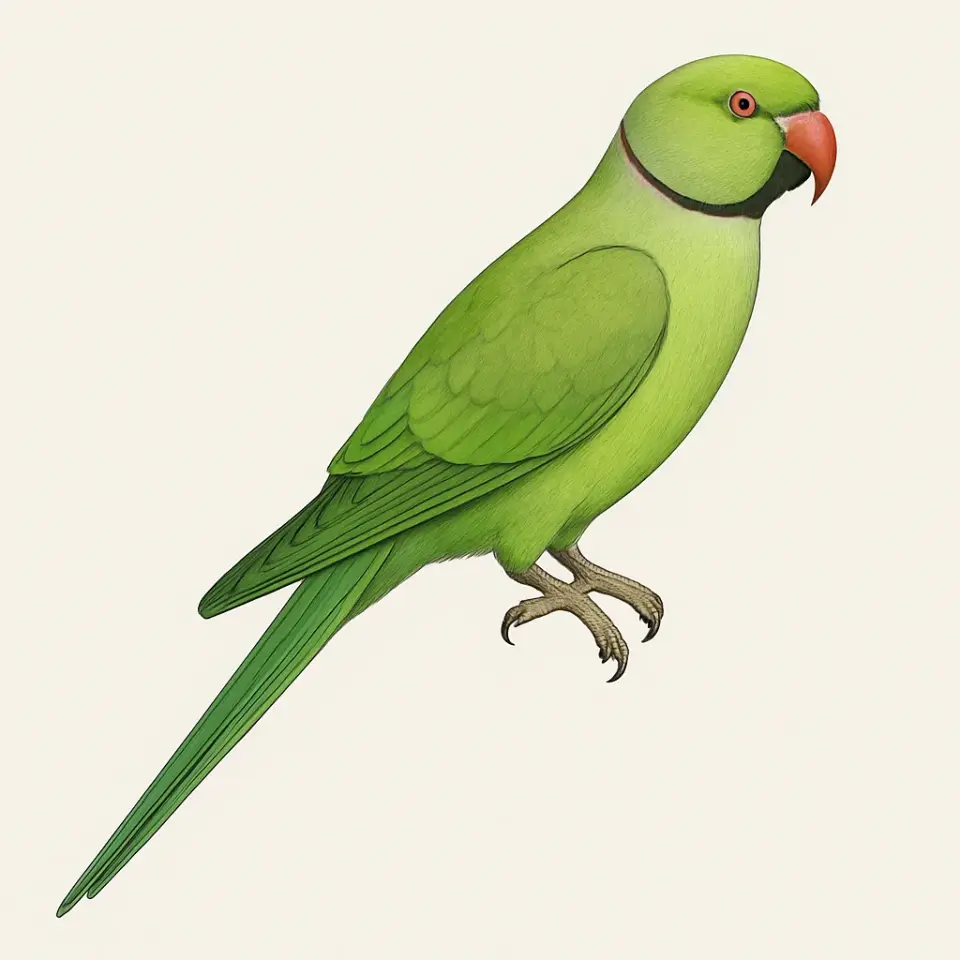
Rose-ringed parakeet, the green parrot of Indian cities
तोता (tota)
The rose-ringed parakeet is the slim green parrot with a very long tail that you hear before you see: a sharp ringing kee-ak as a flock cuts across at roof height. Grown males wear a thin black-and-rose collar; females and young birds have a plain green neck. It is one of the few parrots that thrives in cities, and in India it is a protected wild bird, not a pet.
A slim green parrot with a very long tail. Grown males wear a thin black-and-rose collar; females and young birds have a plain green neck.
How to recognise it
Hearing comes before seeing: a sharp ringing «kee-ak» as a flock cuts across at roof height. Then look for the long tapering tail and the fast straight flight on shallow, stiff wingbeats.
Protection
Schedule II, Wildlife (Protection) Act 1972 - capture and keeping are offences
Where to see it
Bengaluru
Long kept as a cage bird and still the parrot of temple fortune-telling, which is why it is called Rama's parrot in several South Indian languages. Keeping one is now illegal in India.
 Lalbagh Botanical Garden · Cubbon Park · Sankey Tank
Delhi
The parrot on a shoulder is a stock image of Indian miniature painting and of the pet trade that once fed on it; trade in Indian parakeets is now illegal, and the birds you see are wild.
Lodhi Garden · Sunder Nursery · Amrit Udyan (Rashtrapati Bhavan Gardens)
Hyderabad
The parrot on a shoulder is a stock image of Indian miniature painting and of the pet trade that once fed on it; trade in Indian parakeets is now illegal, and the birds you see are wild.
KBR National Park · Hyderabad Botanical Garden (Kotla Vijayabhaskara Reddy) · Lumbini Park and the Boat to the Buddha
Jaipur
The tota is the mount of Kamadeva and a stock character in Rajasthani miniature painting, where a parrot on a woman's wrist carries a message. Jaipur's havelis were built with parapet niches that parakeets still nest in.
Kanak Vrindavan Garden · Central Park · Jhalana Leopard Reserve
Pushkar
Tota is the bird of Kamadeva and the messenger-parrot of Rajasthani miniature painting; the old havelis were built with parapet niches that parakeets still use as nest holes.
Pushkar Lake · Budha Pushkar Lake (Old Pushkar) (often)
Tirumala
Andhra Pradesh notified its own state symbols in May 2018, four years after the bifurcation with Telangana: the rose-ringed parakeet replaced the Indian roller, which Telangana kept, and jasmine replaced the water lily. The blackbuck and the neem were retained.
Sri Venkateswara Zoological Park · Kalyani Dam · Chakra Teertham
Ujjain
The parrot on a shoulder is a stock image of Indian miniature painting and of the pet trade that once fed on it; trade in Indian parakeets is now illegal, and the birds you see are wild.
Naulakhi Eco Tourism Park · Shipra River and Shri Ram Ghat
Varanasi
The parrot on a shoulder is a stock image of Indian miniature painting and of the pet trade that once fed on it; trade in Indian parakeets is now illegal, and the birds you see are wild.
Sarnath Deer Park
Vrindavan
A green parrot sits beside Radha in a great deal of Braj painting, and Shukadeva Goswami, the sage who recites the Bhagavata Purana (the text that made Vrindavan famous), carries the parrot's name, shuka. The parakeet is the bird you will hear most often over Vrindavan's temple lanes.
Vrindavan Parikrama Marg · Gahvar Van · Bhandirvan (Bhandir Vat)
How to identify it
It measures 37–43 cm, and much of that is tail. In flight the long tapering tail and fast, straight flight on shallow, stiff wingbeats give it away even against the light. The collar is the way to sex a bird: only adult males have the black-and-rose ring, so a flock of green-necked birds is females and youngsters, not another species.
In the wild it eats buds, nectar, fruit, seeds and grain. In India flocks feed on cereal crops and, in winter, on pigeon peas, which does not endear them to farmers. In north-west India pairs form between September and December, choose and defend nest holes through the cold season and raise their young from April to June. Old trees and wall cavities are the usual nest sites. Both males and females can mimic human speech, which is the root of the old pet trade.
The parrot of painting and myth
The tota, as the parakeet is called in Hindi, is the mount of Kamadeva, the god of love, and a stock figure of Rajasthani and Braj miniature painting: a parrot on a woman's wrist carries a message, a green parrot sits beside Radha. Shukadeva Goswami, the sage who recites the Bhagavata Purana, the text that made Vrindavan famous, carries the parrot's name, shuka. In several South Indian languages it is Rama's parrot, rama chiluka in Telugu, and it is still the bird of temple fortune-tellers.
In May 2018 Andhra Pradesh made the rose-ringed parakeet its state bird, replacing the Indian roller, which Telangana kept after the two states separated.
Not a pet: the law
In India the rose-ringed parakeet is protected under Schedule II of the Wild Life (Protection) Act as amended in 2022. Catching, keeping or selling one is an offence, so the birds you see in parks are wild, and a parakeet should not be bought from a street seller. The IUCN lists it as Least Concern worldwide: its numbers are rising, although trapping and farmers have reduced it in parts of its native range.
Where to see it
Almost any Indian city with old trees, all year. The best shows are the dusk roosts, when flocks stream in and the trees go loud. In Delhi the birds gather in the old trees around the tombs of Lodhi Garden at dusk and are common at Sunder Nursery; more city birds are on the Delhi birds page. In Bengaluru there are noisy roosts in the old trees by the lake at Lalbagh, flocks feed in the fruiting figs of Cubbon Park through the morning, and they are regulars at Sankey Tank; see also Bengaluru birds.
In Vrindavan it is the bird you will hear most over the temple lanes. Flocks feed in the roadside neem and sheesham along the parikrama path, loudest in the first hour after sunrise and again as the light goes, and the old trees of Gahvar Van hold nest holes. In Jaipur and Pushkar the old havelis were built with parapet niches that parakeets still nest in.
The same bird abroad
Escaped and released pets have founded wild populations far outside India: in London and much of western Europe, in Japan and in Israel, where it has become the fifth most common bird. A Europe-wide count in 2015 found over 85,000. The European birds descend from the Asian subspecies, so the parakeet in a London park is of South Asian stock.
FAQ
What is the rose-ringed parakeet called in Hindi?
Tota (तोता). In Telugu it is rama chiluka, Rama's parrot; in Kannada gili and in Tamil pachai kili.
Is it legal to keep a rose-ringed parakeet in India?
No. It is protected under Schedule II of the Wild Life (Protection) Act, and catching, keeping or trading it is an offence.
How do I tell a male from a female?
Adult males have a thin black-and-rose ring around the neck. Females and young birds have a plain green neck.
Which state has the rose-ringed parakeet as its state bird?
Andhra Pradesh, since May 2018.
When is the best time to see parakeets in Delhi or Vrindavan?
They are there all year. Come in the first hour after sunrise or at dusk, when flocks fly to and from their roosts.
Sources (4)
Facts checked: 8 October 2026. Prices and hours are approximate; check locally.