 India GO
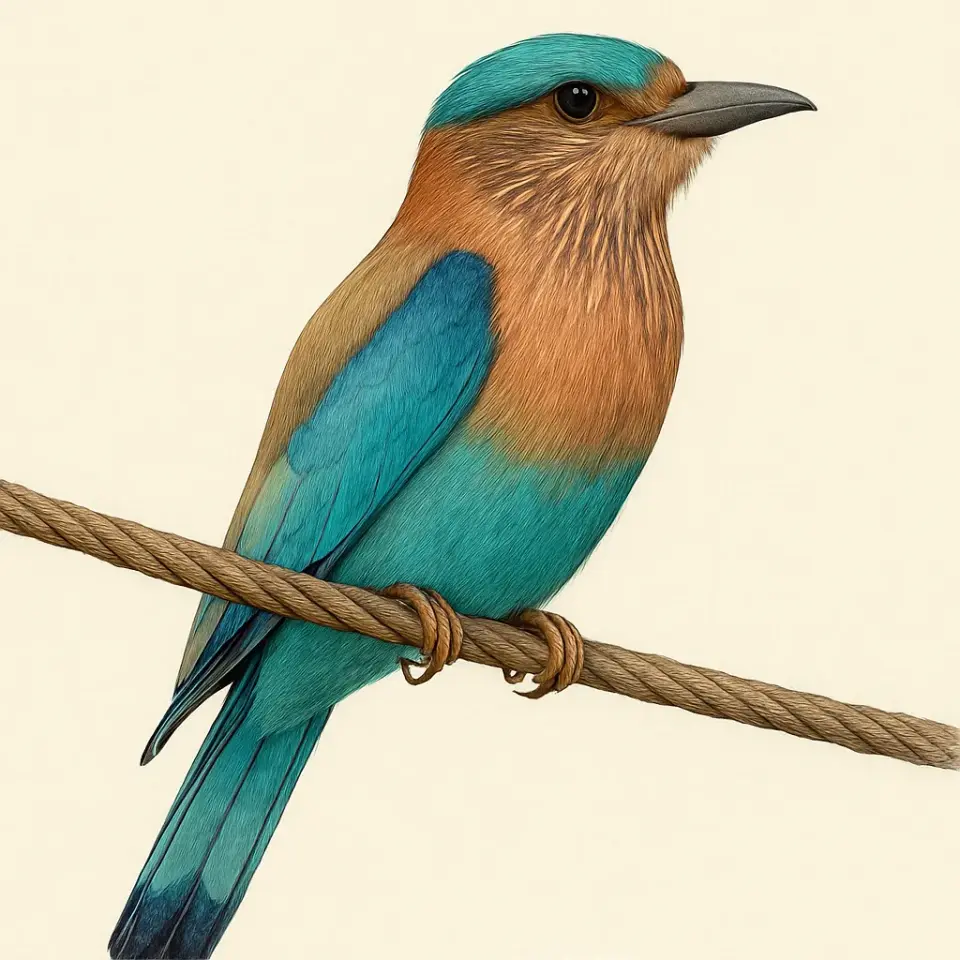
Indian roller (neelkanth): the blue flash on the wire
नीलकंठ (neelkanth)
The Indian roller (Coracias benghalensis), neelkanth in Hindi and palapitta in Telugu, is the stocky bird sitting bolt upright on roadside wires above open fields. Perched, it looks brown and dull; the moment it opens its wings it flashes two shades of electric blue. It is the state bird of Karnataka, Telangana and Odisha, a Dussehra omen across much of India, and now a species classed as Near Threatened.
A thickset blue-and-brown bird that sits on wires and bare branches over open ground. At rest it looks dull; the moment it opens its wings it becomes two shades of brilliant blue.
How to recognise it
Look for a stocky bird sitting upright and motionless on a wire, dropping straight down onto insects. The flash of turquoise and dark blue in the wing is unmistakable, and the male tumbles through the air in spring display.
Protection
Schedule II, Wildlife (Protection) Act 1972
Where to see it
Bengaluru
The state bird of Karnataka, and in Kannada literally nilakantha, “blue throat”, a name of Shiva. Seeing one before a journey counts as a good omen in parts of the Deccan, and it is a Dussehra bird across South India.
 Nandi Hills · Savandurga · Turahalli Forest (often) · Bannerghatta Biological Park (often)
Govardhan
Its Hindi name, nilkanth or “blue throat”, is one of Shiva's names, and seeing the bird on Dussehra is counted as a good sign across north India. The species has been moved to Near Threatened as insect prey and open ground have declined.
Govardhan Hill & Parikrama Marg (often) · Chandra Sarovar & Surdas Kuti, Parasoli (often)
Hyderabad
The state bird of Telangana, where it is palapitta. Seeing one on Dussehra is held to bring success, and the bird is a fixture of Telangana's festival imagery, which is also why releasing captive rollers at Dussehra is now prosecuted as a wildlife offence.
KBR National Park (often) · Khajaguda Hills (Fakhruddingutta) (often) · Mahavir Harina Vanasthali National Park (often)
Jaipur
Its Hindi name, nilkanth (“blue throat”), is a name of Shiva, and seeing the bird around Dussehra is counted as a good omen across northern India.
Jhalana Leopard Reserve · Central Park (often) · Sambhar Salt Lake (often)
Pune
Once common across Maharashtra, where the bird was a reminder that Mahashivratri was approaching, the roller is now largely restricted to Pune's hills and outskirts, such as Vetal Tekdi.
Vetal Tekdi (often) · Pashan Lake (often) · Khadakwasla Dam (often)
Ujjain
The neelkanth, “blue throat”, is a name of Shiva, which gives the bird a particular weight in Ujjain, a city built around Mahakaleshwar. Seeing one on Dussehra is held to bring success.
Naulakhi Eco Tourism Park (often) · Dewas Tekri (Mata Tekri) (often) · Undasa Lake (often)
Size, colours and call
A roller is a bulky bird, 30–34 cm long, around 170 g, with a large head, short neck and a wingspan of 65–74 cm. The face and throat are pinkish with fine pale streaks, the back is brown, and the crown, rump, wings and tail are turquoise and deep purple-blue. Males and females look the same.
The blue is not pigment. It is produced by microscopic structures in the feather barbs that scatter light, a puzzle the physicist C.V. Raman worked on in the 1930s. That is why the bird looks dull on a branch and blazes in flight.
The usual call is a harsh chack. The European roller passes through parts of the same range on migration: it has an all-blue head and black flight feathers.
Why it is called a roller
Rollers hunt from a perch, usually 3–9 m up on a wire or bare branch, dropping onto beetles, grasshoppers and crickets on the ground; beetles make up nearly half the diet. A swarm of flying termites can pull in dozens: one count found 40 birds along 70 m of wire. They follow tractors for disturbed insects and dart into the smoke of grass fires.
The name comes from the breeding display, from about March to June. The male climbs, then tumbles down in steep dives, somersaults and rolls, calling harshly. The pair nests in a hole in a tree, a dead palm or a building, and parents will dive at crows and even people who come too close.
The database points to open country around the cities: Nandi Hills, Turahalli Forest, Savandurga and the approach to Bannerghatta near Bengaluru, and the outer stretches of the Govardhan parikrama. More Bengaluru birds are on the city's bird page. The database also lists KBR National Park and Mahavir Harina Vanasthali in Hyderabad, Jhalana and the road to Sambhar Salt Lake near Jaipur, Vetal Tekdi in Pune and Undasa Lake near Ujjain.
Neelkanth, Shiva and the Dussehra omen
Neelkanth means “blue throat”, a name of Shiva: in the story of the churning of the ocean he drank the halahala poison to save the world and held it in his throat, which turned blue. In parts of India the bird is also linked with Vishnu, and in old Bengal people who saw one recited a couplet asking to see it again at the hour of death.
Across north and central India and the Deccan, seeing a roller on Dussehra is counted as a sign of success. That belief once had a dark side: birds were trapped and kept in cages so they could be “seen” or released on the festival day. Today catching a roller is an offence under India's wildlife law, and according to the database, releasing captive rollers at Dussehra is now prosecuted in Telangana. The Telugu name palapitta, “milk bird”, comes from an old belief that its chopped feathers in fodder made cows give more milk.
From common bird to Near Threatened
For decades the roller was one of the most familiar birds of rural India. The IUCN has moved it from Least Concern to Near Threatened after counts showed a decline of about 30% in India: open scrub, grassland and fallow land are disappearing, pesticides cut its insect food, and nest holes in old trees and palms are lost. Power lines are a quieter killer; in Rajasthan it was found to be the second most often electrocuted bird after the house crow, and feeding on roadsides sometimes gets it hit by traffic.
In India it has been legally protected since the Wild Birds Protection Act of 1887 and is now in Schedule II of the Wild Life (Protection) Act as amended in 2022.
FAQ
What is the state bird of Karnataka?
The Indian roller, called nilakantha in Kannada. It is also the state bird of Telangana and Odisha.
What is the Indian roller called in Hindi?
Neelkanth (नीलकंठ), “blue throat”, a name of Shiva. In Telugu it is palapitta, in Tamil panangadai.
Why is seeing a neelkanth on Dussehra lucky?
The bird shares its name with Shiva, and a sighting on Dussehra is traditionally read as a sign of success. Look for a wild one on a wire; caged birds offered for viewing are illegal.
Is the Indian roller endangered?
Not endangered, but it is now Near Threatened on the IUCN Red List after a decline of about 30% in India. It is protected under Schedule II of India's wildlife law.
Why is it called a roller?
For the male's breeding display from about March to June: steep dives, somersaults and rolls in mid-air, with loud harsh calls.
Sources (4)
Facts checked: 8 October 2026. Prices and hours are approximate; check locally.