 India GO
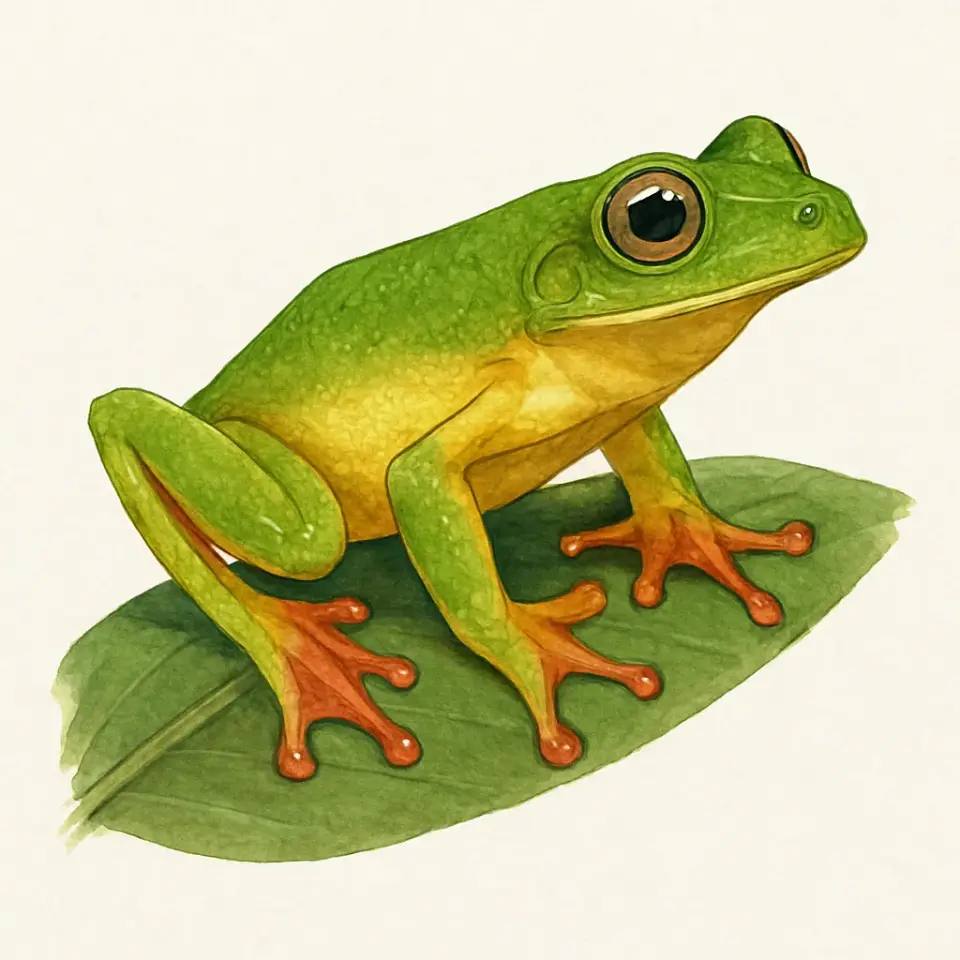
Malabar gliding frog: the monsoon frog of the Western Ghats
The Malabar gliding frog (Rhacophorus malabaricus) is a vivid green tree frog of the Western Ghats with huge orange-red webbed feet. Spread wide, they let it glide from the treetops for 9–12 m. It lives only in this mountain chain, and it shows itself in the monsoon, from June to September, when pairs whip up white foam nests on branches over the water.
A bright green tree frog of the Western Ghats with red webbed feet that it spreads to glide between trees.
How to recognise it
Found at night in monsoon forest, usually near a foam nest hanging over water. The webbing between the toes is bright orange-red.
Where to see it
Goa
The Western Ghats monsoon has become a wildlife season of its own, and the gliding frog is its emblem: bright green, red-footed, and found by torchlight beside a stream.
 Chorla Ghat (in season) · Budbudyanchi Tali (Bubbling Lake), Netravali (in season) · Dudhsagar Falls (in season)
A big green frog with red feet
Its body is about 10 cm long, and females are bigger than males. The back is finely grained and plain bright green without marks, the belly pale yellow. Skin fringes run along the limbs, there is a small triangular flap at the heel, and the toe discs are large. The webbing between fingers and toes is big and orange-red.
A very similar species, Rhacophorus pseudomalabaricus, has a black-marbled back and was long lumped with this one; a clean green back means malabaricus.
The frog does not truly fly. It leaps from a high branch and spreads its webbing like a parachute, breaking the fall into a glide of 9–12 m, up to about 115 times its own length.
Foam nests over the water
Breeding runs through the monsoon, June to September. Males sit on branches by streams and pools and call; a female chooses one and signals him. The male then whips up a mass of foam into which the female lays her eggs, and other males have been seen helping build the nest. A nest is about 8–11 cm long and holds roughly 90–200 small off-white eggs. The female covers it with leaves, and when the tadpoles hatch they drop straight into the water below.
That is how to find the frog: look for the white foam balls hanging over water, then search the leaves around them after dark.
Where to look: Goa's monsoon ghats
The frog is known from the Western Ghats of Kerala, Tamil Nadu, Karnataka, Goa and Maharashtra, from about 40 m to almost 1,900 m above sea level. It is not confined to pristine forest: it turns up in plantations and even in towns, on leaves near streams.
In Goa the database points to Chorla Ghat on the Karnataka border, the village of Netravali with its Bubbling Lake, and the forest around Dudhsagar Falls; the rest of Goa's wildlife is on the Goa animals page. The database records it at night in the monsoon, near foam nests over water. Watch the frogs without picking them up.
Status
The IUCN lists the Malabar gliding frog as Least Concern (assessment of 2004). It is not named in the schedules of the Wild Life (Protection) Act as amended in 2022, which list only selected frog species. It breeds in trees hanging over water, so its tadpoles depend on streams and pools with trees along their banks.
FAQ
Can the Malabar gliding frog really fly?
No, it glides. It jumps from a high branch and spreads the webbing between its toes, slowing the fall into a glide of 9–12 m.
When is the best time to see it?
In the monsoon, June to September, at night, when males call by streams and foam nests hang over the water. The database lists it as a monsoon sighting only.
Where can I see the Malabar gliding frog in Goa?
The database points to Chorla Ghat, Netravali and the forest around Dudhsagar Falls. It is recorded at night in the monsoon, June to September.
How big is the Malabar gliding frog?
About 10 cm long. Females are larger than males.
Facts checked: 8 October 2026. Prices and hours are approximate; check locally.