 India GO
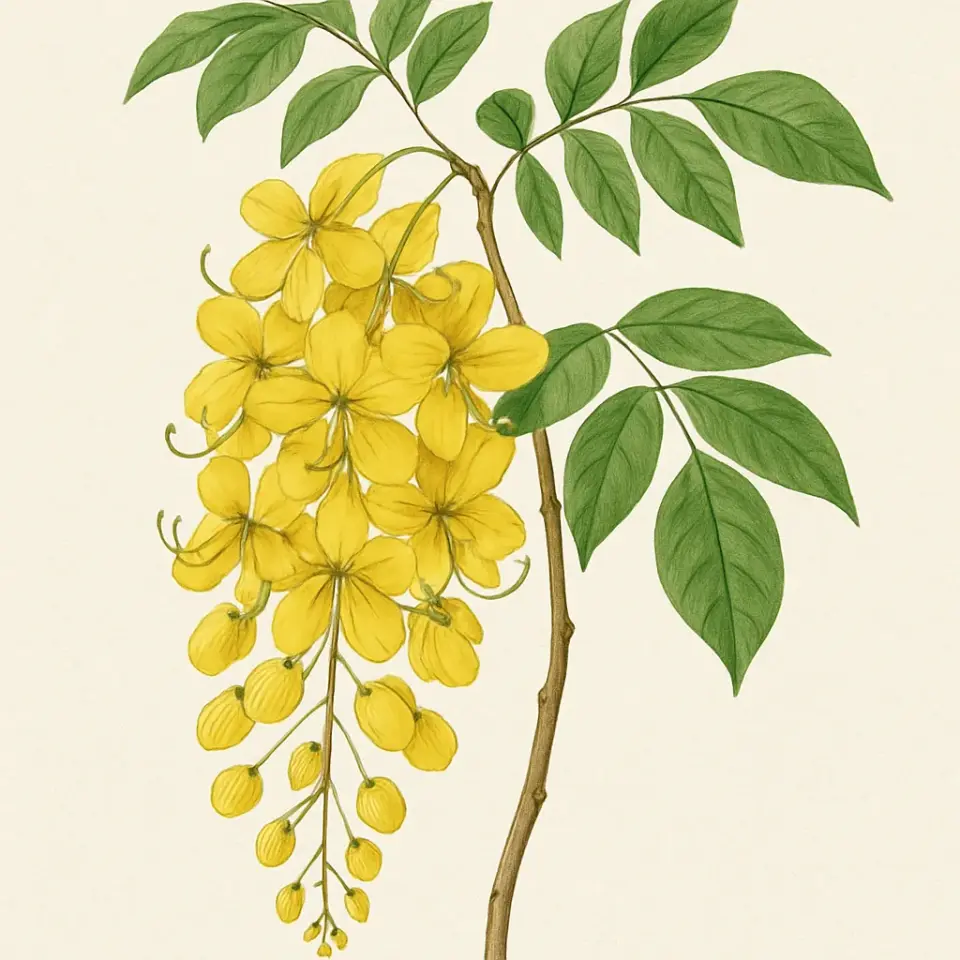
Indian laburnum, amaltas, kanikonna: the golden shower tree
अमलतास (amaltas)
The Indian laburnum, Cassia fistula, is the tree that hangs long chains of yellow flowers in India's hottest weeks: amaltas in Hindi, kanikonna in Malayalam, the golden shower tree in English. It is native to the subcontinent and is the state flower of Kerala, where it belongs to the Vishu new year. In the south it flowers from March to May, in Delhi and Chandigarh from May into early summer.
A native tree that hangs itself with long chains of yellow flowers in the hottest weeks before the monsoon, then carries dark cylindrical pods up to half a metre long.
How to recognise it
Bright yellow, always hanging downward in loose chains, on a tree that is mostly bare when it flowers. The old black pods stay on the tree for months and rattle.
Where to see it
Bengaluru
In Karnataka its flowering marks the last stretch of the hot season.
 Lalbagh Botanical Garden (in season) · Cubbon Park (in season) · Turahalli Forest (in season)
Chandigarh
Chandigarh's roads are known by the trees planted along them, and amaltas was chosen for the inner roads of Sector 34, alongside kadam and bahera. In the city it flowers from May into July.
Leisure Valley (in season) · Pinjore Gardens (in season)
Delhi
The amaltas flowering is Delhi's calendar marker for the hottest weeks of the year: yellow chains on leafless trees along the ring roads through May and June.
Lodhi Garden (in season) · Sunder Nursery (in season) · Garden of Five Senses (in season)
Kochi
Kanikkonna is the flower arranged in the Vishukkani, the first thing a household looks at on the morning of Vishu, the Malayali new year in mid-April. Warmer springs have been pushing the flowering earlier than the festival.
Mangalavanam Bird Sanctuary (in season) · Kadamakkudy Islands (in season) · Areekal Waterfalls (in season)
The tree in detail
A medium-sized, fast-growing tree, 10–20 m tall, with large pinnate leaves of three to eight pairs of leaflets that it sheds before flowering. The flowers come in hanging racemes 20–40 cm long; each flower is 4–7 cm across, with five equal yellow petals. In full bloom a tree can show almost no leaves at all, only yellow.
The pods give it away the rest of the year: dark, cylindrical, 30–60 cm long, hanging straight down like sticks and rattling in the wind. They have a pungent smell. Carpenter bees are among its main pollinators, and a forester's experiment in 1911 found that golden jackals eat the pods and spread the seeds.
The English name recalls the laburnum of southern Europe, a different tree of the same pea family that also hangs golden chains of flowers.
When it flowers, city by city
The tree blooms in hot, dry weather in late spring and early summer, and it flowers better where summer and winter are sharply different. In the south it flowers earlier than in the north.
Kochi and Kerala: March to May, with Vishu in mid-April at the centre. Warmer springs have been pushing the bloom earlier than the festival.
Bengaluru: April to May, the last stretch of the hot season. Look in Lalbagh, Cubbon Park and as wild trees in the scrub of Turahalli Forest.
Delhi: May and June, the city's marker for the hottest weeks, on leafless trees along the ring roads and in Lodhi Garden, Sunder Nursery and the Garden of Five Senses.
Chandigarh: from May, on avenues and in Leisure Valley; the city planted amaltas along the inner roads of Sector 34.
The exact weeks vary from year to year with the weather.
Vishu and the state flower of Kerala
On the morning of Vishu, the Malayali new year in April, the first thing a household looks at is the Vishukkani: a tray of auspicious things prepared the day before (rice, fruit, a mirror, coins, gold), with golden kanikonna flowers among them. Kani means "that which is seen first". The tree is also Kerala's state flower.
The tree carries meaning beyond India too. It is the national tree and flower of Thailand, where its yellow is linked to the monarchy; in Laos the flowers are hung in homes for the new year; in Sri Lanka it is grown at Buddhist temples. India has put it on a 20-rupee stamp.
The pods are a laxative, not a snack
In Ayurveda the tree is called aragvadha, and the pulp of its pods is used as a purgative; Ayurvedic texts themselves warn against using it without supervision. The flowers are sometimes eaten in India, but don't experiment with the pods you pick up under a tree.
FAQ
What is the state flower of Kerala?
The Indian laburnum, Cassia fistula, called kanikonna in Malayalam. Its flowers are part of the Vishukkani on the morning of Vishu.
What is Indian laburnum called in Hindi?
Amaltas (अमलतास). In Malayalam it is kanikonna, in Tamil konrai, in Kannada kakke.
When does amaltas flower in Delhi?
In May and June, the hottest weeks of the year. Lodhi Garden, Sunder Nursery and the ring-road avenues are good places to see it.
Is Indian laburnum the same as the European laburnum?
No. Both hang chains of yellow flowers, hence the shared English name, but the laburnum of Europe is a different genus; Cassia fistula is native to South Asia.
Is Cassia fistula poisonous?
The pod pulp is a purgative, and Ayurvedic texts advise against using it without medical supervision. The flowers are sometimes eaten in India.
Facts checked: 8 October 2026. Prices and hours are approximate; check locally.