 India GO
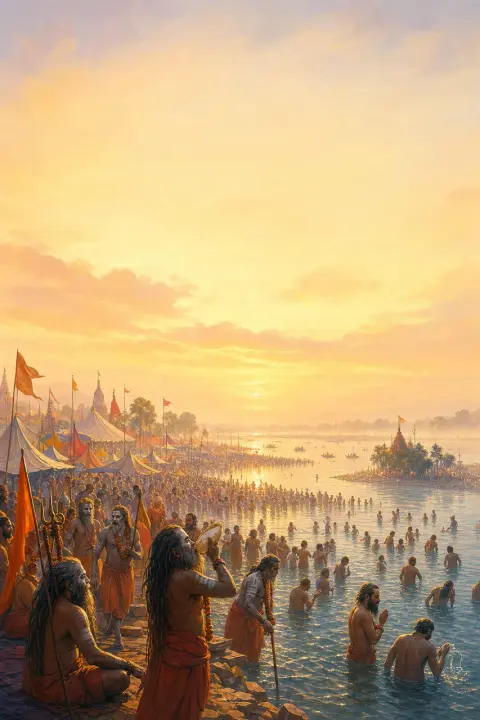
Kumbh Mela in Haridwar: the Kumbh and the Ardh Kumbh
Humanity's largest gathering, on a scale visible from space
Haridwar is one of the four Kumbh Mela cities, on the Ganga at the foot of the Himalayas. It holds a full Kumbh about once in twelve years and an Ardh ("half") Kumbh six years after it, both centred on Har Ki Pauri, where a drop of amrita is said to have fallen. Next mela: 14 January – 20 April 2027.
Haridwar's next mela is the Ardh Kumbh of 14 January to 20 April 2027, and in every other year the city still runs a full mela machine for Kanwar Yatra, Ganga Dussehra and Somvati Amavasya.
Where to watch
Har Ki Pauri (Brahma Kund): the main bathing ghat and the site of both daily aartis; Brahma Kund, within it, is where the amrit is said to have fallen. Open 24 hours, free, about 2 km from Haridwar Junction; the ghats have been repeatedly extended to take Kumbh crowds.
Mansa Devi Temple: the hill temple above the town, one of the two shakti shrines that frame Haridwar, with very heavy footfall through Chaitra Navratri. Reached on foot or by ropeway.
Chandi Devi Temple: the second hill temple, on the far bank, busiest at Chandi Chaudas and Navratri. Reached on foot or by ropeway.
Mela sectors and akhara camps (mela years only): where the akharas camp and the tented accommodation stands during a Kumbh or Ardh Kumbh, laid out in numbered zones and sectors by the Mela Adhikari's office. IAS officer Sonika Singh (Meena) was appointed Mela Adhikari for the 2027 mela in May 2025, the first woman to hold the post.
Free viewing
- Brahma Kund steps at Har Ki Pauri, taken 45 minutes to an hour before the aarti
- The ghat stretch either side of Har Ki Pauri, which shares the same channel and the same sightlines with far less pressure
- The footbridges over the canal channel, which give a view down the whole ghat line
- Mansa Devi hilltop, for the scale of the ghat line from above rather than the ritual itself
Programme
Arrive, walk the ghat line, learn the geography before it fills
Walk from Har Ki Pauri along the ghats to fix the layout in mind: which footbridge crosses to which bank, where the barricaded lanes run, which side of Brahma Kund the aarti platform is on.
 Har Ki Pauri and the ghat stretch along the Ganga canal channel
Arrive, walk the ghat line, learn the geography before it fills
Shringar Aarti (the evening Ganga Aarti). Entry is free and takes no ticket. The aarti has been performed here since 1916 and is organised by Shri Ganga Sabha.
Brahma Kund, Har Ki Pauri
The bathing date itself
The first dip. On an Amrit Snan (formerly Shahi Snan) date the akhara processions take the water first in a fixed order and the general ghats open around them; on an ordinary Parv Snan date the ghats are open from first light.
Brahma Kund at Har Ki Pauri is the most sought spot; the flanking ghats along the same channel take the overflow
The bathing date itself
Mangala Aarti at Har Ki Pauri.
Brahma Kund, Har Ki Pauri
The bathing date itself
Expect the ghat approach lanes to be barricaded and one-directional, and the mela area to be closed to private vehicles with parking pushed to the outskirts and shuttles running in.
Haridwar mela area
The akhara camps, the hill temples and the way out
In a mela year, walk the akhara camps and the tented sectors while they are still standing. Outside a mela year, the same morning goes to Mansa Devi and Chandi Devi, the two hill temples above the town.
Mela sectors in a Kumbh or Ardh Kumbh year; Mansa Devi Temple and Chandi Devi Temple otherwise
The akhara camps, the hill temples and the way out
Leave. Road restrictions usually lift the day after a bathing date rather than the same evening.
Haridwar Junction, or by road toward Rishikesh and Dehradun
The Haridwar mela: Kumbh and Ardh Kumbh
Haridwar's mela follows the sky: the Kumbh is held when Jupiter is in Kumbha (Aquarius) and the Sun enters Mesha (Aries), so the great bath falls on Mesha Sankranti in April. Haridwar's mela seems to be the original one: its timing follows the sign that gives the festival its name. The Ardh Kumbh comes six years after a full Kumbh; the state government fixes its window and bathing days with the thirteen akharas (monastic orders of sadhus) and their council, the Akhara Parishad, usually a year or more ahead. The most important bathing days are the Amrit Snan, the royal baths when the akharas enter the water first; the dates are on the Kumbh Mela page.
The gathering is old: the Khulasat-ut-Tawarikh of 1695 is among the earliest texts to use the name Kumbh Mela, and a census on one day in April 1867 counted about 2.9 million pilgrims.
Where to bathe and where to watch
Everything centres on a short stretch of the Ganga canal; the mela sectors spread out from it.
Har Ki Pauri and Brahma Kund
The main bathing ghat and the place of both daily aartis; Brahma Kund, within it, is where the amrita is said to have fallen. Open round the clock and free, about 2 km from Haridwar Junction; on the great days the akharas bathe here first. More: Har Ki Pauri, Ganga aarti.
The ghats either side
The ghats either side of Har Ki Pauri share the same channel and sightlines with far less pressure, and the canal footbridges look down the whole ghat line. For the aarti, take the Brahma Kund steps 45 minutes to an hour before it, or settle here.
Kushavarta Ghat
A short walk downstream, built by the Maratha queen Ahilyabai Holkar in the 18th century and one of Haridwar's Panch Tirth, the five sacred spots. It is the ghat of shraddh, rites for ancestors, which many pilgrims perform at the mela. Kushavarta Ghat.
Mansa Devi hilltop
The hill temple above the town, on foot or by ropeway, shows the scale of the ghat line from above; footfall is very heavy through Chaitra Navratri. Mansa Devi.
Mela sectors and akhara camps
In a mela year the akharas camp and the tented accommodation stands in numbered zones and sectors laid out by the Mela Adhikari's office, the mela administration. The camps host discourses, kirtan (devotional singing) and anna dana, free meals for pilgrims and sadhus.
Getting there and getting in on bathing days
Haridwar Junction is about 2 km, a twenty-minute walk, from Har Ki Pauri, so the train is the best way in. On mela days, be in town the afternoon before.
- From Delhi by train
Daytime fast trains (Vande Bharat from Anand Vihar, the morning Shatabdi) and overnight expresses run from Delhi: about ₹975 in the Vande Bharat chair car, from about ₹200 in sleeper on the night trains. Check times on the Indian Railways site. Reservations open 60 days ahead and trains around the big bathing dates go quickly: have the plan fixed before the window opens.
- By bus or air
Buses leave Delhi's ISBT Kashmere Gate day and night, about 5 h. Jolly Grant airport (DED) near Dehradun is about 38 km away; taxi from about ₹1,200.
- On bathing days: on foot
On big bathing dates the approach roads close to private vehicles and traffic is parked outside the mela area, so a same-day arrival ends in a long walk. Even on ordinary evenings Har Ki Pauri is closed to vehicles roughly 9:00–22:00. More: How to get to Haridwar.
Where to stay and when to book
Two nights at least, three ideally: the evening before, the bathing day and the next morning in the akhara camps. Prices rise steeply in a mela year.
- Book about four months ahead
Earlier for the Amrit Snan dates. Stay within walking distance of Har Ki Pauri; see where to stay in Haridwar.
- Tents in the mela sectors
In a mela year much of the extra bed stock is tented accommodation in the mela sectors. Private "Kumbh camp" websites are travel agents, not the mela administration.
- Rishikesh as a fallback
Rishikesh takes the overflow when Haridwar is full, but come down the afternoon before a bath, not on the morning itself.
Crowds and safety
The UK Foreign Office advises care at large religious gatherings, where stampedes have caused deaths and injuries; crushes have happened at Haridwar melas too: in 1986 and on the last royal bath of 2010. The Amrit Snan days draw the largest crowds; for a calmer dip, choose an ordinary bathing day.
- Keep documents and money in a body pouch, and agree a meeting point away from the ghat.
- Expect hours of walking inside the mela area.
- Winter nights can drop to about +5°C: bring warm layers.
- Emergency number: 112. More: Haridwar safety, Is India safe?
FAQ
When is the Kumbh Mela in Haridwar?
Next mela: 14 January – 20 April 2027. Haridwar holds a full Kumbh about once in twelve years, when Jupiter is in Aquarius, and an Ardh Kumbh six years after it.
What is the difference between the Kumbh and the Ardh Kumbh?
The full (Purna) Kumbh comes about once in twelve years; the Ardh, "half", Kumbh is held six years after it, at Haridwar and Prayagraj only. Both have royal baths led by the akharas.
What is the history of the Haridwar Kumbh?
Haridwar's mela is thought to be the original one, timed by the sign of Kumbha (Aquarius). The name Kumbh Mela appears in a text of 1695, and an 1867 count found about 2.9 million pilgrims on one day.
Where do pilgrims bathe in Haridwar?
At Har Ki Pauri, above all at Brahma Kund, where the amrita is said to have fallen; the ghats either side share the same channel with less crowding.
How do I get to Haridwar for the mela?
By train from Delhi, by Vande Bharat, Shatabdi or an overnight express; Haridwar Junction is about 2 km from Har Ki Pauri. Arrive the afternoon before your bathing day, since roads close to private vehicles.
Sources (7)
Facts checked: 21 October 2026. Prices and hours are approximate; check locally.