 India GO
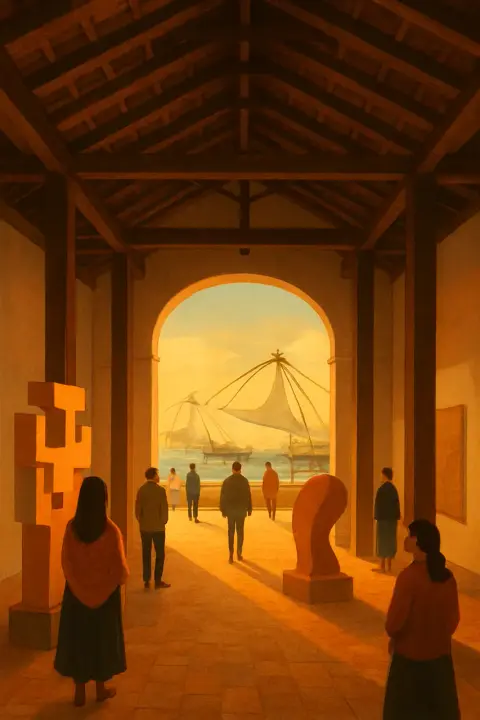
Kochi-Muziris Biennale: contemporary art in Fort Kochi's warehouses
Contemporary art moves into the old spice godowns of Fort Kochi
The Kochi-Muziris Biennale is India's first and largest international exhibition of contemporary art, held every two years in Kochi, Kerala, from mid-December to the end of March. For about 110 days the art moves into the spice warehouses, godowns and old houses of Fort Kochi and Mattancherry and into halls across the city, and most of it is free. The Kochi Biennale Foundation announces each edition's dates on its website.
The Kochi Biennale Foundation sets each edition: the opening day has been made public about a year ahead and the full run about five months ahead.
The legend
Two thousand years ago the port of Muziris stood north of today's Kochi. Pliny the Elder called it the first emporium of India.
Sangam-era Tamil poetry tells of the ships of the Yavanas, Greeks and Romans, arriving with gold and leaving with pepper.

In 1341, it seems, a Periyar flood reshapes the coast: Muziris vanishes from the maps, and Kochi rises as the trading port.

In 2010 two Kerala-born artists, Bose Krishnamachari and Riyas Komu, propose a biennale in Kochi on the lines of Venice's.

Since 12 December 2012 the show, named for Kochi and ancient Muziris, fills the city's galleries, heritage buildings and empty houses every other year.
Meaning
Fort Kochi
Arabs, Chinese, Jews, Portuguese, Dutch and English all settled in Kochi, and in 1664 the Dutch made Fort Kochi the first municipality on the subcontinent.
The carnival
In the last ten days of December, with the biennale already open, Fort Kochi holds the Cochin Carnival.
Customs
A city-wide show
The show is spread across the city: galleries, halls, streets, old buildings. In 2012 Aspinwall House alone showed 44 of the 80 artists.
Artist-curators
Each edition has a new curator, usually an artist: Sudarshan Shetty in 2016, Anita Dube in 2018, Shubigi Rao in 2022, Nikhil Chopra in 2025.
More than a show
Around the show run talks, seminars, screenings, music and workshops, with classes for schoolchildren and students.
Words of the festival
ബിനാലെ
biennale
Italian for "every other year": a large international show of contemporary art
മുസിരിസ്
Muziris
from the Old Tamil for "cleft lip": the Periyar splits in two here
കുരുമുളക്
kurumulaku
black pepper, the cargo Roman ships came to Muziris for
ചീനവല
cheena vala
"Chinese net": the lift nets on Kochi's shore, brought in the 14th century
True or myth
✅ True. Kochi has hosted the country's first art biennale since 2012; the first had 80 artists, nearly half of them from abroad.
❌ Myth. It is still debated: Kodungallur was long favoured, and digs at Pattanam since 2007 have convinced some experts, but not all.
❌ Myth. Entry was free only until 23 December 2012; after that a ticket cost ₹50.
Where to celebrate
Kochi
Worth the trip
For about a hundred days every other winter, Fort Kochi's spice warehouses and colonial godowns are hung with contemporary art from around the world.
What the Biennale is
The Biennale was founded in 2010 by the Kochi Biennale Foundation, an artists' collective: two Kerala-born artists, Bose Krishnamachari and Riyas Komu, proposed a biennale for Kochi on the lines of Venice's. The first edition opened on 12 December 2012 with 80 artists, nearly half of them from abroad. The Foundation describes it as site-responsive and artist-led, a civic project rooted in the everyday life of Fort Kochi and Mattancherry rather than a show in a single museum.
The last edition, the sixth, ran for 110 days across 29 venues in Fort Kochi, Mattancherry, Willingdon Island and Ernakulam, with Aspinwall House in Fort Kochi as the central hub. It brought 66 artist projects from more than 25 countries and drew about 6.6 lakh (660,000) visitors. Around the main exhibition run talks, film programmes, performances, workshops and residencies, the Students' Biennale and art rooms for children. The first edition was curated by the two founders; since then each edition has had a new curator, usually an artist: Jitish Kallat, Sudarshan Shetty, Anita Dube, Shubigi Rao and, for the sixth, Nikhil Chopra with HH Art Spaces.
When the next Biennale opens
The Biennale runs every other winter, from mid-December to the end of March. The seventh edition will be curated by Kader Attia, an artist, curator and professor at HFBK Hamburg, born in France, who took part in the Biennale's second edition; he is beginning his curatorial research, with Kochi as the point of departure. In past editions the opening day was made public about a year ahead and the full run about five months ahead. Check kochimuzirisbiennale.org before you book flights: the opening has moved before, and the edition planned for December 2020 opened only in December 2022.
How to see it
The Biennale is spread over a city, so the question is less what to see than how to pace it.
- Tickets: only a few venues
At the last edition only six of the 29 venues were ticketed, Aspinwall House among them. A day ticket cost about ₹200, about ₹100 for students and people over 60, and children under 10 went free; tickets were sold online on the Biennale website and at Aspinwall House. Durbar Hall Art Centre in Ernakulam was one of the free venues.
- Two to three days
Allow two to three days in Fort Kochi: most visitors need two full days for the main venues. The Foundation also offers guided walk-throughs with trained art mediators, booked through its website.
- When in the run
Any day in January or February is a good time; December and March are quieter. From early or mid December to New Year's Day Fort Kochi also holds the Cochin Carnival, with its finale on 31 December, so the area is busiest at the end of December.
Where to stay and getting around
Fort Kochi is the natural base: the main venues are a walk apart.
- Stay in Fort Kochi
Homestays and heritage hotels in Fort Kochi and Mattancherry put the venues within walking distance or a short ferry ride. Book about a month ahead; more in where to stay in Kochi.
- Cross the water
For the Ernakulam venues take the Water Metro from High Court to Fort Kochi, about 20 minutes for about ₹40, or the old state ferry from Ernakulam, about 20 minutes for about ₹6. The airport is about 40 km from Fort Kochi. More in getting around Kochi.
FAQ
When is the next Kochi-Muziris Biennale?
It runs every two years from mid-December to the end of March. The seventh edition, curated by Kader Attia, is in preparation; the Kochi Biennale Foundation announces the dates on kochimuzirisbiennale.org.
Who founded the Kochi Biennale Foundation?
Artists. The Foundation was set up in 2010 after Bose Krishnamachari and Riyas Komu, both born in Kerala, proposed a biennale in Kochi.
Where does the Biennale happen in India?
In Kochi, Kerala: in Fort Kochi and Mattancherry, with Aspinwall House as the hub, and at venues on Willingdon Island and in Ernakulam.
How much is a Kochi Biennale ticket?
At the last edition a day ticket cost about ₹200, about ₹100 for students and seniors, with children under 10 free. Most venues needed no ticket at all.
Are there exhibitions in Kochi between Biennales?
Yes. Durbar Hall Art Centre in Ernakulam, renovated by the Kochi Biennale Foundation, holds national and international shows all year, most of them free.
Sources (6)
- Kochi-Muziris Biennale (Kochi Biennale Foundation)
- Kochi Biennale draws to close, Kochi Biennale Foundation
- Kader Attia to curate the seventh edition, Kochi Biennale Foundation
- Book a guided tour, Kochi Biennale Foundation
- Kochi-Muziris Biennale
- Tickets from Rs 100 to Rs 200 as Kochi-Muziris Biennale opens, TravelMedia
Facts checked: 21 October 2026. Prices and hours are approximate; check locally.