 India GO
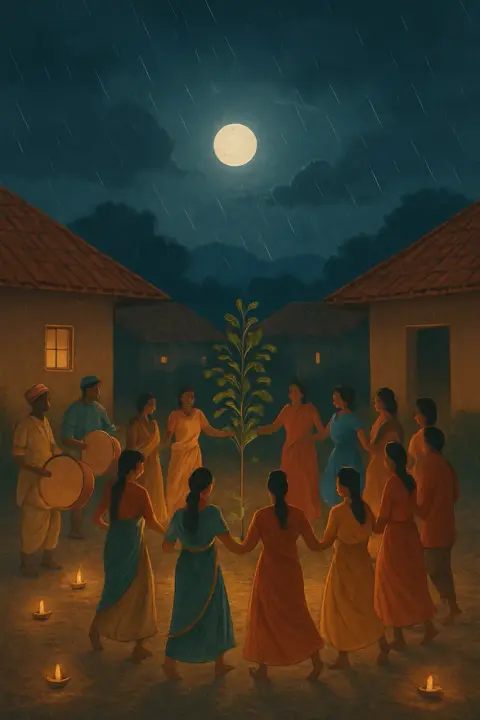
Karam Parab: the night a karam branch becomes a god
A branch of the karam tree becomes a god for one night of dancing
Karam Parab, also called Karma Puja, is a village festival of the monsoon. Every year Adivasi communities of Jharkhand and its neighbours bring a branch of the karam tree in from the forest, plant it in the middle of the village ground and worship it as Karam Devta, the god of strength and youth. Then they sing and dance around it until morning. Dates: 11–12 September 2027 (expected). It falls on Ekadashi, the eleventh lunar day of the bright half of the month of Bhadrapada (Bhado), which lands between late August and late September.
The day follows the lunar calendar; the Jharkhand holiday list, published in November or December of the previous year, carries Karma Puja.
The legend

Legend tells of seven brothers who came home from the fields to find their wives dancing round a karam branch; one of them angrily threw it into the river.

Karam Devta was offended and the family fell on hard times: the crops failed and the house decayed. Since then Karam has been worshipped.
Karam Devta is the god of strength and youth. The festival falls on the Ekadashi of the bright half of Bhado, at summer's end.
Customs
Jawa
For 7–9 days girls tend nine kinds of seed, rice, wheat, maize and more, sown in a basket; later they swap jawa flowers as a sign of friendship.
Karam night
To drumming a karam branch is brought from the forest and planted mid-ground; all night people sing and dance round it, and at dawn it goes into the river.
How the festival runs
Preparations start more than a week before. Girls sow nine kinds of grain (rice, wheat, maize and others) in a basket and tend the seedlings for seven to nine days. These sprouts are the jawa, and later the girls exchange jawa flowers as a sign of friendship.
On the day itself young villagers go to the forest to the sound of drums, worship a karam tree and cut a branch. It is carried back and planted in the middle of the dancing ground, which has been plastered with cow dung and decorated with flowers. The village priest (called pahan or dehuri, depending on the region) makes offerings of the germinated grain and recites the legend of Karam.
After that the night belongs to the dance. People link arms in a long chain and move around the branch, singing Karam songs to the beat of the drum. The Government of Jharkhand calls it one of the rare examples of such a vital youth festival in the state's tribal areas. The next morning the branch is taken up and carried to a river or stream for immersion.
The legend of Karam
Several versions of the story are told; the one most often repeated goes like this. Seven brothers came home from the fields and found their wives dancing around a karam branch instead of bringing them their meal. One of the brothers, angry, threw the branch into the river. Karam Devta took offence, and the family's luck turned: the crops failed and the house fell into ruin. Only when the brothers went in search of the karam tree and worshipped it again did their fortune return, and since then Karam has been worshipped every year.
Another telling replaces the brothers with a merchant: back from a voyage, he found his household busy dancing, uprooted the karam tree in anger, and his ship sank. The meaning is the same in each: the karam tree protects the harvest and the health of the village, and it has to be honoured.
Who keeps it, and where
Karam belongs to many communities across the Chota Nagpur plateau and its edges, among them the Oraon, Munda, Ho and Kurmi (Kudmi), and non-tribal Hindu villagers of the region keep it too. It is celebrated across Jharkhand and in the neighbouring parts of Odisha, Chhattisgarh and West Bengal, and further east in Assam. Places where it is especially well known include Gumla in Jharkhand, Purulia in West Bengal and Sundargarh in Odisha.
Karma Puja is a public holiday in Jharkhand: the state's holiday list, published in November or December of the year before, gives the day, and in some years a second day off follows. Assam lists Karam Puja among its holidays as well.
If you are invited
- It is a village rite, not a staged show. There is no ticketed venue or programme. The way to see Karam is with a local host who invites you, and then you follow their lead on where to stand and when to join the dance.
- Worth it with a host, not a trip in itself. A night of song around the branch stays in the memory, but without an invitation there is little to go to.
- Respect the customs of rural and tribal areas. The UK Foreign Office asks travellers to respect local dress and customs in rural areas and to keep to official guidelines when visiting tribal areas.
- Expect the monsoon. Late August and September are still rainy in Jharkhand, so village roads can be muddy.
FAQ
What is the Karma festival of Jharkhand?
Karam Parab, or Karma Puja, is a monsoon harvest festival of Jharkhand's Adivasi communities. A branch of the karam tree is planted in the village ground, worshipped as Karam Devta, the god of strength and youth, and danced around all night before it is immersed in a river the next morning.
When is Karam Parab?
Next: 11–12 September 2027 (expected). It falls on Ekadashi of the bright half of Bhadrapada, between late August and late September; Jharkhand confirms the day in its holiday list, published late in the previous year.
What is jawa in Karam Puja?
Jawa are the seedlings of nine kinds of grain that girls sow in a basket and tend for seven to nine days before the festival. They are offered during the puja, and the girls exchange jawa flowers as a sign of friendship.
Is Karam Puja celebrated in Assam?
Yes. Assam keeps Karam Puja on its list of state holidays, on the same lunar day as Jharkhand.
Can I attend Karam Parab as a visitor?
Only really as a guest. It is a village rite with no public venue or tickets, so the way to see it is with a local host who invites you; follow their lead during the night.
Sources (6)
Facts checked: 21 October 2026. Prices and hours are approximate; check locally.