 India GO
Bandna and the Sohrai wall paintings of Hazaribagh
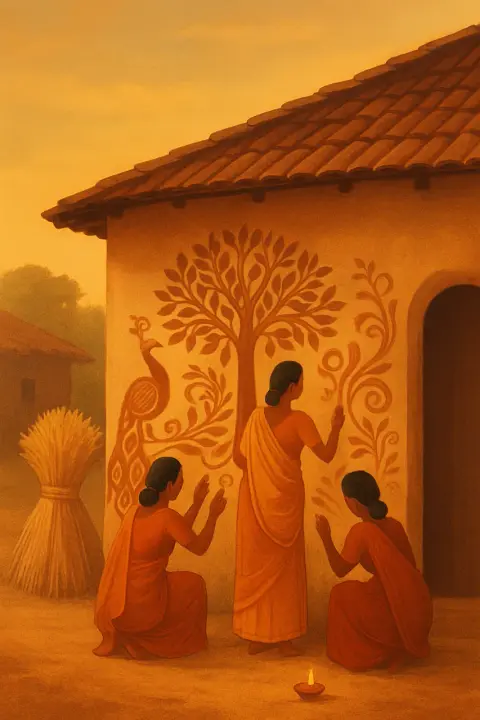
Women repaint the mud walls of their homes in earth colours for the harvest festival
Bandna, also called Sohrai, is the harvest and cattle festival of the villages of Jharkhand, held over five days around the new moon of Diwali. Cattle are bathed, anointed and fed, and in the days before, women repaint the mud walls of their houses with Sohrai murals of animals and plants. Around Hazaribagh these paintings are the reason to come. Dates: 8–12 November 2026.
No single announcement: villages keep their own days around the Diwali new moon; the Jharkhand holiday list carries Diwali and Govardhan Puja.
The legend
Legend says people began to mistreat the cattle Shiva had given them, so the god promised to inspect the cowsheds in secret on the new moon of Kartik.

People washed the cattle, anointed their horns and lit lamps in the sheds. Shiva found the herd content, and so Bandna began.

Sohrai murals share their animal and plant motifs with cave paintings found nearby. In 2020 Sohrai-Khovar received a Geographical Indication tag.
Customs
Painted walls
Women coat the walls with clay and draw animals and flowers into it with fingers and sticks before it dries. The skill passes from mother to daughter.
Cattle day
Cows and bullocks are bathed, their horns and foreheads anointed with oil and vermilion, and they are fed rice and vegetables.
Words of the festival
बांदना
Bandna
A farming festival at which domestic cattle and farm tools are worshipped.
Khovar
Kho is house, var is groom: the painting a bride's mother makes in the couple's room.
A festival for the cattle
Bandna is a farming festival at which domestic cattle and farm tools are honoured after the harvest. It falls around Kartik Amavasya, the new moon of Kartik in October or November, and coincides with Govardhan Puja during Diwali. The main day is the one after the new moon. Cows and bullocks are washed, their horns and foreheads are anointed with oil and vermilion, and they are given a meal of rice and vegetables. In the evening earthen lamps are lit in the houses and in the cattle sheds.
The festival is kept by many communities of the Chota Nagpur plateau, among them the Santal, Munda, Oraon, Ho, Bhumij and Kurmi, and also in neighbouring West Bengal, Odisha, Chhattisgarh and Bihar. Customs differ from village to village: in some, offerings are made to the spirit of the cowshed. In the Santal Parganas of eastern Jharkhand, Sohrai is celebrated in January instead.
There is no single public event. Each village keeps its own days, and the state holiday list names only Diwali and Govardhan Puja.
How the Sohrai murals are made
Before the festival, women of the village clean their houses and repaint the outer walls. The surface is first coated with a mix of soil and cow dung, then with a layer of white clay. While the clay is still partly wet, the design is drawn into it with fingers, sticks or a comb, or painted with cloth swabs and chewed twigs of the sal tree. The skill passes from mother to daughter.
In Sohrai the red lines come first and stand for the blood of the ancestors, then black lines for Shiva, then white lines for food, since this is a harvest art. The motifs are animals, many of them pregnant or with their young: humped cows, buffaloes, hens with chicks, tigers, wild pigs, along with plants and flowers. The same animal and plant forms appear in cave paintings found in the area, and local people believe those paintings were made by their ancestors.
Khovar is the related painting of the marriage season. Kho means house and var groom: a bride's mother paints the room where the couple will live, usually with comb-cut patterns. Sohrai is the winter harvest art; together the two were given a Geographical Indication tag in 2020. Today the same designs are also painted on paper and cloth for sale, but the village murals are painted afresh on the house walls each year.
Visiting the painted villages
The murals are on people's homes, not in a gallery. The best way to see them is with a local guide who knows which villages are painting this season.
- Go in the days before — The murals are freshly painted in the days leading up to the cattle day, so that is the time to see them.
- Ask first — Ask before entering a courtyard or photographing a house, its people or its cattle. FCDO advises respecting local dress code and customs, particularly in rural areas.
- Do not touch the walls — The murals are drawn in clay on the walls of people's homes and are easily damaged.
- Check the area — FCDO lists Jharkhand among the states with Naxalite (Maoist, Left Wing Extremism) activity and advises seeking advice from your travel provider and the local authorities on affected areas before travelling.
Where else and what to pair it with
Hazaribagh district is the heartland of the painting, but Bandna is also kept around Ranchi and in Purulia across the border in West Bengal. In Hazaribagh town, the Sanskriti Museum and Art Gallery, set up in 1992 by the environmental activist Bulu Imam, collects Sohrai and Khovar work; he was the first to show the outside world the link between the murals and the cave paintings.
The festival falls in the same days as Diwali and Govardhan Puja. Two other village festivals of Jharkhand worth knowing are Sarhul and Tusu Parab.
FAQ
When is Bandna?
Next: 8–12 November 2026. It runs five days around Kartik Amavasya, the new moon of Diwali, usually between mid-October and mid-November; the cattle day is the day after the new moon. Villages keep their own days.
What is Sohrai painting?
A wall painting of Hazaribagh district in Jharkhand, made by women on fresh clay before the harvest festival, with animals and plants drawn in red, black and white. It received a Geographical Indication tag in 2020 together with Khovar.
What is the difference between Sohrai and Khovar?
Sohrai is painted for the harvest and cattle festival; Khovar is painted by a bride's mother in the marriage room, usually with comb-cut patterns.
Who celebrates Sohrai?
Many communities of Jharkhand and neighbouring states, among them the Santal, Munda, Oraon, Ho, Bhumij and Kurmi.
Sources (7)
Facts checked: 21 October 2026. Prices and hours are approximate; check locally.