 India GO
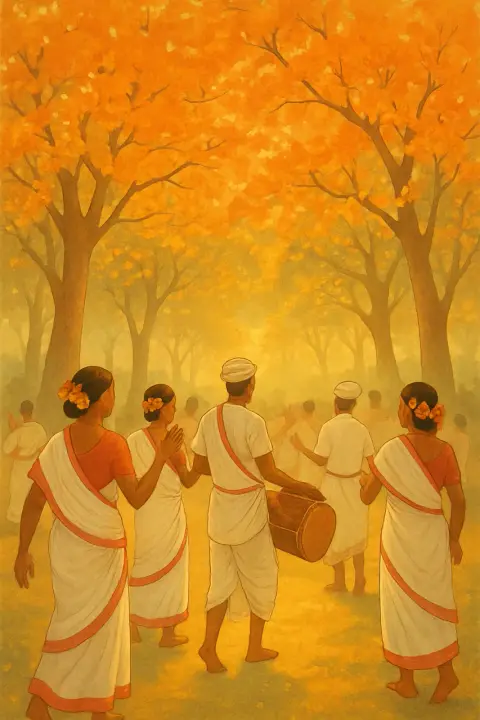
Sarhul: Jharkhand's spring new year of the sal tree
Sal blossom in the hair and a pot of water read for the coming rains
Sarhul is the spring new year of Jharkhand's Adivasi peoples, among them the Oraon, Munda and Ho: worship at the sarna, the village's sacred grove, as the sal trees come into flower. It falls on Tritiya, the third lunar day of the bright half of Chaitra; next dates: 9–10 April 2027 (expected). In the villages it stays a grove rite led by the village priest, the pahan; in Ranchi it becomes a very large afternoon procession of drums and sal blossom.
The Jharkhand holiday list, published in November or December of the previous year, carries Sarhul; the Central Sarna Samiti announces the Ranchi procession route in the week before.
The legend

Sarhul is Jharkhand's spring new year. The name is Nagpuri: sar, the sal tree, and hul, a grove; it celebrates nature through the sal.
Tradition holds that Sarhul is the marriage of the Earth and the Sun. Worship takes place not in a temple but in the sarna, the village's sacred grove.
Each people has its own name for it: the Kurukh call it Khaddi, flower; the Ho and Munda, Baa Parab; the Santals, Baha Parab.
Customs
The water pot
The pahan, the village priest, sets a pot of water in the grove and next morning reads it for the year's rain; no one ploughs that day.
Sal blossom
The pahan hands out sal flowers; people wear them in their hair and dance with them to the dhol, nagara and mandar drums.
The Ranchi procession
Since 1961 Sarhul has brought large processions in Ranchi and Gumla; in Ranchi they converge on the Siram Toli sarna.
Where to celebrate
Ranchi
In Ranchi, Sarhul is an afternoon of drums and sal blossom as processions from across the city converge on Siram Toli; in the villages it stays a grove rite with a priest and pots of water.
What Sarhul means
The name is Nagpuri: sar is the sal tree (Shorea robusta), and hul is read as 'collectively' or 'grove'. Sarhul celebrates nature through the sal, which flowers in spring, and its worship takes place not in a temple but in the sarna, the grove kept by each village. Tradition holds that Sarhul is the marriage of the Earth and the Sun.
Each people has its own name for the festival. The Kurukh-speaking Oraon call it Khaddi, flower; the Munda and Ho, Baa Parab; the Santal, Baha Parab; the Bhumij, Hadi Bonga; the Kharia, Amnuakhia. Besides Jharkhand it is kept in parts of West Bengal, Odisha, Chhattisgarh and Assam. In the Kolhan region of Jharkhand it is known as Baa Porob, the flower festival.
The rite in the sacred grove
The Government of Jharkhand describes the village rite in this order.
- The pahan prepares
The village priest, the pahan, fasts for a couple of days. On the morning of the rite he bathes and puts on a new dhoti of unspun cotton.
- The water pots
The evening before, he fills three new earthen pots with fresh water. Next morning he looks at the water level: if it has dropped, he predicts scarce rain; if it is unchanged, a good monsoon.
- The offering
Before the puja the pahan's wife washes his feet. At the sarna he offers three young roosters of different colours: one to the supreme god, called Singbonga or Dharmesh by the Munda, Ho and Oraon, one to the village deities and one to the ancestors. The villagers stand around the grove while dhol, nagara and turhi players drum.
- Sal flowers for everyone
After the puja the young men carry the pahan home on their shoulders, with girls dancing ahead. He gives sal flowers to his wife and to every villager as a sign of friendship, and tucks them into the roof of each house, a custom called phool khonsi. Handia, rice beer, is shared as prasad.
The Ranchi procession
Since 1961 Sarhul has brought large processions to Ranchi and Gumla; before that, people danced only around the sarna. In Ranchi the morning belongs to the city's groves, such as the Hatma sarna, where the pahan reads the water pots. In the afternoon processions from across the city, with drums, dancers and sal blossom in their hair, meet around Albert Ekka Chowk and Main Road and make their way to the central Siram Toli sarna, where they end. The centre is closed to traffic, and the Central Sarna Samiti announces the route in the week before.
The procession is free to watch from the roadside. Sarhul is also a state holiday in Jharkhand, carried in the state holiday list, and the celebrations continue in the villages of the Chhotanagpur region for weeks after the day itself.
Etiquette and safety
Sarhul is a living rite of the Adivasi faith, not a show. A few rules keep a visit respectful.
- Villages only with a host — A village Sarhul in Khunti, Gumla or Simdega districts is not something to turn up at uninvited. Arrange a local host well before you travel.
- The grove is sacred — Stand back from the sarna during the puja, follow what the villagers do, and ask before photographing the pahan or the offerings.
- Watch, then join if asked — In Ranchi stay at the roadside rather than walking in the procession, unless you are invited to join.
- Official advice — The UK Foreign Office (FCDO) notes that Naxalite (Maoist, or Left Wing Extremism) insurgents target police officers, paramilitary forces and government officials in states including Jharkhand, and advises seeking advice from your travel provider and local authorities on affected areas if you plan to travel there. In large crowds, keep to the edges and follow the police. See also Is India safe?
FAQ
When is Sarhul?
On Tritiya, the third lunar day of the bright half of Chaitra, in March or April when the sal trees flower; next: 9–10 April 2027 (expected).
How do people celebrate Sarhul?
The village priest worships at the sacred grove, reads the year's rain from pots of water and makes offerings to the supreme god, the village deities and the ancestors. Then he hands out sal flowers, and people dance to the dhol, nagara and mandar; in Ranchi, processions fill the city centre in the afternoon.
What is Sarhul?
The spring new year of the Oraon, Munda, Ho and other Adivasi peoples of Jharkhand and neighbouring states: worship of the sal tree and of nature at the village's sacred grove.
Is Sarhul a holiday in Jharkhand?
Yes. Sarhul is in the Jharkhand state holiday list, published in November or December of the previous year.
Which tribal festivals are celebrated in Jharkhand?
Among the major Adivasi festivals of the state are Sarhul in spring and Karam Parab (Karma Puja).
Facts checked: 21 October 2026. Prices and hours are approximate; check locally.