Jejuri Bhandara: Khandoba's hill in a cloud of turmeric
The day a hilltop temple vanishes into a golden cloud of turmeric
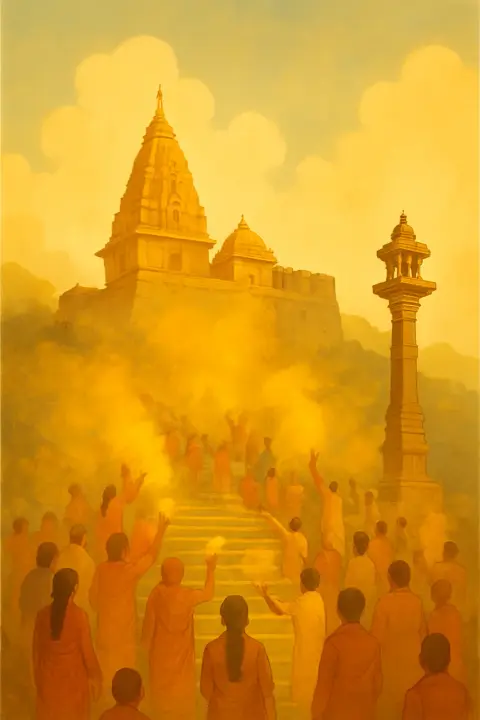
Jejuri Bhandara is the turmeric festival of Khandoba, the warrior form of Shiva worshipped across Maharashtra, at his fort-like temple on a hill in Jejuri, about 50 km from Pune. Pilgrims climb the stone steps throwing bhandara, turmeric powder, until stone, steps and people turn yellow: the town is called Sonyachi Jejuri, golden Jejuri. Turmeric flies on several days a year, the biggest being Champa Shashthi and each Somvati Amavasya. Next yatra day: 9 November 2026 (expected).
Countdown9 November 2026
When9 November 2026
The Shri Martand Devsansthan in Jejuri publishes the yatra calendar for the year, including each Somvati Amavasya.
The legend
👹
In the Malhari Mahatmya, the demon brothers Malla and Mani won invincibility from Brahma and began to torment the sages.
Shiva took the form of Martanda Bhairava, a warrior shining like gold and the sun and covered in turmeric.
🐎
The battle raged for six days, and on the sixth, Champa Shashthi, Khandoba slew the demons. Dying, Mani gave him his white horse.
Ever since, Khandoba has ruled from his fort at Jejuri, handing out gold. So the town is called golden Jejuri and showered with turmeric until all is yellow.
Meaning
Karnataka
Here the same god is Mailara. Marathi tradition says Khandoba came to Jejuri from Pember near Bidar.
Pali
At Pali the wedding of Khandoba and Mhalsa, a rich merchant's daughter, is held every year on the full moon of Pausha.
Muslims
Some Muslims revere Khandoba as Mallu Khan, and in Jejuri a Muslim family traditionally keeps the god's horses.
Customs
Bhandara
Every Somvati Amavasya pilgrims bring tonnes of turmeric, smearing each other and flinging it into the air amid song and dance.
Climb to the fort
About 450 steps, 18 arches and 350 stone lamp towers, deepmalas, lead up to the fort-like temple.
Palanquin to the Karha
On Somvati Amavasya the images of Khandoba and Mhalsa are carried in a palanquin from the hill temple to the Karha river and bathed there.
Tali bharne
A plate is filled with turmeric, coconut and bel leaves, lifted over the head three times, then the coconut is showered around.
Songs of the Vaghyas
The Vaghyas, Khandoba's bards, call themselves his dogs and sing his deeds through the night.
What people eat
Bharit with bhakri
roasted aubergine and flatbread, Khandoba's Champa Shashthi offering
Words of the festival
भंडारा
bhandara
turmeric offered to Khandoba and thrown into the air
सोन्याची जेजुरी
Sonyachi Jejuri
"golden Jejuri", the name of the town turned yellow by turmeric
दीपमाळ
deepmala
a stone tower for oil lamps in front of the temple
जय मल्हार
Jai Malhar
from the cry "Yelkot yelkot Jai Malhar": glory to Malhar, the foe of the demon Malla
सोमवती अमावस्या
Somvati Amavasya
a new moon falling on a Monday, the day of the great yatra at Jejuri
True or myth
Turmeric flies at Jejuri only once a year.
❌ Myth. Besides the six-day festival ending on Champa Shashthi, a yatra falls on every Somvati Amavasya, a Monday new moon, and there are several a year.
Khandoba's temple holds a bell from a Portuguese church.
✅ True. After the Battle of Vasai in 1739 the Maratha general Chimaji Appa took church bells and gave them to temples; one went to Jejuri.
Khandoba is shown with a dog.
✅ True. In legend a faithful dog helped him defeat the demons, so on Champa Shashthi part of the offering is given to dogs.
Where to celebrate
Jejuri
Khandoba's hill temple on its great yatra days: pilgrims climb the stone steps from dawn, turmeric is thrown by the sackful until everything is yellow, and the palanquin goes down to the Karha.
Which days turmeric flies
There is no single Bhandara day. Jejuri has two kinds of great yatra (pilgrimage) days:
Champa Shashthi, the sixth lunar day of the bright half of Margashirsha, which closes a six-day Khandoba festival, usually between mid-November and mid-December.
Somvati Amavasya, a new moon that falls on a Monday. It comes one to three times a year, and each one is a yatra day with turmeric and the palanquin procession to the river.
The Ministry of Tourism's festival portal counts close to six lakh (600,000) visitors at the Bhandara festival. The temple trust, Shri Martand Dev Sansthan, publishes the yatra calendar for the year, including each Somvati Amavasya, so check it before you fix a date. The list of upcoming days is in the dates block on this page.
What happens on a yatra day
From dawn pilgrims climb the long stone stairway to the temple, passing under arches and between deepmalas, stone towers for oil lamps. Turmeric is bought at the foot of the steps and thrown on the way up and in the courtyard, by the handful and by the sackful, to the cry "Yelkot yelkot Jai Malhar". By mid-morning the steps are crowded. The temple itself is built like a fort with walled compounds, and locals call it kot, fort.
Families perform tali bharne: a plate filled with turmeric, coconut and bel leaves is lifted over the head three times, then the coconut is showered around. The Vaghyas, Khandoba's bards, who call themselves his dogs, sing his deeds.
On Somvati Amavasya the images of Khandoba and his consort Mhalsa leave the temple in a palanquin in the afternoon and are carried about 7 km through the town and nearby villages to the Karha river, where they are bathed near Rambhai Visava, then brought back in the evening. The riverbank and the route are free to stand on. Higher up the hill is Kadepathar, the older shrine, also crowded on the big days.
Khandoba and the story of the turmeric
The legend is told in the Malhari Mahatmya. The demon brothers Malla and Mani won invincibility from Brahma and began to torment the sages. Shiva took the form of Martanda Bhairava, a warrior shining like gold and the sun and covered in turmeric, and fought them for six days; on the sixth, Champa Shashthi, he slew them. Ever since, the story goes, Khandoba has ruled from his fort at Jejuri, handing out gold, and the yellow powder thrown on his hill recalls that golden form.
Khandoba, also called Malhari Martand, Mhalsakant or Mylaralinga, is the family deity of many Maharashtrian households, from warrior and priestly families to farmers and herders, including the Dhangar shepherd communities. In Karnataka the same god is worshipped as Mailara, and Marathi tradition says Khandoba came to Jejuri from Pember near Bidar. Some Muslims revere him as Mallu Khan, and in Jejuri a Muslim family traditionally keeps the god's horses. The temple also holds a bell from a Portuguese church at Vasai, given by the Maratha general Chimaji Appa after the battle of 1739.
Getting there from Pune
Jejuri is in Purandar taluka of Pune district, and the practical plan is a day trip from Pune: Jejuri has little accommodation, while Pune has rooms at every price, and a week's notice is usually enough even for a yatra day. By road it is about 50 km, roughly two hours on the MSRTC state buses from Swargate via Saswad. Local trains on the Pune–Miraj line also stop at Jejuri station.
On a yatra day, start early: the aim is to be at the steps around dawn, before the crowd thickens by mid-morning. More about the temple itself is on the Jejuri Khandoba Temple page.
Before you climb
Shoes off at the bottom — Footwear comes off at the foot of the steps, not at the temple door.
Everything turns yellow — Clothes, skin and cameras all collect turmeric. Wear clothes you do not mind staining and bring a cover for the camera or phone.
Entry is free — The steps and the temple courtyard cost nothing; only the bhandara you throw costs a little.
Another pilgrimage nearby — The other great pilgrimage of the Pune region is the Pandharpur Wari, the walk to Vitthal's temple at Pandharpur.
FAQ
What is Jejuri famous for?
For the hill temple of Khandoba, the family deity of many Maharashtrian households, and for the Bhandara: turmeric thrown by pilgrims until the hill turns yellow, which is why the town is called golden Jejuri.
When is the Jejuri Bhandara?
On several days a year: the six-day festival ending on Champa Shashthi (usually mid-November to mid-December) and every Somvati Amavasya, a Monday new moon. Next yatra day: 9 November 2026 (expected).
How many steps are there at Jejurigad?
Counts differ between sources: the most common figure is about 200 steps to the main temple, and the older Kadepathar shrine is several hundred steps higher.
Where is Jejuri located in Maharashtra?
In Purandar taluka of Pune district, about 50 km from Pune, on the road via Saswad; it also has a railway station on the Pune–Miraj line.
Is there an entry fee at Jejuri temple?
No. Entry to the steps and the temple courtyard is free; turmeric is sold cheaply at the foot of the steps.
 India GO