 India GO
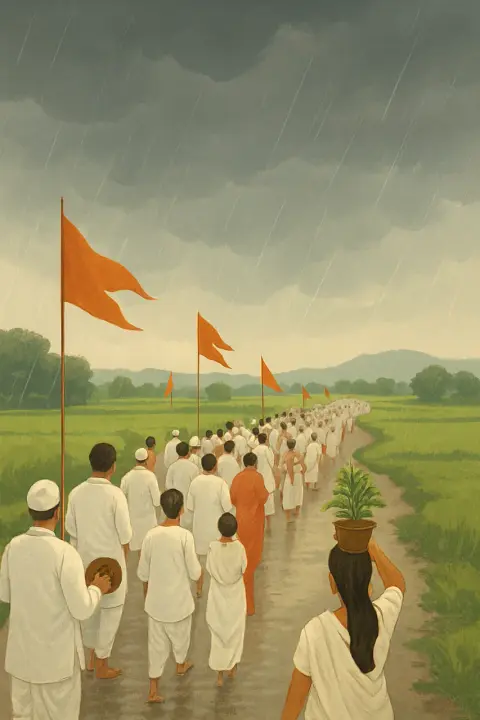
Pandharpur Wari: the walk to Vithoba
A river of saffron flags that sings its way through the monsoon rain
The Pandharpur Wari is the annual walk of the varkaris, devotees of Vithoba (Vitthala), to his temple at Pandharpur in Maharashtra. The palanquins (palkhis) carrying the sandals of the poet-saints Dnyaneshwar and Tukaram leave Alandi and Dehu near Pune and cover about 250 km in roughly three weeks, reaching Pandharpur for Ashadhi Ekadashi. Next Wari: 26 June – 14 July 2027 (expected), with Ashadhi Ekadashi on 14 July 2027 (expected). Around a million people take part, on the road or in Pandharpur, and anyone may join for a day.
The palkhi trusts of Sant Tukaram and Sant Dnyaneshwar publish the day-by-day route in May.
The legend
Legend says Pundalik served his aged parents so devotedly that he did not stop even when Krishna himself came to his door.
He threw his guest a brick to wait on, and Krishna stood on the brick and waited.

His service done, Pundalik asked the god to stay like this forever, with Rukmini, and bless his devotees.

So Vithoba at Pandharpur stands on a brick, hands on hips, and Varkaris read the name Vitthala as "the one standing on a brick".
To him the Varkaris walk: each year, for Ashadhi Ekadashi, the palanquins with the sandals of Dnyaneshwar and Tukaram go from Alandi and Dehu to Pandharpur.
Meaning
Poet-saints
The Varkari poet-saints included Namdev the tailor, his maid Janabai, Sena the barber, Gora the potter, Chokhamela the Mahar and even the Muslim Sheikh Muhammad.
Hampi
In Karnataka the Haridasa poets sang of Vitthala, and his temple at Hampi, a World Heritage Site, is the most important outside Maharashtra.
Goa
In Margao, Goa, a Dindi festival for Vithoba has been held every November since 1909, at the Vitthal Rakhumai and Damodar temples.
Customs
Three calls
Each morning, after the saint's sandals are worshipped, the palkhi sets off at six. A tutari horn sounds three times: get ready, line up, walk.
A bow
Varkaris bow to one another because "everyone has God's soul in them", and prize forgiveness, simplicity and humility.
Tulsi beads
Varkaris wear a necklace of tulsi beads, a reminder not to forget God amid daily duties.
The run at Velapur
At Velapur the pilgrims run: it is believed that from here Tukaram glimpsed the spire of Vitthala's temple and ran all the way to Pandharpur.
River first
On reaching Pandharpur, pilgrims first bathe in the river and only then go to Vithoba's temple.
What people eat
Sabudana khichdi
sago with peanuts and potato, a food for the ekadashi fast
Words of the festival
वारी
vari
the regular journey to Pandharpur on ekadashi and other holy days
वारकरी
varkari
"one who performs the vari"
पालखी
palkhi
the palanquin with a saint's sandals, carried on a chariot along the way
दिंडी
dindi
a band of Varkaris from one village or community, with its own flags and drummer
अभंग
abhang
"unbroken": a Marathi hymn to Vithoba, sung on the road
चंद्रभागा
Chandrabhaga
the Bhima's name at Pandharpur, where the river bends like a crescent moon
How to greet
पुंडलिक वरदा हरी विठ्ठल
Pundalik varada Hari Vitthal!
The Varkari call, "O Hari Vitthala, who gave a boon to Pundalik", said at the start of any undertaking.
True or myth
✅ True. In 1685 his youngest son, Narayan Maharaj, turned the vari into a procession carrying the saints' sandals in a palkhi.
❌ Myth. After Pune they part: Dnyaneshwar's goes via Saswad and Phaltan, Tukaram's via Baramati and Indapur, and they meet only at Wakhari near Pandharpur.
✅ True. At dawn the Chief Minister of Maharashtra and his wife perform the mahapuja of Vitthala and Rukmini.
Where to celebrate
Pandharpur
Worth the trip
The walk ends here: the palkhis of Dnyaneshwar and Tukaram arrive the day before Ashadhi Ekadashi, and the town fills with varkaris who bathe in the Chandrabhaga and queue for Vithoba.
The route, stage by stage
The day-by-day timetable, with every halt, lunch stop and night stay, is published by the palkhi trusts of Sant Tukaram and Sant Dnyaneshwar in May and is strictly followed. The shape of the route stays the same each year.
- Dehu and Alandi: the departures
Tukaram's palkhi leaves Dehu, about 30 km north-west of Pune, a day or two before Dnyaneshwar's leaves the samadhi temple at Alandi, about 25 km north of the city, both on the Indrayani river.
- Pune: two nights together
The two palkhis meet at Wakdewadi and enter Pune together about sixteen days before Ekadashi, rest in the city a full day (Dnyaneshwar's at the Palkhi Vitthal temple in Bhavani Peth, Tukaram's at the Nivdunga Vitthal temple in Nana Peth) and leave before dawn on the third day. Streets around both halts close to vehicles. More in Pune festivals.
- Two roads south
After Pune they part. Dnyaneshwar's palkhi climbs Dive Ghat towards Saswad and goes on via Phaltan; Tukaram's goes via Baramati and Indapur. Many other palkhis and dindis join along the way.
- Ringans: the great circles
In the last ten days the columns stop in open fields for ringan, when the pilgrims form vast circles in the field. The ringan grounds are listed on each year's palkhi timetable.
- Wakhari and Pandharpur
The two palkhis meet again at the Wakhari ground just outside Pandharpur two days before Ekadashi and walk into the town the next day. On Ekadashi the varkaris bathe in the Chandrabhaga, as the Bhima is called here, and queue for Vithoba.
Walking with the varkaris
The Wari has no tickets and no central authority: it is organised by the dindis, bands of varkaris from one village, community or temple, each with its own flags and drummer, numbered and given a fixed place in the procession. Their managers go ahead to arrange food and shelter, and the dindi feeds and houses its members. Anyone may walk alongside for a day or for the whole road.
For a first time, the Pune legs are the easiest: join the column on the road out of the city on the morning of departure, or walk part of the climb towards Saswad, and return to Pune by road. Each day starts early: after the saint's sandals are worshipped, the palkhi sets off at about six, when a tutari horn sounds three times. Walking the whole way means joining a dindi; dindis have long required vaccination against cholera and typhoid, so ask the one you join well in advance.
The varkaris sing abhangs, Marathi hymns to Vithoba, as they walk, wear tulsi-bead necklaces and greet one another with a bow. Walk with the column rather than against it, keep to the side when it halts, and follow what the people around you do.
In Pandharpur on Ekadashi
Pandharpur is where the Wari ends and where the crowd is densest: in recent years the authorities have prepared for 20 to 25 lakh pilgrims.
- Darshan — Over the yatra the Vitthal Rukmini temple stays open round the clock and VIP and online darshan are suspended. The queue for padsparsh darshan, touching the feet of the image, runs through covered pavilions along Gopalpur Road and can take about six hours; mukh darshan, seeing the face of the image, is a separate, shorter line.
- Free to watch — The palkhis walking in from Wakhari on the day before Ekadashi, the ghats of the Chandrabhaga at dawn on Ekadashi, and the pradakshina, the circuit of the town with the saints' palanquins.
- Rooms and trains — Book a room in Pandharpur or Solapur about three months ahead; lodges fill first and prices climb steeply. Take trains when the 60-day booking window opens: Central Railway runs extra Wari specials, and the state bus corporation MSRTC adds thousands of buses from across Maharashtra.
Monsoon and crowds
The Wari walks through the south-west monsoon, so expect rain, mud and heat between showers; carry rain gear, water and comfortable broken-in footwear, see monsoon travel. The UK Foreign Office notes that stampedes have happened at large religious gatherings in India and advises following the instructions of local authorities. In Pandharpur on Ekadashi, agree a meeting point and keep valuables in a front pocket.
FAQ
When is Pandharpur Wari?
Next: 26 June – 14 July 2027 (expected). The palkhis leave Dehu and Alandi about eighteen days before Ashadhi Ekadashi and reach Pandharpur on that day, 14 July 2027 (expected). The exact day-by-day route is published in May.
How many days is Pandharpur Wari?
About three weeks on the road from Dehu and Alandi to Pandharpur, a walk of about 250 km.
What is the story behind Pandharpur Wari?
Legend tells that Krishna came to the devotee Pundalik, who threw him a brick to stand on while he finished serving his parents; Vithoba still stands on that brick at Pandharpur. The custom of carrying a saint's sandals in a palkhi was begun by Tukaram's son Narayan Maharaj in 1685.
Can foreigners or non-Hindus join the Wari?
The Wari is open: anyone may walk alongside the palkhis for a day or longer. To walk the whole route with food and shelter, you join a dindi, a group of varkaris.
Where do the palkhis stop in Pune?
Dnyaneshwar's palkhi halts at the Palkhi Vitthal temple in Bhavani Peth and Tukaram's at the Nivdunga Vitthal temple in Nana Peth, for two nights and a rest day.
Do the two palkhis walk together?
Only from Pune's outskirts into the city. After Pune they take different roads and meet again at Wakhari near Pandharpur.
Sources (6)
- Pandharpur Vari (Wikipedia)
- Ashadhi Wari: official schedule of the Sant Dnyaneshwar Maharaj palkhi, Pune Pulse
- Pandharpur temple announces 24-hour darshan schedule, Lokmat Times
- Central Railway special trains for the Wari, Lokmat Times
- Pune traffic restrictions for the palkhis, The Bridge Chronicle
- FCDO travel advice: India, safety and security
Facts checked: 21 October 2026. Prices and hours are approximate; check locally.