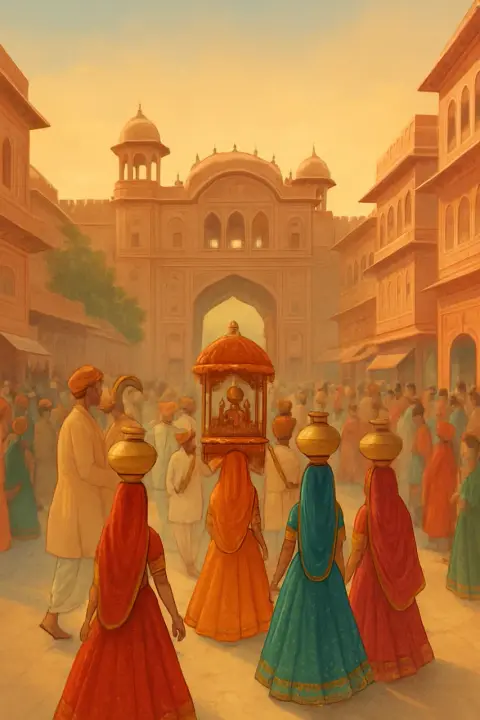
Gangaur: eighteen days for Gauri and Shiva, ending in a procession
Gauri's farewell: a palanquin carried through the pink bazaars at dusk
Gangaur is Rajasthan’s festival of Gauri, that is Parvati, and her husband Shiva, called Isar here: gan, a word linked with Shiva, and Gauri, a name of Parvati. Women worship clay images of the couple at home from the day after Holi, unmarried girls for a good husband and married women for their husbands’ long life, and the worship ends on Tritiya, the third lunar day of the bright half of Chaitra, in late March or April, with processions to the water. In Jaipur the processions leave the City Palace on 9–10 April 2027.
Countdown9–10 April 2027
When9–10 April 2027
Rajasthan Tourism publishes the dates years ahead (its current list runs to 2030) and can revise them; check its calendar a few months before.
The legend
Legend says that the day after Holi, Gauri, who is Parvati, comes home to stay with her parents.
In another tale Shiva and Parvati travel the earth, and a village's poor women greet them with water, fruit and flowers. Parvati grants them lasting marriages.
For eighteen days the women sing to their guest: girls ask for a good husband, wives for a long life for theirs.
👑
Then Isar, who is Shiva, comes to fetch her, and on the third lunar day of Chaitra she is seen off to her husband's home.
So in Jaipur the goddess is carried out of the City Palace in a palanquin and through the old bazaars: the city sees Gauri off as it would a bride.
Meaning
Udaipur
The procession leaves the City Palace, and the images of Isar and Gauri are immersed in Lake Pichola at Gangaur Ghat, named after the festival.
Maharashtra
Here and in northern Karnataka the same day is kept as a variant of the festival, Chaitra Gauri Vrat.
Customs
Clay images
Images of Shiva and Parvati are shaped from clay; some families have wooden ones repainted each year by painters called matherans.
Mehndi
Hands and feet are painted with henna: sun, moon and stars, flowers or simple geometric patterns.
Pots of light
From the seventh evening after Holi, girls carry pierced clay pots with a lamp inside on their heads, singing and collecting sweets and small gifts.
Dressing the gods
In the last three days the images of Isar and Gauri are dressed in new clothes made for the festival, until they look alive.
Farewell at the water
On the final day the images are carried to a tank, a well or a lake and immersed.
What people eat
Ghevar
a honeycomb disc of ghee batter in syrup, shared with family
Words of the festival
गणगौर
Gangaur
gan for Shiva, gaur for Gauri, that is Parvati: a festival of the divine couple
ईसर
Isar
the Rajasthani name for Shiva, Gauri's husband
पीहर
pihar
a married woman's parental home, where Gauri comes for the festival
मेहँदी
mehndi
henna patterns on hands and feet
ghudlia
a clay pot pierced with holes, with a lamp lit inside
True or myth
Gangaur is celebrated only in Rajasthan.
❌ Myth. It is also kept in Madhya Pradesh, Haryana, Gujarat and Bengal, and in Maharashtra the same day is Chaitra Gauri Vrat.
On Gangaur, Gauri's image is carried without a canopy; on Teej, under one.
✅ True. That is how the goddess's two festivals are told apart in procession.
Gangaur is a one-evening festival.
❌ Myth. The procession is only the finale: home worship starts the day after Holi and lasts eighteen days.
At Gangaur, Gauri leaves Jaipur's City Palace in a silver palanquin in the early evening and is carried through the old bazaars to Talkatora, with some two hundred folk performers around her.
Gangaur is mostly a home festival. Rajasthan Tourism counts the worship from the first day of Chaitra, the day after Holi, to its culmination on the 18th day. Images of Isar and Gauri are shaped from clay, or old wooden ones are repainted by painters called matherans. Women sing to the goddess every day; from the seventh evening after Holi girls go round with ghudlias, clay pots pierced with holes with a lamp inside, collecting sweets and small gifts. On the eve of the festival women paint their hands with mehndi, and in the last three days the images are dressed in new clothes made for the occasion.
At the end the images are carried to a garden, step-well, tank or lake to songs about Gauri leaving for her husband’s home, and on the last day they are immersed. These processions are the festival’s public face. The rest is kept indoors among women, and a visitor sees it only if invited into a home.
The story behind Gangaur
Legend says that the day after Holi Gauri comes home to stay with her parents, in her pihar, and that Isar comes to fetch her at the end; the last day is her farewell, which is why the processions are sung as a bride’s departure. The vrata katha, the festival’s own story, tells another tale. Shiva and Parvati travel the earth, and the poor women of a village honour them with whatever water, fruit and flowers they have; Parvati blesses them with lasting marriages. She then worships Shiva in a lingam she shapes from sand, and Shiva promises the same blessing to every married woman who worships the couple on the third lunar day of Chaitra. More about the goddess: Parvati.
Where to see Gangaur
Gangaur is kept all over Rajasthan in some form; these are the places where its public side is easiest to see.
Jaipur
Gauri leaves the Zanani Deodhi of the City Palace in a palanquin and is carried through Tripolia Bazaar, Chhoti Chaupar and Gangauri Bazaar to Talkatora, on two evenings. Details: Gangaur in Jaipur.
Udaipur
Processions from the City Palace end at Gangaur Ghat on Lake Pichola, named after the festival, where the images are immersed. The Mewar Festival is held at the same time: 9–11 April 2027.
Elsewhere in Rajasthan
Bikaner, Jodhpur and Nathdwara have their own processions, and Jodhpur also keeps a related festival, Dhinga Gavar.
Beyond Rajasthan
Gangaur is also kept in Haryana, in Malwa and Nimar in Madhya Pradesh, and in parts of Gujarat and West Bengal. In Maharashtra and northern Karnataka the same day is Chaitra Gauri Vrat, in Telangana and Andhra Pradesh Saubhagya Gauri Vratam.
Gangaur and Teej
Both are festivals of Gauri kept by women, and both end in processions out of Jaipur’s City Palace. Gangaur comes in spring, in Chaitra, the first month of the Hindu calendar; Teej comes in the monsoon (4–5 August 2027). In procession you can tell them apart by the image: on Gangaur Gauri is carried without a canopy, on Teej under one.
If you go
Practical points for planning around the festival.
Dates — Rajasthan Tourism publishes Gangaur dates years ahead and can revise them; check its calendar a few months before you travel.
Booking — For Jaipur, book a room about 45 days ahead, earlier for one on the procession route; trains and flights need about a month.
Ghevar — In Jaipur the sweet of Gangaur is ghevar, a honeycomb disc of ghee batter in syrup, bought to eat and to share with relatives.
Heat — Jaipur averages highs of about 32°C in March and 38°C in April. The processions set out in the late afternoon or early evening; carry water.
FAQ
In which month is Gangaur celebrated?
In Chaitra (March–April). Worship starts the day after Holi and ends on the third lunar day of the bright half of Chaitra; Jaipur’s processions: 9–10 April 2027.
How many days is Gangaur?
Rajasthan Tourism counts 18 days of worship ending in the festival; Wikipedia gives 16 days, with the full 18 binding for a woman in the first year of her marriage. The public processions take two evenings.
What is the special dessert of Gangaur?
Ghevar, a honeycomb disc of ghee batter soaked in syrup; in Jaipur people buy it for Gangaur and share it with family.
What is the difference between Gangaur and Teej?
Both honour Gauri, but Gangaur falls in spring (Chaitra) and Teej in the monsoon. In procession, Gauri is carried without a canopy on Gangaur and under one on Teej.
What is the story behind Gangaur?
In legend Gauri comes to her parents’ home after Holi and leaves with Shiva at the end, so the last day is her farewell. The vrata katha tells how Parvati blessed village women with lasting marriages.
 India GO