 India GO
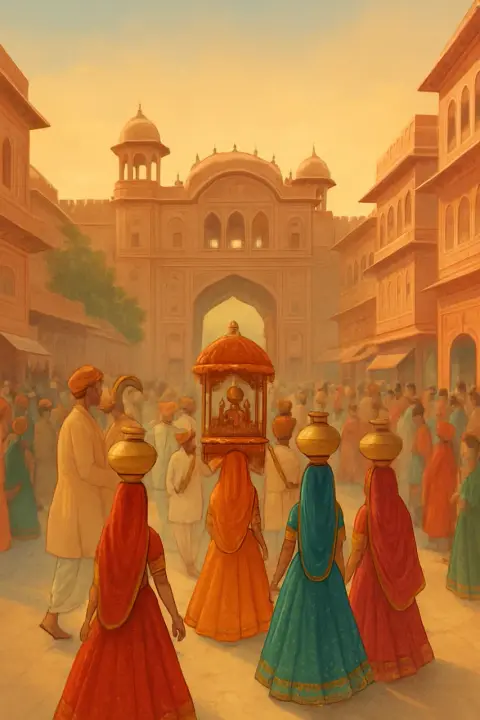
Gangaur in Jaipur: Gauri’s palanquin through the pink bazaars
Gauri's farewell: a palanquin carried through the pink bazaars at dusk
In Jaipur, Gangaur ends with two evening processions. On the first, the image of Gauri leaves the Zanani Deodhi of the City Palace in a silver palanquin, passes out through Tripolia Gate and is carried through Tripolia Bazaar, Chhoti Chaupar and Gangauri Bazaar to Talkatora, with some two hundred folk performers around her. On the second evening, Budhi Gangaur, the procession goes out again. Dates: 9–10 April 2027. Watching from the street is free.
At Gangaur, Gauri leaves Jaipur's City Palace in a silver palanquin in the early evening and is carried through the old bazaars to Talkatora, with some two hundred folk performers around her.
Where to watch
Zanani Deodhi, City Palace: the former royal family worships the goddess here before she sets out; the procession leaves through Tripolia Gate at about 17:45 (2026).
Tripolia Bazaar and Chhoti Chaupar: the first and narrowest stretch, best seen from a balcony or rooftop.
Gangauri Bazaar and Chaugan Stadium: more room to stand; the procession pauses at the stadium.
Talkatora: the tank near the palace where the procession ends.
For foreign nationals: the tourism department sets up seating on a hotel terrace opposite Tripolia Gate (2025).
Free viewing
- Tripolia Bazaar, Chhoti Chaupar and Gangauri Bazaar from about 17:30; come early for a place at the barriers
- Chaugan Stadium, where the procession pauses and there is room to stand
- The second evening, Budhi Gangaur, when the procession goes out again from Tripolia Gate
- Keep out of the line of the palanquin, and cover your shoulders if you follow it into a temple courtyard
Programme
Day 1
The procession leaves the Zanani-Deodhi of the City Palace in the late afternoon (old palanquins, bullock carts and chariots, with folk troupes ahead of it) and goes down Tripolia Bazaar to Chhoti Chaupar, Gangauri Bazaar and Chaugan stadium.
 Jaipur old city
Day 2
The procession repeats on a shorter route and the clay images of Isar and Gauri are taken to water and immersed
Jaipur old city and Talkatora
How the evening runs
The day starts inside the palace. The former royal family worships the goddess at the Zanani Deodhi, the women’s quarters of the City Palace, before she sets out, and the procession then leaves through Tripolia Gate in the late afternoon or early evening, at an hour fixed each year. At its head come elephants, horses and camels, old palanquins, chariots, bullock carts and folk artists; the tourism department stages the festival with the palace. Then comes Gauri herself, carried without a canopy, the sign that tells Gangaur from Teej.
The first stretch, Tripolia Bazaar and Chhoti Chaupar, is the narrowest and is best seen from a balcony or rooftop. Gangauri Bazaar and the Chaugan stadium, where the procession pauses, give more room to stand. It ends at Talkatora, the tank near the palace. The second evening, Budhi Gangaur, follows the same start through Tripolia Gate.
The procession is only the end of the festival. Women have worshipped clay images of Gauri and Isar at home for about eighteen days before it; see Gangaur for what happens in homes and in other towns.
Planning the procession evening
One night is enough for the procession; three let you arrange a viewing place and see the old city, and a fourth covers Budhi Gangaur.
- About 45 days ahead: a room on the route
Rooms and rooftops on Tripolia Bazaar and near Chhoti Chaupar go first, and hotels there sell terrace places for the procession. Trains and flights to Jaipur need about a month. See where to stay in Jaipur.
- Two days before: arrive
If you want a balcony or rooftop seat, arrive two days early: these places are arranged through hotels and fill fast. The tourism department has also set up seating for foreign nationals on a hotel terrace opposite Tripolia Gate; ask the tourist office whether it is offered.
- During the day: ghevar
Ghevar, a honeycomb disc of ghee batter in syrup, is the sweet of Gangaur in Jaipur, bought to eat and to share with relatives. See ghevar.
- Before the start: your place
The starting hour is fixed each year and reported in the local press a day or two before. Be at the barriers on Tripolia Bazaar, Chhoti Chaupar or Gangauri Bazaar well ahead of it, or head for the Chaugan stadium, where there is room to stand.
- The next evening: Budhi Gangaur
The procession goes out again from Tripolia Gate; a second chance if the first evening was too crowded.
Etiquette and safety
The procession is a religious rite as well as a show. See also is India safe.
- Give the goddess room — Keep out of the line of the palanquin, and cover your shoulders if you follow it into a temple courtyard. More: temple dress code in Jaipur.
- Crowds — The FCDO notes that stampedes have occurred at large parades and religious gatherings. In the narrow first stretch stand where you can step back, follow police directions and agree a meeting point.
- Pockets — The FCDO advises taking care of possessions in crowds; keep phone and cash in a front pocket.
- Heat — Jaipur averages highs of about 32°C in March and 38°C in April. The procession is in the early evening, but carry water while you wait.
FAQ
When is Gangaur in Jaipur?
On the third lunar day of the bright half of Chaitra and the evening after, in late March or April: 9–10 April 2027.
Where does the Gangaur procession start and end in Jaipur?
It starts at the Zanani Deodhi of the City Palace, leaves through Tripolia Gate and passes Tripolia Bazaar, Chhoti Chaupar, Gangauri Bazaar and the Chaugan stadium before ending at Talkatora.
What time does the Gangaur procession start?
In the late afternoon or early evening; the exact hour is fixed each year and reported in the local press shortly before. Take your place on the route well ahead of it.
What is Gangaur Puja in Rajasthan?
The worship of Gauri (Parvati) and Isar (Shiva) by women for about eighteen days after Holi, for a good husband or a husband’s long life, ending in processions to the water.
Are Teej and Gangaur the same?
No. Both honour Gauri and both have City Palace processions in Jaipur, but Gangaur is in spring and Teej in the monsoon; on Teej the image is carried under a canopy.
Is it free to watch?
Yes, from the street. Rooftop and terrace places on the route are sold by hotels.
Sources (5)
Facts checked: 21 October 2026. Prices and hours are approximate; check locally.