 India GO
Cochin Carnival: Fort Kochi's fortnight to New Year
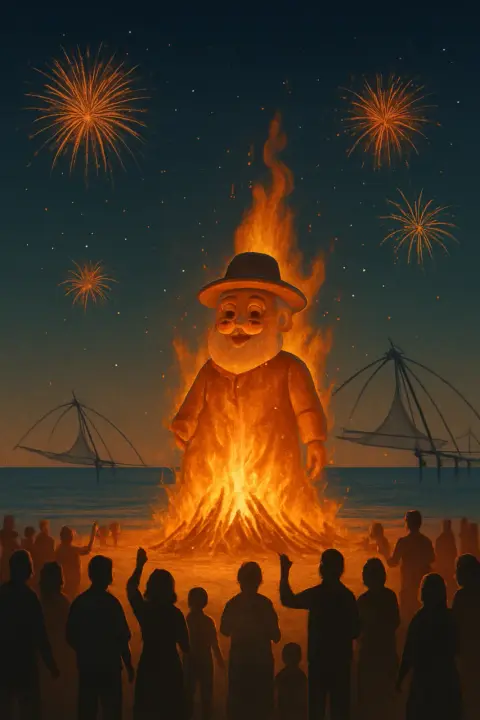
At midnight a giant old man in a suit burns, and the old year with him
The Cochin Carnival is Fort Kochi's New Year festival: about two weeks of street contests, music and shows from early or mid-December, ending at midnight on 31 December, when a giant effigy of an old man, the Pappanji, is burnt as the old year. A carnival rally through the quarter on New Year's Day closes it. The finale: 31 December 2026 – 1 January 2027 (expected). Everything on the street is free; the hard part is a room.
The Cochin Carnival committee and DTPC Ernakulam publish the programme in early December, one to three weeks before the opening.
The legend
In 1984 three young people from Kochi planned a beach festival in Fort Kochi to mark the UN naming 1985 International Youth Year.
Some 150 youth clubs backed them. In the second week of December they began with a cycle race, then kabaddi, tug of war, kalari and floor drawings.
The neighbourhood already had a custom of its own: at New Year's midnight it burned the Pappanji, an effigy of an old man, the year that is leaving.

The custom is traced to the Portuguese, in Kochi from 1503 to 1663. Another view links it to Kerala's Jews, who burned a Greek general's effigy at Hanukkah.
The carnival took in the Pappanji, and now it ends like this: at the stroke of midnight on 31 December the old year burns, and with it, people say, all ills.
Meaning
A mix of cultures
The carnival blends the cultures Kochi has known: Portuguese, Dutch, Arab, Gujarati, Punjabi, Anglo-Indian and Malayali.
Customs
Flag on the square
The carnival is officially opened by raising the flag of India on Vasco da Gama Square.
Beach games
For two weeks there are contests: beach football, cycle races, kayaking, swimming, wrestling, boxing and a marathon, with fairs and art shows alongside.
White bunting
Fort Kochi is hung with white paper bunting: at the carnival, white stands for peace and calm.
Burning the Pappanji
The giant old man is set alight at midnight sharp. Today he is built on an iron frame from jute, cloth and paper; in 2019 he stood 50 feet tall.
Till morning
After the burning Fort Kochi dances to music till morning, and on New Year's Day a great procession passes through the quarter.
Words of the festival
പപ്പാഞ്ഞി
Pappanji
the old year's effigy; from a Portuguese word for "grandfather", "old man"
kalam vara
floor drawing, one of the first pastimes of the 1984 carnival
kuttiyum kolum
an old game with two sticks, a big one striking a small one; also on the 1984 bill
Carnivale Cochin
the name given to the first great procession, on 1 January 1985
True or myth
❌ Myth. He is the old year as an old European man. For a while the effigy came to look like Santa, but the old form was later restored.
❌ Myth. The carnival itself began in 1984. Only the Pappanji custom is traced to the Portuguese, and that is just one theory.
✅ True. The white bunting stands for peace and calm.
Where to celebrate
Kochi
In the last weeks of December Fort Kochi gives its streets to the carnival, and at midnight on the 31st a giant effigy of an old man in a suit goes up in flames.
How the carnival began
The carnival is younger than it looks. In 1984 three young people from Kochi planned a beach festival in Fort Kochi to mark the United Nations naming 1985 International Youth Year. Some 150 youth clubs backed them. They began in the second week of December with a cycle race, then kabaddi, tug of war, kalari, kuttiyum kolum (an old game in which a big stick strikes a small one) and kalam vara, floor drawing. It ended on 1 January 1985 with a procession called Carnivale Cochin, and grew from there.
The Pappanji is older than the carnival. Fort Kochi already burnt an effigy of an old man at New Year's midnight; the name is traced to a Portuguese word for grandfather. One account links the custom to the Portuguese, who held Kochi from 1503 to 1663; another to Kerala's Jewish community, which burnt the effigy of a Greek general at one of its feasts. Neither is settled. For a while the effigy came to look like Santa Claus, but the organisers restored the old form of a European gentleman in a suit. Today it is built from jute, cloth and paper on an iron frame, and since the Kochi-Muziris Biennale began in 2012 artists have made it. In 2019 it stood 50 feet tall.
For the Christmas side of the same weeks, see Christmas in Kochi.
How the fortnight runs
The carnival committee, about ninety clubs led by the Sub-Collector of Fort Kochi, and the District Tourism Promotion Council of Ernakulam publish the year's programme in early December, one to three weeks before the opening.
- Opening, second Sunday of December
The Ceremony of Peace and Solidarity at the War Memorial in Fort Kochi, with the Navy, the mayor, a church choir and schoolchildren. On the third Sunday the Kochi MLA raises the carnival flag on Vasco da Gama Square, followed by the flags of the clubs.
- The days between
Contests run through the fortnight: beach football and volleyball, beach motorbike racing, swimming, kayaking, rowing, angling, cycling, kite flying, boxing, wrestling, rangoli and kolam. Evenings bring music, dance and performing arts. K B Jacob Road, the main carnival street, is lit with thousands of stars, and the quarter is hung with white paper bunting for peace.
- 31 December, midnight
The Pappanji is set alight at the stroke of midnight, with music and fireworks; people say the old year's ills burn with it. Kerala Tourism places the burning on Fort Kochi beach; in some years more than one effigy has been burnt, at Vasco da Gama Square or the Parade Ground, to spread the crowd. Fort Kochi then dances until morning.
- 1 January, the Carnival Rally
A parade of folk arts, masquerades, floats, bands and martial arts passes the Chinese fishing nets and the decorated streets; the best entries win the Cochin Mayor's Trophy.
New Year's Eve in Fort Kochi: practical notes
Fort Kochi is a small peninsula, and for the last week of the year it is full.
- Book about three months ahead — Fort Kochi is booked out for New Year and rates are at their annual peak. Nothing on the street needs a ticket.
- Sleep in Fort Kochi if you can — On 31 December routes are closed and barricaded, and the bridge roads jam after midnight. Ernakulam across the water is cheaper, but the regular boats stop in the evening: on the official Water Metro timetable the last boat from Fort Kochi to High Court leaves at about 21:00. If you stay in Ernakulam, check before the night whether any late services are announced. Fort Kochi, getting around Kochi.
- Arrive by 29 December — Fort Kochi is full for the whole week. Coming earlier, around 22 December, adds Christmas and the quieter carnival evenings.
- Weather — December in Kochi is mostly dry, about 33°C by day and 22°C at night. The beach is crowded at midnight; bring water and nothing you would mind losing.
Crowds at the Pappanji
The burning draws thousands of people, foreign visitors among them, into a few streets and a beach. In 2023 several people were hurt in a crush at the burning, and since then the authorities have looked at spreading it over more than one site. The UK Foreign Office notes that stampedes have occurred at large gatherings in India and advises following the local authorities' instructions. Keep to the edges, agree a meeting point, watch your bag and phone, and follow the police barricades. Drinking alcohol in public places is illegal. Emergency number: 112. More: is India safe.
FAQ
Where does the Cochin Carnival happen?
In Fort Kochi. The main grounds are Vasco da Gama Square, the Parade Ground, Pallath Raman Ground and Fort Kochi beach; K B Jacob Road is the main decorated street.
When is the Cochin Carnival?
It opens in early or mid-December and ends on New Year's Day. The finale, with the Pappanji burnt at midnight on 31 December: 31 December 2026 – 1 January 2027 (expected).
What is the Pappanji?
A giant effigy of an old European man in a suit, standing for the year that is leaving. It is burnt at midnight on 31 December; the name is traced to a Portuguese word for grandfather.
Is the Pappanji Santa Claus?
No. It stands for the old year. For a while the effigy came to look like Santa, but the organisers restored the older form.
Is the Cochin Carnival free?
Yes, the street events, contests, the Pappanji and the New Year rally are free to watch. Rooms in Fort Kochi are the expensive part.
Is there another carnival in India?
Yes, the Goa Carnival before Lent. The Cochin Carnival is a New Year festival and not tied to Lent.
Sources (5)
Facts checked: 21 October 2026. Prices and hours are approximate; check locally.