 India GO
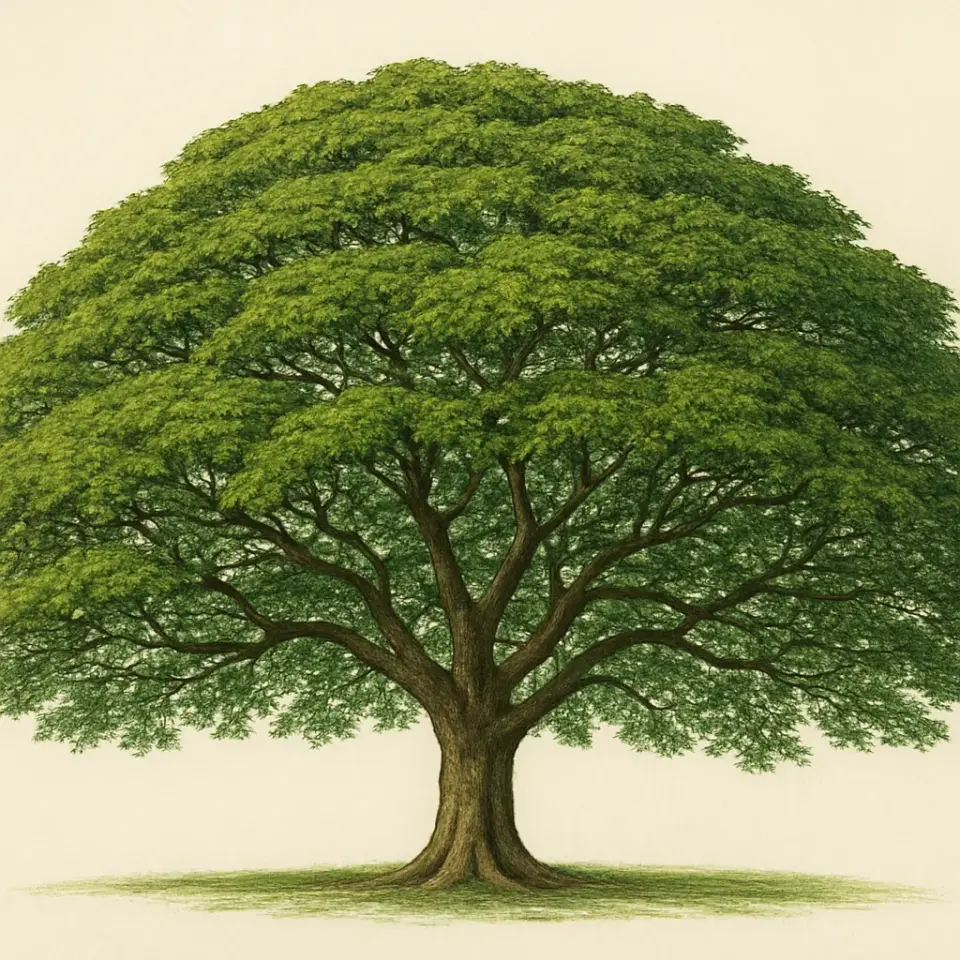
Rain tree: the umbrella over Bengaluru's old avenues
The rain tree (Samanea saman) is a huge shade tree with a flat, umbrella-shaped crown that can spread more than 30 m across. Its feathery leaflets fold shut at dusk and in rain, and that habit gave it its English name. It is not native to India: it comes from Central and South America. In Bengaluru it roofs Cubbon Park and most of the city's older avenues.
A huge flat-topped shade tree with canopies that can spread more than thirty metres. Brought from tropical America, it is not native to India.
How to recognise it
Feathery leaflets that fold shut at dusk and in rain - the name comes from that, and from the drip of sap-feeding insects beneath. Pink powder-puff flowers in April and May.
Where to see it
Bengaluru
The tree that roofs Cubbon Park and most of Bengaluru's older avenues, planted across the city under the Mysore state horticulture programme. The storm losses of recent years have pushed the city's tree officers toward native species for new avenues.
 Cubbon Park · Lalbagh Botanical Garden
How to recognise a rain tree
The shape gives it away first: a broad, symmetrical, umbrella-shaped crown that can be wider than the tree is tall. A rain tree usually grows 15–25 m high, while the canopy can reach 30 m across.
The leaves are feathery, divided into small diamond-shaped leaflets 2–4 cm long, dull on top and finely hairy beneath. In the evening and in rainy weather the leaflets fold together, so the crown looks thinner and lets rain through. That habit also gives it the name five o'clock tree.
In April and May the crown is dotted with pink powder-puff flowers, each head a cluster of flowers with long white and red stamens. Later come curved, leathery pods with sticky, edible pulp around the seeds.
Why it is called the rain tree
Nobody knows for certain. The encyclopedia lists several explanations: the leaves folding in wet weather, which lets rain fall through to the ground; the greener grass under the crown; the steady drizzle of sugary drops from insects feeding on the leaves and from nectaries on the leaf stalks; and the shower of stamens during heavy flowering.
Indian names pick up the same sleepiness. In Tamil it is thoongu moonji maram, the sleepy-faced tree, and in Telugu nidra ganneru, again from nidra, sleep. In Kannada it is male mara, the rain tree. In Hindi it is vilaiti siris, the foreign siris.
Where to see it in Bengaluru
In Bengaluru the rain tree is the tree that roofs Cubbon Park, where the canopy closes over most of the walking paths, and it is common in Lalbagh Botanical Garden. It was planted across the city under the horticulture programme of the old Mysore state, and many of Bengaluru's older avenues are still lined with it.
According to the guide, storm losses in recent years have pushed the city's tree officers towards native species for new avenues. More of the city's trees are on the page Bengaluru trees and flowers.
Mind the branches in a storm
Large rain tree branches tend to break off, particularly during rainstorms, and the encyclopedia notes this as a hazard because the tree is so widely planted along roads. In a monsoon storm, do not shelter or park under an old avenue tree.
FAQ
Is the rain tree native to India?
No. It comes from Central and South America and was introduced to South and Southeast Asia.
Why do rain tree leaves close?
The leaflets fold together in the evening and in rainy weather. This is why it is also called the five o'clock tree.
When does the rain tree flower in Bengaluru?
Its pink powder-puff flowers appear in April and May.
What is the rain tree called in Tamil and Kannada?
In Tamil thoongu moonji maram, the sleepy-faced tree; in Kannada male mara, the rain tree.
Is the rain tree dangerous?
Not in itself, but its large branches can break off in rainstorms. Avoid sheltering under old avenue trees during a monsoon storm.
Sources (3)
Facts checked: 8 October 2026. Prices and hours are approximate; check locally.