 India GO
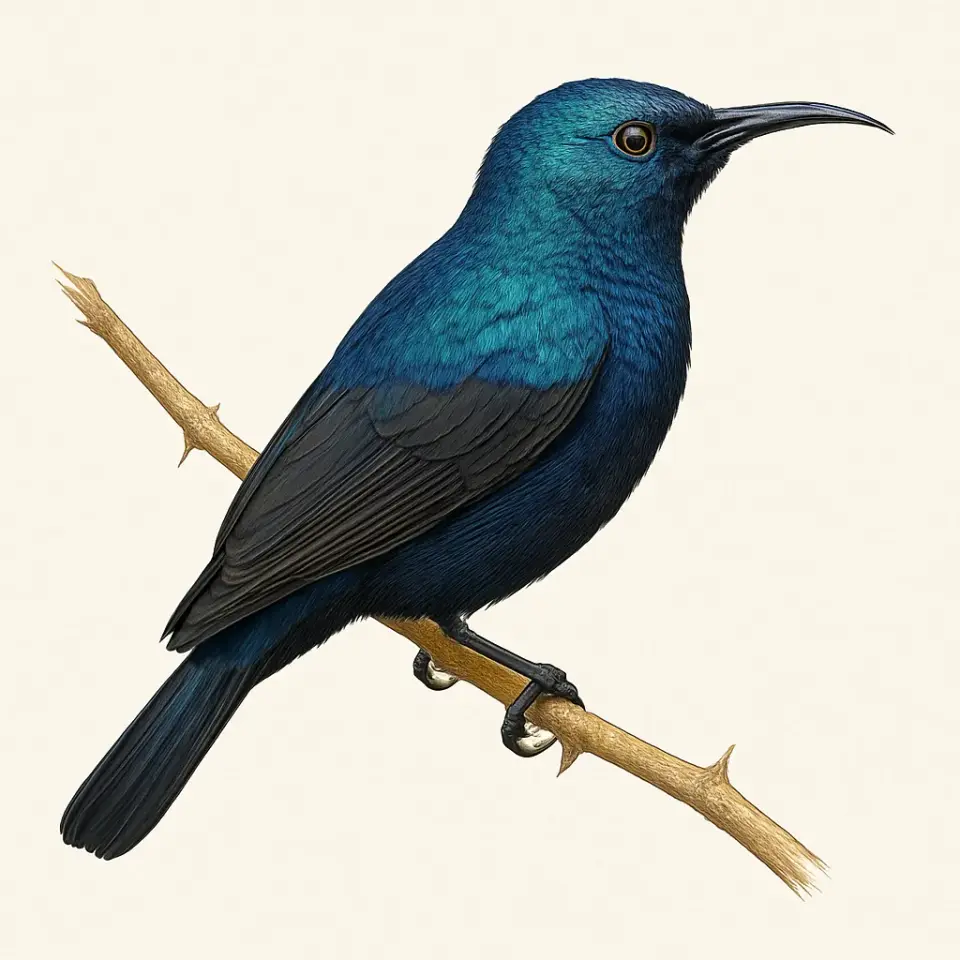
Purple sunbird: India's tiny nectar thief
The purple sunbird (Cinnyris asiaticus) is the tiny bird darting between hibiscus flowers in Indian gardens, even in dense cities, under 10 cm long with a fine curved bill. The breeding male looks black until the sun catches him and turns him metallic purple-blue; the female is olive and yellow. It is often taken for a hummingbird, but India has none, and the two families are not related.
A sparrow-sized nectar feeder. The breeding male is glossy blue-black all over and looks simply black until sunlight hits him at the right angle.
How to recognise it
Watch any flowering hedge - hibiscus, Russelia, coral tree - for a small bird hovering briefly then clinging sideways to a flower. The call is a sharp, insistent chewit.
Where to see it
Bengaluru
Sunbirds, not hummingbirds, are the small hovering nectar feeders of India; the two families are unrelated and hummingbirds do not occur here at all.
 Lalbagh Botanical Garden · Cubbon Park · Bugle Rock Park
Male, female and the half-black male
The breeding male is glossy metallic blue to purple-black all over, with a patch of bright blue on the shoulder and a maroon sheen around the neck. In display he flashes yellow tufts at the sides of the breast.
Outside the breeding season many males change into eclipse plumage: yellow underparts with a single black streak down the centre. If you see an odd half-black, half-yellow sunbird outside the breeding season, that is a male, not a different species.
The female is olive-brown above and yellow below, with a pale stripe over the eye; both sexes have white tips to the outer tail feathers. In the south the breeding male can be confused with Loten's sunbird, which has a longer, more curved bill and a broad maroon band across the breast.
Listen for a sharp chwit and a song that starts as a fast rattle and ends in ringing metallic notes.
Nectar, theft and a nest of cobwebs
Sunbirds can hover briefly, but usually they perch at the base of a flower and reach in with a brush-tipped tubular tongue, flicking their wings as they feed. They pollinate plants such as the flame of the forest, acacias and mistletoes, and sometimes cheat: with long-tubed flowers like firebush they slit the base and take the nectar without touching the pollen. They also eat insects, especially when feeding chicks, and small berries.
The nest is a hanging pouch of cobwebs, plant strips, lichen and bark with a side entrance, often under a little porch. The female builds it almost alone over five to ten days, pushing the inside wider by turning round in it with her wings open. It usually hangs from a low thorny branch, but sunbirds also build close to houses, on wires and other man-made objects, and even indoors. Two eggs hatch after 15–17 days. In north India the main season is April to June, before the monsoon.
Where to see it
The purple sunbird ranges from West Asia across the Indian subcontinent into Southeast Asia, from the plains up to about 2,400 m in the southern hills. It needs flowers, not forest, so it is at home in thin woodland, farm hedges and gardens deep inside cities. Most birds stay put, though some move: one ringed at Bharatpur turned up about 350 km north in Dehradun.
In Bengaluru the database names the flowering shrubs near the Glass House in Lalbagh, Cubbon Park and Bugle Rock Park. Elsewhere, look at flowering hedges such as hibiscus, Russelia or coral tree. More of the city's birds are on the Bengaluru bird page.
Protection
Common and widespread, the purple sunbird is listed as Least Concern by the IUCN. It is protected by law: it is named in Schedule II of the Wild Life (Protection) Act as amended in 2022, so trapping or caging it is an offence.
FAQ
Are there hummingbirds in India?
No. The small nectar-feeding birds at Indian flowers are sunbirds, an Old World family unrelated to the hummingbirds of the Americas.
How do I tell a male purple sunbird from a female?
The breeding male is glossy purple-black all over; the female is olive-brown above and yellow below. A bird that is yellow below with a black central stripe is a male in non-breeding plumage.
What does a purple sunbird nest look like?
A small hanging pouch of cobwebs, plant fibre, lichen and bark with a side entrance, usually on a low thorny branch, sometimes on a wire or other object near houses.
Where can I see purple sunbirds in Bengaluru?
The database names the flowering shrubs near the Glass House in Lalbagh, Cubbon Park and Bugle Rock Park.
Facts checked: 8 October 2026. Prices and hours are approximate; check locally.