 India GO
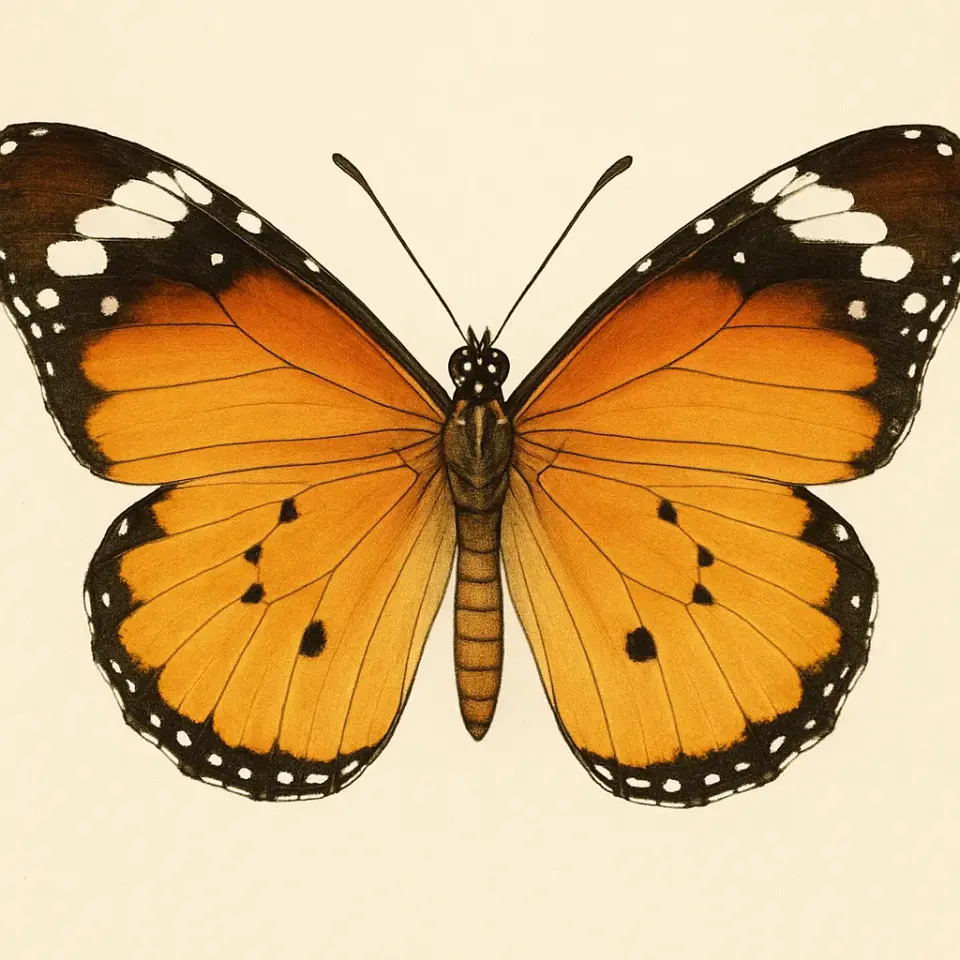
Plain tiger (Danaus chrysippus): the slow orange butterfly of Indian waste ground
तितली (titli)
The plain tiger (Danaus chrysippus), also called the African monarch, is the medium-sized orange butterfly with black wing tips and a white band that drifts low over Indian lawns, fields and waste ground in every month of the year. It flies slowly and openly because predators find it distasteful: its caterpillars feed on madar and other milkweeds, and birds that try one learn to leave it alone.
A medium-sized orange butterfly with black wing tips crossed by a white band and a scatter of black spots. It is common and flies all year.
How to recognise it
The flight is slow and unhurried, low over grass and flower beds — it does not dodge, because it does not need to. Males have an extra black spot in the middle of each hindwing.
Where to see it
Agra
Its caterpillar feeds on the madar plant, a shrub of waste ground and roadsides.
 Taj Nature Walk · Keoladeo Ghana National Park (Bharatpur)
Chandigarh
Its caterpillar feeds on the madar plant, a shrub of waste ground and roadsides.
Butterfly Park, Sector 26 · Leisure Valley
Delhi
Aravalli Biodiversity Park built its butterfly conservatory by planting more than 100 species of host plants, and the tiger butterflies are among the notable species the park lists there.
Aravalli Biodiversity Park · Garden of Five Senses · Sunder Nursery
Hampi
Its foodplant Calotropis is the madar offered to Shiva and to Hanuman, so the butterfly's entire life cycle runs on a plant that is laid at the shrines all over Hampi.
Daroji Sloth Bear Sanctuary · Hemakuta Hill · Sanapur Lake
Haridwar
Its caterpillar feeds on the madar plant, a shrub of waste ground and roadsides.
Jhilmil Jheel Conservation Reserve · Rajaji National Park, Chilla
Hyderabad
Its caterpillar feeds on the madar plant, a shrub of waste ground and roadsides.
KBR National Park · Hyderabad Botanical Garden (Kotla Vijayabhaskara Reddy) · Mahavir Harina Vanasthali National Park
Jaipur
Its bright warning colours are copied by several harmless butterflies that gain protection by looking like it. It is one of the classic cases of mimicry, and it plays out on any patch of Jaipur waste ground where aak grows.
Central Park · Jhalana Leopard Reserve · Sisodiya Rani Bagh (often)
Mathura
The caterpillars feed on milkweeds, whose sap makes the adult butterfly distasteful to birds, hence the slow, obvious flight and the warning colours. Several other Indian butterflies copy its pattern for the same protection. It is one of the commonest butterflies of the Braj plain.
Raman Reti, Gokul · Brahmand Ghat, Mahavan
Pushkar
Wherever aak grows the plain tiger follows, which in the Pushkar valley means almost any strip of sandy waste ground. Several harmless butterflies mimic its colours to borrow the protection.
Pushkar Sand Dunes · Budha Pushkar Lake (Old Pushkar) (often)
Ujjain
Its caterpillar feeds on the madar plant, a shrub of waste ground and roadsides.
Naulakhi Eco Tourism Park · Dewas Tekri (Mata Tekri)
Varanasi
Its caterpillar feeds on the madar plant, a shrub of waste ground and roadsides.
Sarnath Deer Park · Chandraprabha Wildlife Sanctuary
How to recognise it
The wingspan is about 7–8 cm. The wings are brownish orange, brighter on top than beneath; the outer half of each forewing is black, crossed by a white band; the hindwing has three black spots in the middle, and all the wings are edged in black with small white half-moons. The body is black with white spots. The species varies a lot, so not every individual matches exactly.
Males carry scent glands on the hindwings, visible as an extra black spot with a white centre that females lack. The flight is the best field mark: slow, straight and low over grass and flower beds, with no attempt to dodge.
The common tiger looks similar at a glance but, despite the name, is not a close relative. The danaid eggfly (Hypolimnas misippus) has evolved to look like the plain tiger, and the reason is the poison.
Poison, warning colours and copycats
The caterpillars feed on milkweeds; in India a well-known food plant is madar (aak, Calotropis), whose sap contains cardenolides, heart poisons that make whatever eats them vomit. Some of these toxins can be stored by the butterfly, and adults also take up pyrrolizidine alkaloids from plants; how much each contributes varies between populations. Either way, a bird that tries one plain tiger learns the colours and avoids them afterwards.
That lesson is borrowed by other species. Palatable butterflies such as the danaid eggfly have evolved to look like the plain tiger and get the same protection without the poison, a textbook case of Batesian mimicry. In parts of Africa other distasteful species share the pattern as well, so each reinforces the same warning.
Where and when to look
The plain tiger flies all year, but it is most numerous after the monsoon, roughly September to November across the north (to March around Mathura, to December around Hampi). It prefers dry, open ground to forest, so patches of madar are a good place to look.
In Delhi the butterfly conservatory of the Aravalli Biodiversity Park was planted with more than 100 species of caterpillar food plants, and the park lists the tiger butterflies among its notable species; the Garden of Five Senses and Sunder Nursery have them over the flower beds. Around Mathura look over the grass at Raman Reti in Gokul. Chandigarh's Butterfly Park in Sector 26 was laid out specifically for butterflies, with host and nectar plants, and in Pushkar it follows the aak across the sand dunes.
FAQ
Is the plain tiger butterfly poisonous?
To birds and other predators it is distasteful: it carries toxins from its milkweed food plants and from other plants the adults visit, and predators that try one learn to avoid it. It is harmless to people to watch.
What does the plain tiger caterpillar eat?
Milkweeds. In India a well-known food plant is madar or aak (Calotropis), the shrub of roadsides and waste ground.
How do I tell a male plain tiger from a female?
Males have an extra black spot with a white centre on each hindwing, formed by scent glands; females lack it.
When is the best time to see the plain tiger in India?
It flies all year, but numbers peak after the monsoon, roughly September to November in most of the north.
Sources (2)
Facts checked: 8 October 2026. Prices and hours are approximate; check locally.