 India GO
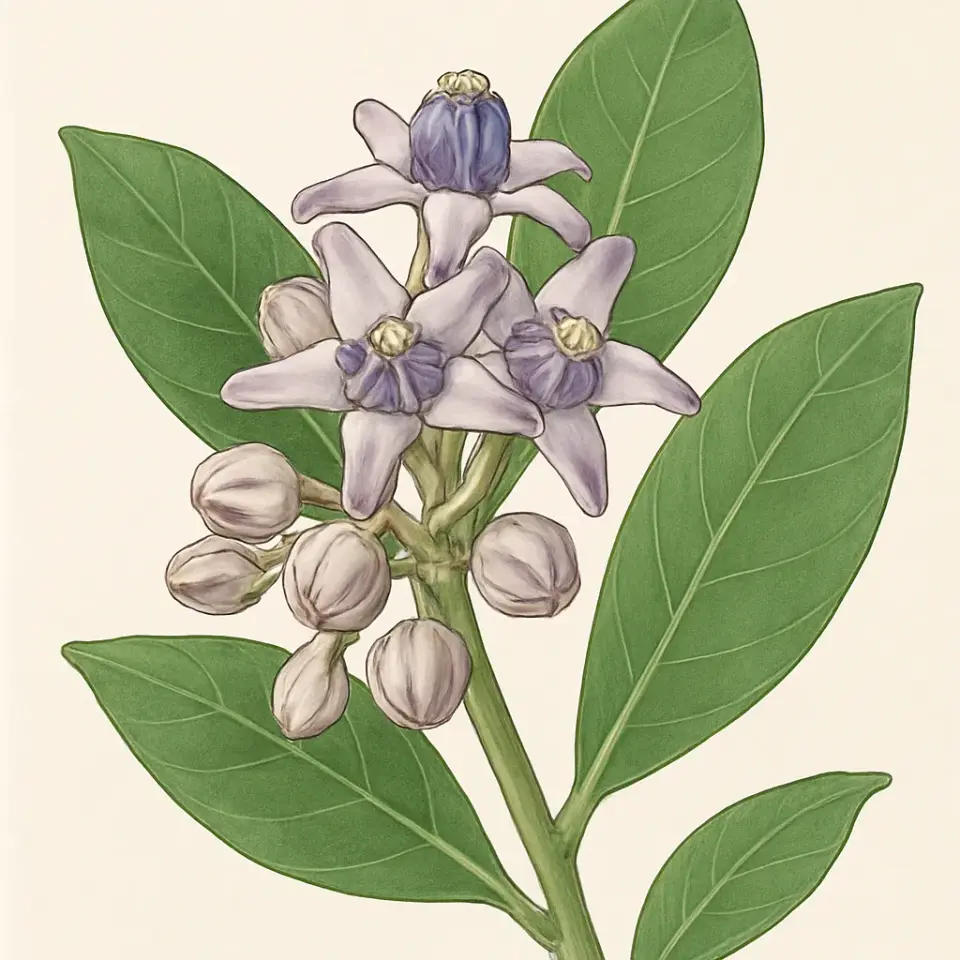
Madar or aak (Calotropis gigantea): the crown flower offered to Shiva
आक / मदार (aak / madar)
Madar, or aak (Calotropis gigantea), arka in Sanskrit and crown flower in English, is the tough grey-leaved shrub of Indian roadsides and waste ground, with waxy white or lilac flowers and a milky sap. It has a place in Hindu worship: its flowers and leaves are offered to Shiva and to Hanuman. The same sap is poisonous, and it is worth knowing before you pick a flower.
A tough grey-leaved shrub of wasteland and roadsides with waxy lilac-white star flowers and a milky sap.
How to recognise it
Thick pale leaves that look dusted with flour, and flowers arranged like a small crown. Breaking a stem releases white latex.
Where to see it
Agra
Aak flowers and leaves are offered to Shiva and to Hanuman, and the plant grows precisely where nothing is cultivated, so it is always within reach of a shrine.
 National Chambal Sanctuary · Sur Sarovar Bird Sanctuary (Keetham Lake)
Delhi
Aak flowers and leaves are offered to Shiva and to Hanuman, and the plant grows precisely where nothing is cultivated, so it is always within reach of a shrine.
Aravalli Biodiversity Park · Asola Bhatti Wildlife Sanctuary (Neeli Jheel) · Sanjay Van (often)
Haridwar
Aak flowers and leaves are offered to Shiva and to Hanuman, and the plant grows precisely where nothing is cultivated, so it is always within reach of a shrine.
Varanasi
Aak flowers and leaves are offered to Shiva and to Hanuman, and the plant grows precisely where nothing is cultivated, so it is always within reach of a shrine.
Vishwanath Gali
What it looks like
Madar is a large shrub, up to about 4 m tall, with an upright branching stem full of milky latex. The leaves are thick, pale and 10–20 cm long, set in opposite pairs and often clasping the stem. The flowers are the giveaway: waxy, white or lavender, five pointed petals and a small raised “crown” in the centre that holds the stamens. They have no scent.
The fruit is a pair of fat pods. When they split, the seeds float off on the wind on tufts of silky white hair. Its main flowering and fruiting time is given as November to April, though around north Indian towns flowers can be found in most months.
Why aak is offered to Shiva
According to the Shiva Purana, the madar flower is especially dear to Shiva, and its flowers and garlands are offered to him; the plant is also counted among the nine trees of the navagraha, the nine planetary deities. Its leaves and flowers are offered to Hanuman as well. It grows precisely where nothing is cultivated, so there is always some within reach of a shrine.
In Varanasi the stalls in Vishwanath Gali, the lane to the Kashi Vishwanath temple, sell aak flowers together with bel (bilva) leaves and datura as the standard offering for Shiva. In Maharashtra its leaf, called rui in Marathi, is one of the five leaves of the panch pallava used in rituals.
Other names: akondo in Bengali, ekka in Kannada, erikku in Malayalam, erukku in Tamil, jilledu in Telugu.
The sap is poisonous
Madar is a poisonous plant. Its milky latex contains cardiac glycosides (calotropin, calotoxin and related compounds), the same kind of heart poison found in foxglove, and has been used as an arrow poison and a cattle poison. On the skin the sap causes redness and blisters; in the eye it can damage the cornea and cause temporary loss of vision, sometimes without pain at first.
If you pick flowers for an offering, keep the sap off your hands and away from your eyes, and keep children and animals from chewing the plant. Madar has a long history in folk medicine, but those uses are not clinically confirmed. If someone swallows it or gets sap in the eye, call 112.
A plant for butterflies
The poison has a use. Caterpillars of the plain tiger butterfly feed on madar. Toxins taken in this way are thought to be one of the reasons the adult butterfly is distasteful to predators. The flowers are pollinated by bees in an unusual way: the pollen comes in sticky packets that clip onto a bee's legs and get carried to the next flower.
The plant also gives a strong fibre, traded as “bowstring of India” and used for ropes, carpets and fishing nets, and its seed floss is used as stuffing.
Where you will see it
You do not need to look for madar; it finds you. It is common on waste ground, field edges, riverbanks and dry ravines across the north. In Delhi it grows in the Aravalli Biodiversity Park, Sanjay Van and Asola Bhatti; near Agra on the dry ravine slopes of the Chambal; in Haridwar and Varanasi on waste ground and in the scrub along the river.
FAQ
Is the madar (aak) plant poisonous?
Yes. Its milky sap contains cardiac glycosides and is toxic if swallowed; on the skin it causes redness and blisters, and in the eye it can damage the cornea and blur vision. Keep the sap off your skin and out of your eyes.
Why are aak flowers offered to Shiva?
The Shiva Purana describes the madar flower as much liked by Shiva. In Varanasi it is sold for worship together with bel leaves and datura.
What is madar called in English?
Crown flower, after the small crown in the centre of each flower. Its botanical name is Calotropis gigantea; in Hindi it is aak or madar, in Sanskrit arka.
Is madar the same as aak?
Yes. Aak and madar are two Hindi names for the same plant, Calotropis gigantea (आक / मदार).
Facts checked: 8 October 2026. Prices and hours are approximate; check locally.