 India GO
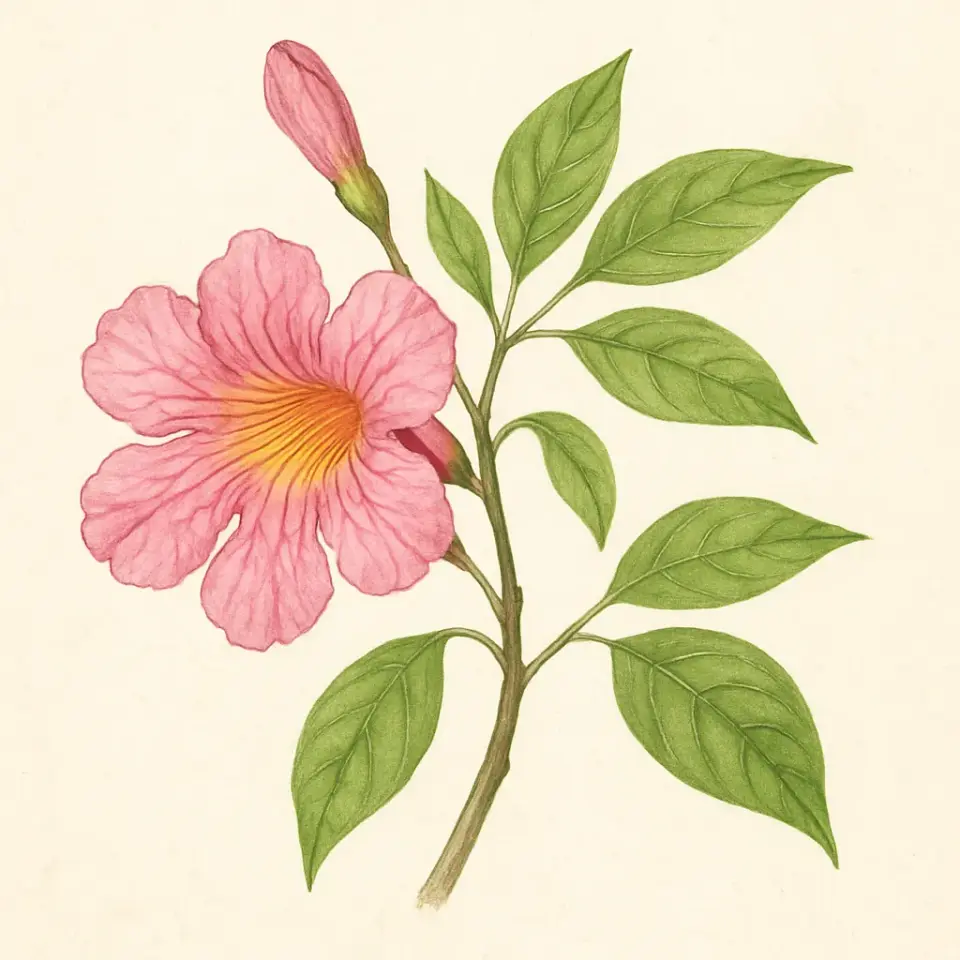
Pink trumpet tree (Tabebuia rosea)
The pink trumpet tree, Tabebuia rosea, is the tree behind Bengaluru's so-called cherry blossom season: for two or three weeks in late winter, usually February to March, it drops its leaves and covers whole avenues in pale pink. It is not a cherry and not Indian at all. It is native from southern Mexico to Venezuela and Ecuador and was planted along Indian streets as an avenue tree.
An avenue tree that drops its leaves in late winter and for two or three weeks turns pale pink with flowers.
How to recognise it
Trumpet-shaped flowers in dense clusters on bare branches, and a pink carpet on the pavement below. It is not a cherry and not related to one - it comes from Central and South America.
Where to see it
Bengaluru
The tree behind Bengaluru's so-called cherry blossom season, when for two or three weeks in late winter whole streets turn pale pink. The avenue planting came out of the Mysore horticulture department's nineteenth and twentieth century experiments; the pink streets are an accident of that programme, not a native season.
 Cubbon Park (in season) · Lalbagh Botanical Garden (in season)
How to recognise it
The flowers are trumpet-shaped, large, in shades from pale pink to purple, and they come in dense clusters while the tree has few or no leaves. So the whole crown turns one colour, and the fallen trumpets lie in a pink carpet on the pavement below. That trumpet shape is the quickest way to rule out a cherry.
Out of flower, the leaves give it away: each is made of five leaflets of different sizes, the middle one largest. Later come long, slender seed capsules up to 35 cm, which split to release papery winged seeds that drift on the wind. In its homeland the tree can reach 30 m, with only a few thick, irregular branches.
Why Bengaluru turns pink
The pink streets are a side effect of history rather than a native season. Bengaluru's avenue planting grew out of the Mysore horticulture department's experiments in the nineteenth and twentieth centuries, and Tabebuia rosea was one of the trees planted. In its native range it flowers mainly in January and February, in the dry period, on leafless branches, and in Bengaluru it blooms in late winter.
The same tree has a similar following elsewhere. In Malaysia it is nicknamed Sakura Malaysia, and in El Salvador, where it is called maquilíshuat, it is the national tree.
Where and when to see it
In the India GO guide the tree belongs to Bengaluru. The bloom usually falls between February and March and lasts two or three weeks, and the exact weeks shift from year to year.
The densest planting is along certain avenues and the edges of parks; within the parks, Cubbon Park and Lalbagh are the easy places to start. The pink trumpet tree in Bengaluru page and trees and flowers of Bengaluru cover the city side.
FAQ
Are Bengaluru's pink trees cherry blossoms?
No. They are pink trumpet trees, Tabebuia rosea, from Central and South America. The flowers are trumpet-shaped, not flat like cherry blossom.
When does the pink trumpet tree bloom in Bengaluru?
Usually in February and March, for two or three weeks. The timing varies from year to year.
Is the pink trumpet tree native to India?
No. It is native from southern Mexico to Venezuela and Ecuador and was planted in India as an avenue tree.
Where is the best place to see pink trumpet trees in Bengaluru?
Along the avenues where the planting is densest and at the edges of parks such as Cubbon Park and Lalbagh.
Sources (1)
Facts checked: 8 October 2026. Prices and hours are approximate; check locally.