 India GO
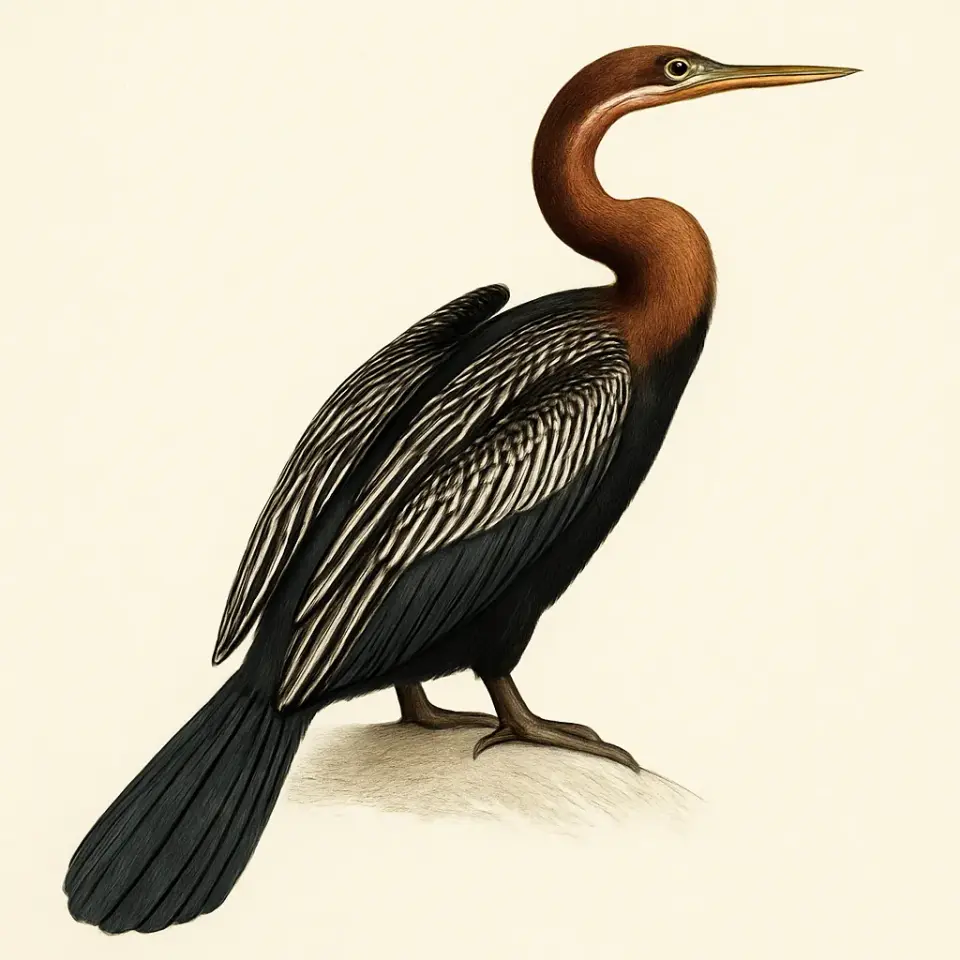
Oriental darter: the snakebird of Indian lakes
The Oriental darter (Anhinga melanogaster) is the bird you mistake for a snake: a thin, kinked neck gliding across a lake with no body in sight. That is why it is called the snakebird, havakki in Kannada and pambu thara in Tamil. It hunts underwater, stabbing fish with a dagger-straight bill, then hangs on a dead branch with its wings spread to dry.
A cormorant-like bird that swims with only its long thin neck above water, which is exactly why it is called the snakebird. It spears fish rather than grabbing them.
How to recognise it
Two clues: a kinked neck moving alone across the water, and birds perched with wings spread open to dry, since their feathers are not waterproof.
Where to see it
Mysore
Darters breed inside Mysore itself: Kukkarahalli, a tank built in 1864 for the city's water supply, holds a colony on an island left when a half-built bund washed away, and Karanji Lake has another.
 Ranganathittu Bird Sanctuary · Kukkarahalli Lake (often) · Karanji Lake Nature Park (often)
Darter or cormorant?
Both swim low and both perch with open wings, so the confusion is natural. The darter has a much longer, thinner neck with a sharp kink in it, a straight, dagger-like bill, and a long fan of a tail that drags on the ground when it hops. In flight look for the long straight neck, broad wings and wedge-shaped tail. Darters also soar on thermals in the heat of the day.
Adults are black with silvery streaks on the wing coverts and a pale stripe running down each side of the brownish neck. The eye is white with a yellow ring. Females have a shorter bill and a broad buff band at the base of the neck; young birds have a pale brown neck and look whitish below.
The bird is mostly silent. At the nest it grunts, croaks and gives a repeated chigi-chigi.
A neck built like a spring
The kink in the neck is the weapon. Strong muscles around the 8th and 9th vertebrae let the darter fire its head forward underwater and impale a fish; tiny inward-pointing serrations near the bill tips hold it. It surfaces, tosses the fish into the air and swallows it head first.
Its feathers soak up water instead of shedding it, so after a session underwater it is waterlogged. Hence the familiar pose: a darter on a stump or dead tree in the water, wings held wide open, drying in the sun.
After breeding adults moult all their flight feathers at once and cannot fly for a short while. Disturbed then, they drop into the water and escape by swimming underwater.
Where and when it nests
Darters live on freshwater lakes, tanks and slow rivers across South and Southeast Asia, and nest in mixed-species heronries, building stick platforms in trees standing in water. The season depends on the rains: June to August in north India, April and May in the south-west, and winter in the south-east, where the north-east monsoon brings the rain.
In Mysore they breed inside the city itself. Kukkarahalli Lake, a tank built in 1864 for the city's water supply, has a colony on its island and birds on the dead trees standing in the water; Karanji Lake has another. At Ranganathittu on the Kaveri they nest alongside painted storks and spot-billed pelicans, and ranger-guided boat tours run among the islets. The rest of Mysore's birds are on the city's bird page.
Protection
The IUCN lists the Oriental darter as Least Concern. In India it is in Schedule II of the Wild Life (Protection) Act as amended in 2022. Its long scapular feathers were once in demand for hats, and in parts of north-east India darters were used, as cormorants are in parts of Southeast Asia, to catch fish with a ring around the neck to stop them swallowing.
FAQ
Why is the Oriental darter called a snakebird?
Because it swims with its body under the surface and only the long thin neck showing, which looks exactly like a snake moving through the water.
Why does the darter sit with its wings spread?
Its feathers get waterlogged rather than shedding water, so after fishing it spreads its wings to dry them.
How is a darter different from a cormorant?
A darter has a much longer, thinner, kinked neck, a straight dagger-like bill and a long fan-shaped tail, and it spears fish instead of grabbing them.
Where can I see Oriental darters near Mysore?
At Kukkarahalli Lake and Karanji Lake inside the city, and at Ranganathittu Bird Sanctuary on the Kaveri, where they nest among storks and pelicans.
Sources (3)
Facts checked: 8 October 2026. Prices and hours are approximate; check locally.