 India GO
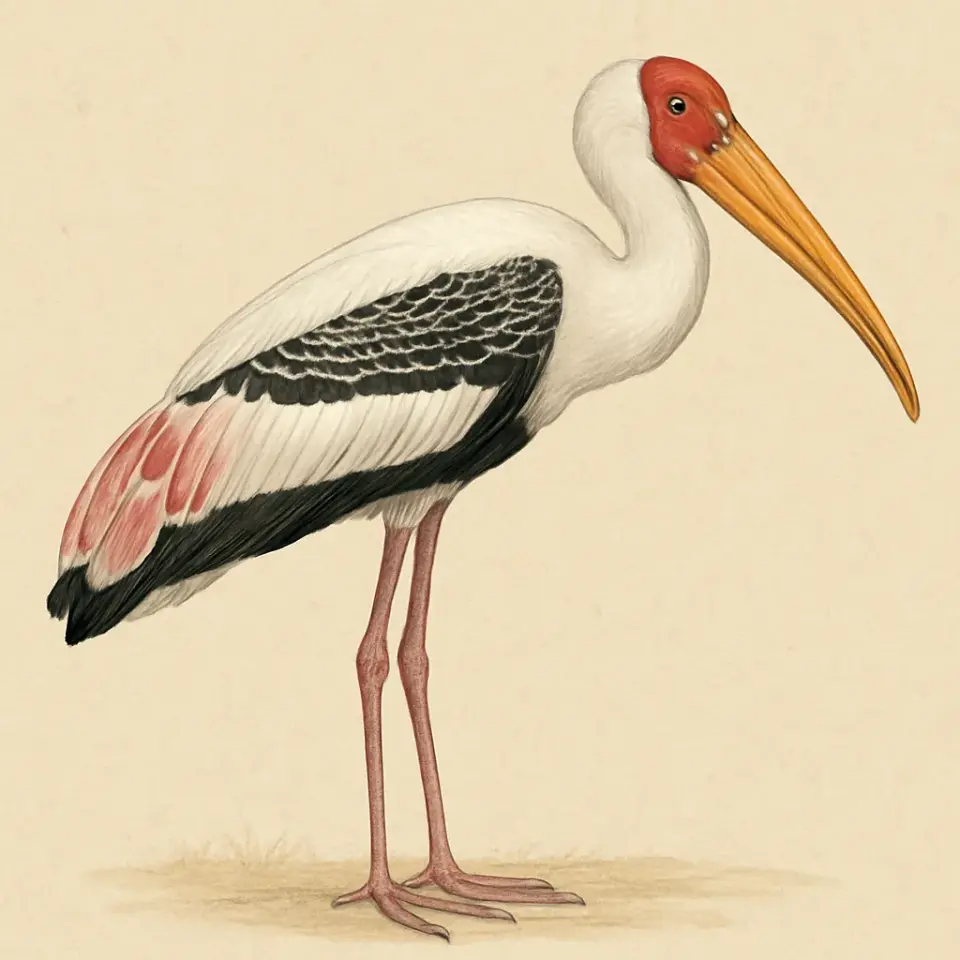
Painted stork: the pink-backed stork of Indian wetlands
जांघिल (janghil)
The painted stork (Mycteria leucocephala) is a large white stork with black wing bands, a wash of bright pink over the lower back and a heavy yellow bill curved down at the tip. It feeds in flocks in shallow water and nests in noisy colonies in big trees, often right inside villages, zoos and city lakes.
A large white stork with black wing bars, a pink wash across the lower back and a heavy yellow bill curved at the tip.
How to recognise it
Feeds by sweeping a half-open bill through shallow water. Nests in noisy colonies in big waterside trees, dozens of nests to a tree.
Where to see it
Agra
At Keoladeo the storks nest mainly in desi babool (Acacia nilotica): its sturdy branches carry their bulky nests and its thorns keep predators off. Nesting runs from September to December, and the spread of invasive Prosopis juliflora is the main threat to those trees.
 Keoladeo Ghana National Park (Bharatpur) · Sur Sarovar Bird Sanctuary (Keetham Lake)
Ajmer
Ana Sagar was dammed in the twelfth century and has been an important wintering stop on the migration route through central Rajasthan ever since it filled; the painted storks that fish in front of the marble pavilions are one sign of it.
Ana Sagar Lake (often) · Foy Sagar Lake (Varun Sagar)
Delhi
The breeding colony inside the Delhi Zoo is wild: the birds come in from outside to nest on the island trees, and have done so for decades.
Okhla Bird Sanctuary · National Zoological Park (Delhi Zoo) (in season)
Govardhan
Painted storks breed in colonies in big trees over water and need shallow fishing ground within reach. The tanks and irrigated plots of the Govardhan circuit provide that, and the flocks are one of the clearer signs that the sacred ponds are still doing ecological work.
Kusum Sarovar (in season) · Chandra Sarovar & Surdas Kuti, Parasoli (in season)
Hyderabad
Ameenpur was notified in November 2016 as the first water body in India to be declared a Biodiversity Heritage Site, and the first such site in an urban area. Around 170 bird species have been recorded there.
Ameenpur Lake (in season) · Osman Sagar (Gandipet Lake) (in season) · Hussain Sagar Lake
Mysore
Ranganathittu's islets were formed by a dam built across the Kaveri in the 1640s; the ornithologist Salim Ali persuaded the Mysore ruler to protect them, and the sanctuary was declared in 1940.
Ranganathittu Bird Sanctuary
Pune
Several Indian villages protect their stork colonies by custom rather than by law, and the birds nest year after year in the same trees.
Pashan Lake (in season) · Khadakwasla Dam (in season)
Ujjain
Several Indian villages protect their stork colonies by custom rather than by law, and the birds nest year after year in the same trees.
Undasa Lake (in season) · Rudra Sagar Lake (in season) · Vishnu Sagar Lake (in season)
How to recognise a painted stork
It is a big bird: 93–102 cm tall, with a wingspan of 150–160 cm. The adult has a bare orange to reddish face, a thick yellow bill with a down-curved tip, and a black band across the breast with white scaly marks. The long pink-tipped tertial feathers lie over the back and rump at rest; that pink is where the name comes from.
The legs are yellowish to red but often look white, because storks cool off by defecating on their legs.
The feeding style is the best field mark. A painted stork wades slowly with its half-open bill under water, sweeping it from side to side and snapping shut when it touches a fish, stirring the mud with its feet as it goes.
When painted storks nest
Painted storks are not true migrants: they stay in India all year and move locally with water and food. What changes with the season is where they gather to breed.
Breeding starts after the monsoon. In north India it begins from mid-August; the wild colony in the Delhi Zoo assembles about 30–40 days after the monsoon reaches the city, and at Keoladeo near Bharatpur nesting runs from September to December. In the south nesting starts around October and continues to February or even April.
The storks are mostly silent, but at the nest they clatter their bills and give harsh croaks and low moans.
Where to see painted storks
The guide records painted storks in nine cities:
- Mysore: Ranganathittu Bird Sanctuary, where the boat passes directly under the nesting islets in the Kaveri. The islets formed behind a 1640s dam; at Salim Ali's request the sanctuary was declared in 1940.
- Delhi: the National Zoological Park, where wild storks fly in to nest on the island trees and have done so for decades (they are not exhibits), and Okhla Bird Sanctuary.
- Bharatpur, near Agra: Keoladeo Ghana National Park, the largest breeding colony in north India, estimated at about 2,500 nests. The storks nest mainly in desi babool (Acacia nilotica), whose thorns keep predators off. Sur Sarovar (Keetham Lake) near Agra also has them.
- Govardhan: flocks feed seasonally at Kusum Sarovar and Chandra Sarovar at Parasoli, in the shallow margins and the wet fields around the tanks.
- Ajmer: frequent in the shallows of Ana Sagar, best on the quieter shore, and occasionally at Foy Sagar.
- Hyderabad: seasonal at Ameenpur Lake, declared in 2016 India's first Biodiversity Heritage Site in an urban area, and at Osman Sagar.
- Pune and Ujjain: seasonal at Pashan Lake and Khadakwasla, and at Undasa, Rudra Sagar and Vishnu Sagar.
- Puducherry: seasonal at Ousteri (Oussudu) Lake.
Karnataka's village of Kokrebellur, between Mysore and Bengaluru, is named after the stork (kokkare in Kannada). Villagers there protect the nesting trees, and the Forest Department compensates owners for trees used by the birds.
Status, protection and the trees it needs
The IUCN Red List rates the painted stork Least Concern (2023 assessment), and the largest secure population is in India. Elsewhere it is in trouble, for example in Pakistan and Thailand. In India it is in Schedule II of the Wild Life (Protection) Act as amended in 2022.
The weak point is the nesting tree. Storks need big trees over or near water, held secure for years, and they return to the same trees season after season. At Keoladeo the spread of invasive Prosopis juliflora is the main threat to the babool trees they nest in. Several Indian villages protect their stork colonies by custom rather than by law.
FAQ
Why is it called the painted stork?
For the bright pink tips of the long feathers that lie over its back and rump, which look as if they have been painted on a white bird.
Is the painted stork a migratory bird?
No. It lives in India year-round and only moves locally with water, food and the breeding season.
When do painted storks nest?
After the monsoon. In the north from mid-August (September to December at Keoladeo); in the south from about October to February or later.
Is the painted stork endangered?
No. The IUCN rates it Least Concern, though it is endangered in Pakistan and was nearly wiped out in Thailand. In India it is protected under Schedule II of the Wild Life (Protection) Act.
What is the painted stork called in Hindi?
Janghil (जांघिल). In Kannada it is called kokkare, in Tamil manjal mookku narai.
Sources (7)
- Painted stork (Wikipedia)
- Protecting the tree that branches out for painted storks (Mongabay India)
- Ranganathittu Bird Sanctuary (official site)
- Keoladeo Ghana National Park (Rajasthan Tourism)
- Ameenpur Lake declared Biodiversity Heritage Site (The Hans India, 2016)
- Kokrebellur (Wikipedia)
- The Wild Life (Protection) Amendment Act, 2022: Schedule II, birds (storks)
Facts checked: 8 October 2026. Prices and hours are approximate; check locally.