 India GO
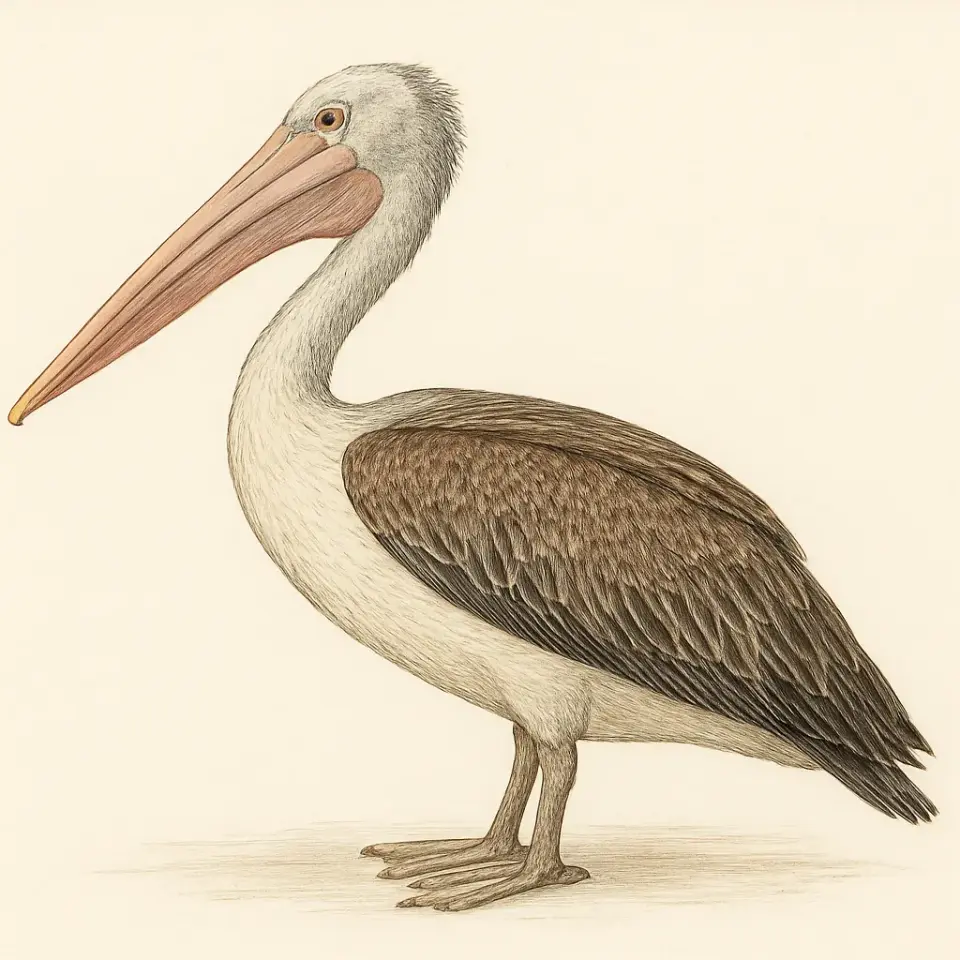
Spot-billed pelican (grey pelican)
The spot-billed pelican, or grey pelican, is a large greyish-white pelican named for the row of dark spots along its upper bill. It breeds only in peninsular India, Sri Lanka and Cambodia, nesting in colonies in waterside trees, sometimes right inside villages. Near Mysuru the breeding colony at Ranganathittu is active from about November to May; at Ousteri near Puducherry resident birds are present all year.
A greyish pelican named for the row of dark spots along the upper mandible. It breeds colonially in tall waterside trees and fishes in long, coordinated lines.
How to recognise it
Size alone gives it away - up to about two and a half metres across the wings. Watch for groups drifting and dipping in unison, and for a pouch that turns pinkish before breeding.
Protection
Ousteri: bird sanctuary (Puducherry portion 2008, Tamil Nadu portion 2015); Important Bird Area
Where to see it
Mysore
In several Karnataka and Andhra villages pelican and stork colonies nest inside the village on protected trees and are looked after by residents: a South Indian tradition of village heronries that predates any wildlife law.
 Ranganathittu Bird Sanctuary · Kukkarahalli Lake
How to recognise it
It is a big bird, 125–152 cm long, 4–6 kg, with a wingspan of 2.1–2.5 m, yet small for a pelican. At a distance it is hard to separate from the great white pelican, which also winters in India. The spot-billed is greyer and duller, with a grey crest of curly feathers on the nape and a brownish tail. The pouch is pinkish to purple with large pale spots, and the upper mandible carries the row of dark spots that gives the bird its name. The tip of the bill is yellow to orange.
Young birds are greyish and speckled, and the bill spots only appear after their first year; full adult plumage takes three years. In breeding condition the skin at the base of the bill darkens and the patch around the eye turns pink.
Tree colonies and fishing lines
Unlike the great white pelican, it does not fish in big flocks. It hunts singly or in small groups, scooping fish into the pouch while swimming, and sometimes a group lines up to drive fish into the shallows. Small groups fly to their roosts in formation.
It nests in colonies on trees near water, building thick platforms of twigs, often beside painted storks. The breeding season runs from about October to May; in Tamil Nadu it follows the onset of the northeast monsoon. A pair lays three or four chalky white eggs, and the young stay at or near the nest for three to five months. Adults are mostly silent, though at the nest they hiss, grunt and snap their bills.
Pelicans in the village
In parts of South India pelicans and storks nest inside villages, on trees that residents protect. Nineteenth-century naturalists already described pelicans building their nests on low trees in the middle of a village, "for ages" by local account, and a colony visited in Tirunelveli district in 1906 was held semi-sacred by the villagers. Some of these colonies vanished over the twentieth century; others were protected, and a few villages with nesting pelicans, such as Kokkare Bellur in Karnataka, Koonthankulam in Tamil Nadu and Uppalapadu in Andhra Pradesh, are now known well beyond their districts. The tradition is older than any wildlife law.
Where and when to see it
Mysuru: Ranganathittu Bird Sanctuary on the Kaveri is the place. The pelicans nest on the islets and are seen there commonly from about November to May, the breeding season. At Kukkarahalli Lake in the city they are only occasional visitors. More on the city's birds: birds of Mysuru.
Puducherry: Ousteri (Oussudu) Lake, about 10 km from town, straddles the Puducherry and Tamil Nadu border. Resident pelicans are there all year, and numbers build up from November to February. The lake is a bird sanctuary and an Important Bird Area, but contrary to frequent claims it is not a Ramsar site.
The species is not migratory in the usual sense, but it wanders locally outside the breeding season, so pelicans can appear on other large tanks too.
Status and protection
It was once abundant in Southeast Asia: in 1877 a naturalist wrote of "millions" of pelicans on the Sittang River in Burma, a colony that vanished by the 1940s, and the species died out in the Philippines, after which it is named, in the 1960s. The Kolleru Lake colony in Andhra Pradesh, about 3,000 birds when found in 1946, disappeared around 1975. Protection has since let the South Indian population recover, and in 2007 the IUCN moved the species from Vulnerable to Near Threatened. In India it is listed in Schedule II of the Wild Life (Protection) Act as amended in 2022.
FAQ
Where can I see spot-billed pelicans in India?
At breeding colonies in South India. Ranganathittu Bird Sanctuary near Mysuru, from about November to May, and Ousteri Lake near Puducherry, where resident birds stay all year.
How do I tell a spot-billed pelican from a great white pelican?
The spot-billed is smaller, greyer and duller, with a row of dark spots on the upper bill and a spotted pink to purple pouch. The great white pelican is whiter and fishes in large flocks.
Is the spot-billed pelican endangered?
It is listed as Near Threatened by the IUCN, improved from Vulnerable in 2007 as South Indian numbers recovered. In India it is protected under Schedule II of the Wild Life (Protection) Act.
Is the spot-billed pelican migratory?
Not really. It is resident in South India and Sri Lanka but moves locally outside the breeding season, and a few birds reach the Gangetic plains in winter.
Facts checked: 8 October 2026. Prices and hours are approximate; check locally.