 India GO
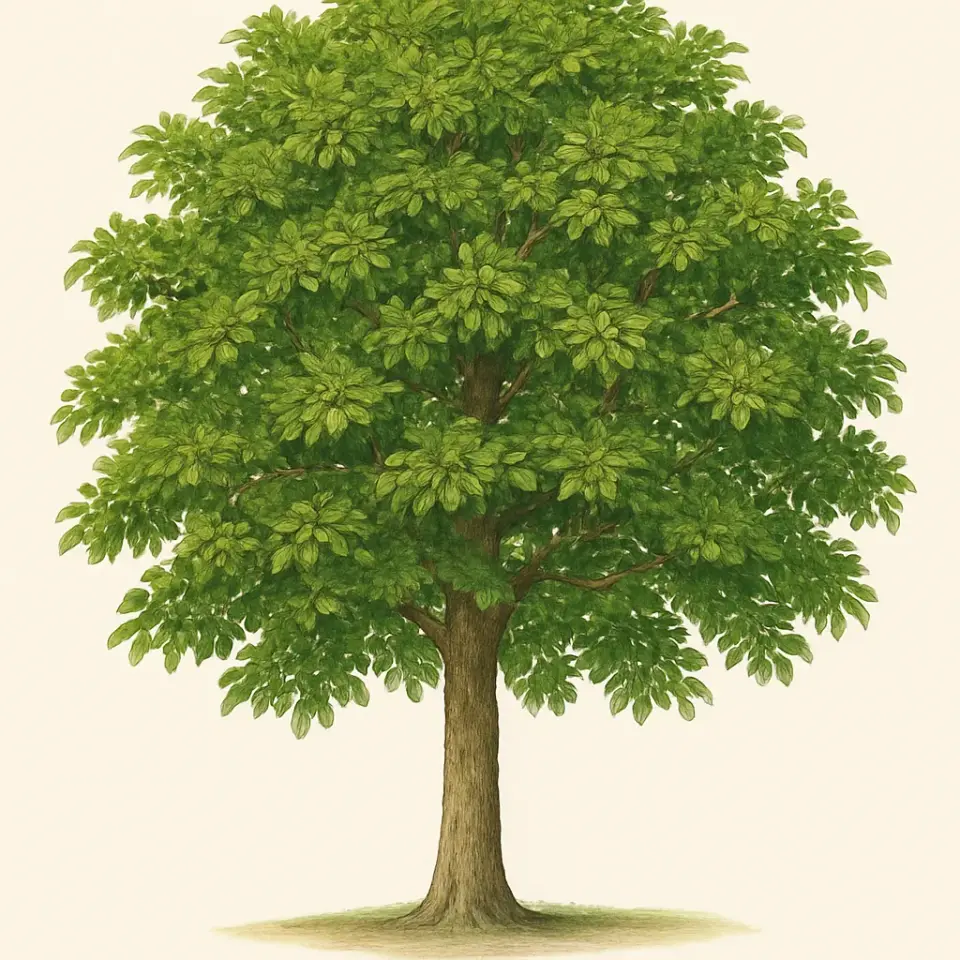
Matti, the crocodile bark tree: Goa's state tree and how to recognise it
साज (saj)
Matti (Terminalia elliptica) is a large deciduous hardwood of the Western Ghats whose grey bark is cracked into deep rectangles like crocodile skin, which is why it is also called the crocodile bark tree. Goa notified it as its state tree in December 2017; Goa's other state tree is the coconut palm. The bark pattern is so distinctive that you can name the tree from a moving car on the Ghat roads, at Chorla or on the way to Dudhsagar.
A large deciduous hardwood of the Western Ghats whose grey bark is cracked into deep rectangles like crocodile skin.
How to recognise it
The bark pattern is the identification and is visible from a moving vehicle. Big leathery leaves turn red before falling in the dry season.
Where to see it
Goa
The state tree of Goa, called matti in Konkani. Its grey bark is cracked into deep rectangles like crocodile skin, which is how it is recognised from a moving car on the Ghat roads.
 Chorla Ghat · Dudhsagar Falls · Sahakari Spice Farm (often)
How to recognise matti
Start with the bark: grey, thick and broken into deep, roughly rectangular plates, exactly like the back of a crocodile. The pattern is visible from the road.
- Size: up to 30 m tall, with a trunk up to a metre across.
- Leaves: big and leathery; they turn red before falling in the dry season, and from February to April the tree stands bare.
- Fruit: about 3 cm long, with five papery wings.
It is one of the main trees of the dry and moist deciduous forests of South India, up to about 1,000 m.
A tree that stores water
Matti has an odd talent: some trees store water in the trunk through the dry season. A survey in Bandipur National Park, near Mysore, found that the bigger the trunk, the more often it held water and the more of it there was; why the tree does this is still not understood. Forest people have long tapped the trunks for drinking water in summer. The bark is also fire-resistant.
Where to see it in Goa
In Konkani the tree is matti (also maddat). Despite its status it is not a tree most people in Goa would point out, so the Ghat forests are the place to look. More of the state's trees are on the Goa trees and flowers page.
Chorla Ghat
Common along the forest road over Chorla Ghat, where the bark is easy to read from the car.
Dudhsagar Falls
Common in the forest around Dudhsagar Falls and on the way there.
Sahakari Spice Farm
Often seen around the plantation at the Sahakari Spice Farm.
Uses and names
The hardwood goes into furniture, joinery, boats and even guitar fretboards; in Goa, being fire-resistant, it was used for the ribs that hold the roof tiles of traditional houses. The bark has been used against diarrhoea and for tanning leather and dyeing fishing nets, and the leaves feed the wild silkworm that spins tussar silk.
Across India it goes by many names: saj or asna in Hindi, marutham in Tamil, matti in Kannada, ain in Marathi, and Indian laurel in English.
FAQ
What is the state tree of Goa?
Goa has two: matti (Terminalia elliptica), notified in December 2017, and the coconut palm.
Why is matti called the crocodile bark tree?
Its grey bark cracks into deep rectangular plates that look like crocodile skin.
What is matti called in Hindi?
Saj or asna; in English it is also called Indian laurel.
Does the matti tree really store water?
Some trees do store water in the trunk in the dry season, more often the thicker ones, according to a study in Bandipur; the reason is not known.
Where can I see matti in Goa?
On the forest roads of the Ghats: Chorla Ghat, around Dudhsagar Falls and near the Sahakari Spice Farm.
Sources (2)
Facts checked: 8 October 2026. Prices and hours are approximate; check locally.