 India GO
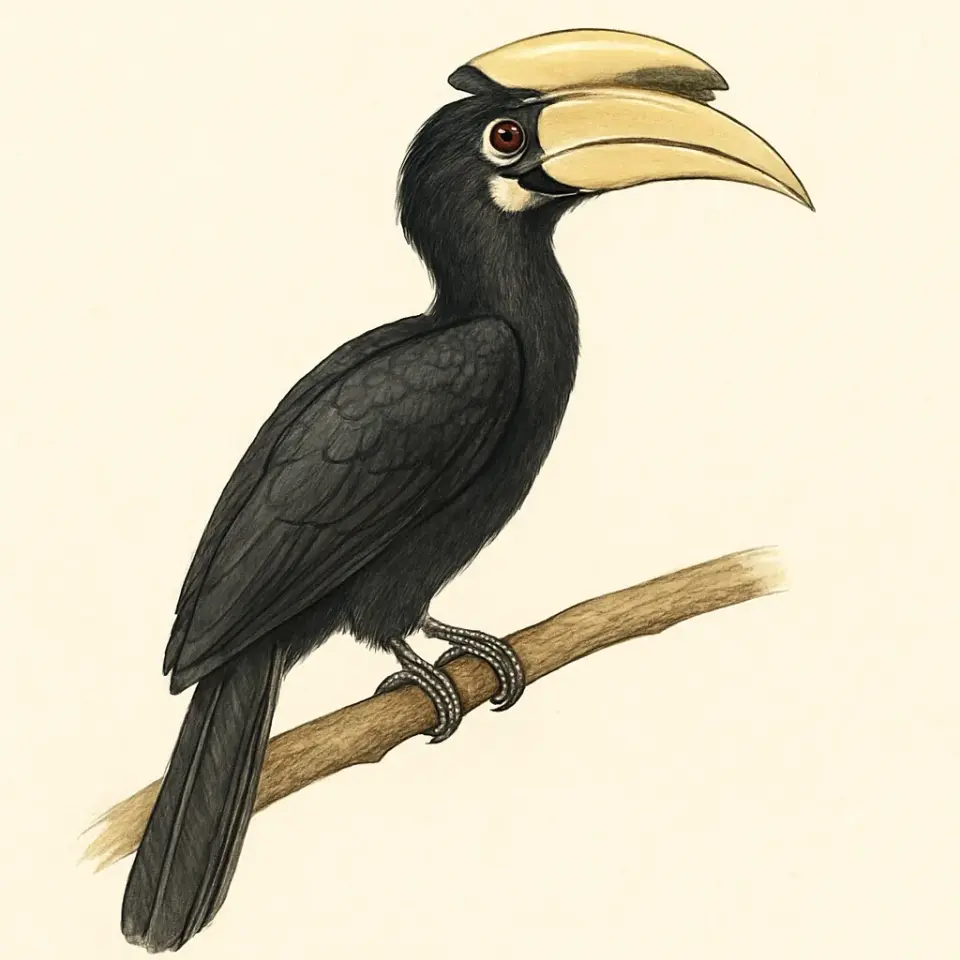
Malabar pied hornbill: the loud black-and-white hornbill
The Malabar pied hornbill (Anthracoceros coronatus) is a large black-and-white hornbill, about 65 cm long, with a yellow bill topped by a big, mostly black casque. It lives in the forests of the Western Ghats and parts of central and eastern India, and in Sri Lanka. In flight it is loud: you hear the wingbeats before you see the bird. It is rated Near Threatened by the IUCN and protected under Schedule I of India's Wild Life (Protection) Act.
A large black-and-white hornbill with a massive yellow bill and casque, living in the riverside fig forests of the Western Ghats.
How to recognise it
The flight is loud — you hear the wingbeats before you see the bird. White tail corners and a white trailing edge to the wing.
Where to see it
Goa
Hornbills need large old trees with natural cavities, so their presence is a direct measure of how much mature forest a valley still has.
 Chorla Ghat (in season) · Dudhsagar Falls (in season) · Budbudyanchi Tali (Bubbling Lake), Netravali (in season)
How to recognise it
The plumage is mostly black, with a white belly, a white throat patch, white outer tail feathers and a white trailing edge to the wing. Seen from below in flight, the white tail corners and the white strip along the back of the wings are the quickest marks. The bird weighs around 1 kg, and its wingbeats are loud enough to hear before it comes into view.
The bill is yellow, and on top of it sits a large casque, a hollow helmet-like ridge, mostly black. Females have bare white skin around the eye, which males lack. Young birds have no casque yet.
The bird most easily confused with it is the oriental pied hornbill, which is similar in pattern.
Figs, old trees and a walled-in nest
Figs are the core of its diet: about 60% of what it eats from May to February, and up to three quarters of the fruit brought to the nest in the breeding months of March and April. It also takes other fruit, including the seeds of strychnine tree (Strychnos nux-vomica), poisonous to many animals, as well as insects, small reptiles, birds and mammals, swallowed whole.
Nesting is the remarkable part. The female settles into a natural hole in a big tree, lays two or three white eggs and seals the entrance with a plaster of mud, droppings and fruit pulp, leaving only a narrow slit. Through it the male feeds her and later the chicks. When the chicks grow too big to share the space, she breaks out, rebuilds the wall, and both parents feed the young through the gap.
Because hornbills need large old trees with natural cavities, their presence is a direct measure of how much mature forest a valley still has.
Where to look in Goa
The species lives mainly in low-altitude moist evergreen and tall deciduous forest, especially near rivers, and also uses plantations and more open woodland. In the Western Ghats it occurs in pockets from western Maharashtra through Goa and Karnataka to Kerala and Tamil Nadu.
In Goa the guide marks it as a seasonal bird of the forested east: at Chorla Ghat, in the forest of the Mandovi headwaters around Dudhsagar Falls, and around Budbudyanchi Tali, the Bubbling Lake at Netravali. A fruiting fig tree is the best place to wait, and the sound of heavy wingbeats is often the first sign. Sightings are never guaranteed; for other species of the region see birds of Goa.
Status and protection
The IUCN Red List rates the Malabar pied hornbill Near Threatened (BirdLife International assessment). In India it is listed in Schedule I of the Wild Life (Protection) Act as amended in 2022, alongside the great hornbill and other hornbills, which gives it the highest level of legal protection. It is also in Appendix II of CITES.
The species nests in natural cavities of large old trees, so it depends on mature forest. A study at Dandeli in Karnataka, comparing populations over a 23-year period, found no significant change.
FAQ
How do I tell a Malabar pied hornbill from other hornbills?
Look for a black bird about 65 cm long with a white belly, white tail corners and a white trailing edge to the wing, and a yellow bill with a big, mostly black casque. The oriental pied hornbill is the most similar species.
Is the Malabar pied hornbill endangered?
The IUCN rates it Near Threatened. In India it has the strictest legal protection, Schedule I of the Wild Life (Protection) Act.
What does the Malabar pied hornbill eat?
Mostly figs, plus other fruit, insects, small reptiles, birds and mammals.
Where can I see the Malabar pied hornbill in Goa?
The guide lists it as seasonal at Chorla Ghat, in the forest around Dudhsagar Falls and around Budbudyanchi Tali, the Bubbling Lake at Netravali. Waiting near a fruiting fig gives the best chance.
Why does the female hornbill seal herself into the nest?
The wall of mud, droppings and fruit pulp leaves only a slit for the male to pass food, which protects the eggs and chicks inside the tree hole.
Sources (2)
Facts checked: 8 October 2026. Prices and hours are approximate; check locally.