 India GO
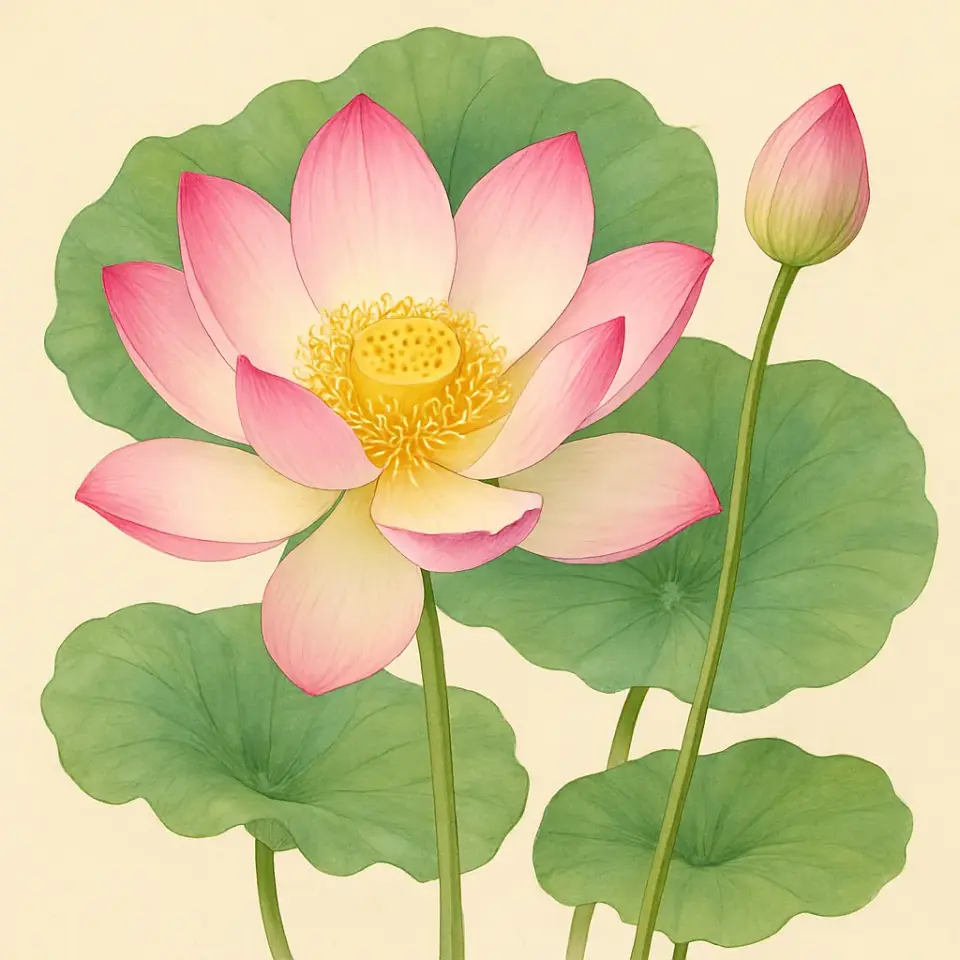
Sacred lotus (kamal): India's national flower
कमल (kamal)
The sacred lotus, Nelumbo nucifera, is kamal or padma in Indian languages and the national flower of India. It is not a water lily: its leaves and pale pink or white flowers stand on stiff stalks clear of the water. Across India it flowers mainly from June to October, in the rains and after, on temple tanks, village ponds and city lakes.
Not a water lily: the lotus holds its round leaves and its flower clear above the water on stiff stalks, and water beads off the leaf surface without wetting it.
How to recognise it
Leaves standing above the surface, pale pink or white flowers, and a flat-topped seed head like a shower rose. Water lilies, by contrast, float flat on the water.
Where to see it
Bengaluru
The state flower of Karnataka and widely called the national flower of India. On city lakes the lotus mats matter practically as well: they are where pheasant-tailed jacanas, moorhens and bronze-winged jacanas nest.
 Kaikondrahalli Lake (in season) · Lalbagh Botanical Garden (in season) · Sankey Tank (in season)
Hampi
Pampa Sarovar is named in the Ramayana as the tank where Shabari waited for Rama, and the lotus is the flower of that whole story, as well as the state flower of Karnataka.
Pampa Sarovar (in season) · Tungabhadra Dam & Gardens (in season)
Kolkata
Each Durga Puja needs 108 lotuses for the Sandhi Puja, at the junction of the festival's eighth and ninth days, and on that day West Bengal's demand reaches about ten million flowers; in most years at least 30 per cent come from other states.
Rabindra Sarobar (in season) · Eco Park (Prakriti Tirtha) (in season) · AJC Bose Indian Botanic Garden & the Great Banyan (in season)
Mayapur
In the Navadvipa-dhama-mahatmya the nine islands of Navadvipa form an eight-petalled lotus, and Antardvipa, where Mayapur lies, is its central whorl.
Chupi Char, Purbasthali (in season)
Ujjain
Beyond the Nandi Dwar of Mahakal Lok, the temple corridor opened in 2022 along the banks of Rudra Sagar, lies a lotus pond with a towering statue of a meditating Shiva among fountains.
Rudra Sagar Lake (in season) · Vishnu Sagar Lake (in season) · Undasa Lake (in season)
Lotus or water lily
The two are often confused, and the older Bentham and Hooker system, long used in Indian botany, even filed the lotus under the water-lily genus as Nymphaea nelumbo. Today it has its own genus, Nelumbo, and genetic studies place it in the order Proteales with the proteas, far from the water lilies.
The practical test is height. Lotus leaves are round, up to 80–100 cm across, with the stalk joined at the centre, and most of them stand above the surface on stalks that can be two metres long. Water slides off them in beads. The flowers rise on thick stems clear of the water, and after the petals fall they leave a flat-topped seed head with holes, like the rose of a watering can. Water lilies, by contrast, lie flat on the water.
Two odd facts: lotus flowers keep themselves at 30–35 °C even when the air is much cooler, and the seeds can wait a very long time. One seed about 1,300 years old, from a dry lake bed in China, has been germinated.
Why the lotus is sacred
The image is simple: roots in the mud, a flower that opens clean above the water. In Hindu thought that is the path of a life lived by dharma, and the open flower stands for moksha, liberation. Lakshmi is shown seated or standing on a lotus and holding lotuses in two of her hands; Vishnu holds one, and his epithet Kamalanayana means "lotus-eyed". In temples lotuses are offered above all to Lakshmi and other goddesses, to Vishnu for prosperity and to Shiva for liberation; the seeds are strung as prayer beads.
The lotus runs through practice and stone as well: padmasana, the lotus pose of yoga; sahasrara, the thousand-petalled lotus of tantra; lotus-bud domes and lotus-stalk pillars in Hindu, Buddhist and Jain temples, and the lotus throne under figures of gods and the Buddha. Buddhists offer it to the Buddha, and Jain art uses the same throne.
Some festivals need it in bulk. Each Durga Puja requires 108 lotuses for the Sandhi Puja, at the join of the eighth and ninth days, which in West Bengal means millions of flowers in a single day.
Where and when to see it in bloom
The flowering season across the India GO cities is the monsoon and the months after: roughly June to October in Bengaluru and Hampi, July to October in Kolkata, Mayapur and Ujjain.
Bengaluru: the lotus is Karnataka's state flower, and on city lakes the mats double as nesting ground for jacanas and moorhens. Try Kaikondrahalli Lake, Sankey Tank and the lake at the south end of Lalbagh.
Hampi: Pampa Sarovar, the tank tied to Shabari's wait for Rama in the Ramayana, is covered in lotus in and after the monsoon.
Kolkata, Mayapur, Ujjain: Rabindra Sarobar and Eco Park in Kolkata, village ponds around Mayapur, and the lakes of Ujjain, including Rudra Sagar beside the Mahakal Lok corridor.
For other trees and flowers of the city, see trees and flowers of Bengaluru.
Lotus on the plate
Almost every part of the plant is eaten somewhere in Asia. In north and east India the lotus stem, kamal kakdi in Hindi, goes into sabzi and is fried as pakoras, and in the south the stem is sliced, salted, dried and fried. Lotus seeds are eaten too.
FAQ
Is the lotus the national flower of India?
Yes, the sacred lotus, Nelumbo nucifera, is India's national flower. It is also the state flower of Karnataka.
What is the difference between a lotus and a water lily?
Lotus leaves and flowers stand above the water on stiff stalks, and the flower leaves a flat seed head like a shower rose. Water lily leaves float flat on the water.
When do lotuses bloom in India?
Mainly in the monsoon and the months after, roughly June to October, depending on the region.
Why is the lotus associated with Lakshmi?
In Hindu iconography Lakshmi sits or stands on a lotus and holds lotuses, and lotuses are her favoured offering. The flower rising clean from mud stands for purity and liberation.
What is lotus called in Hindi?
Kamal (कमल); padma in Sanskrit. The edible stem is called kamal kakdi.
Sources (2)
Facts checked: 8 October 2026. Prices and hours are approximate; check locally.