 India GO
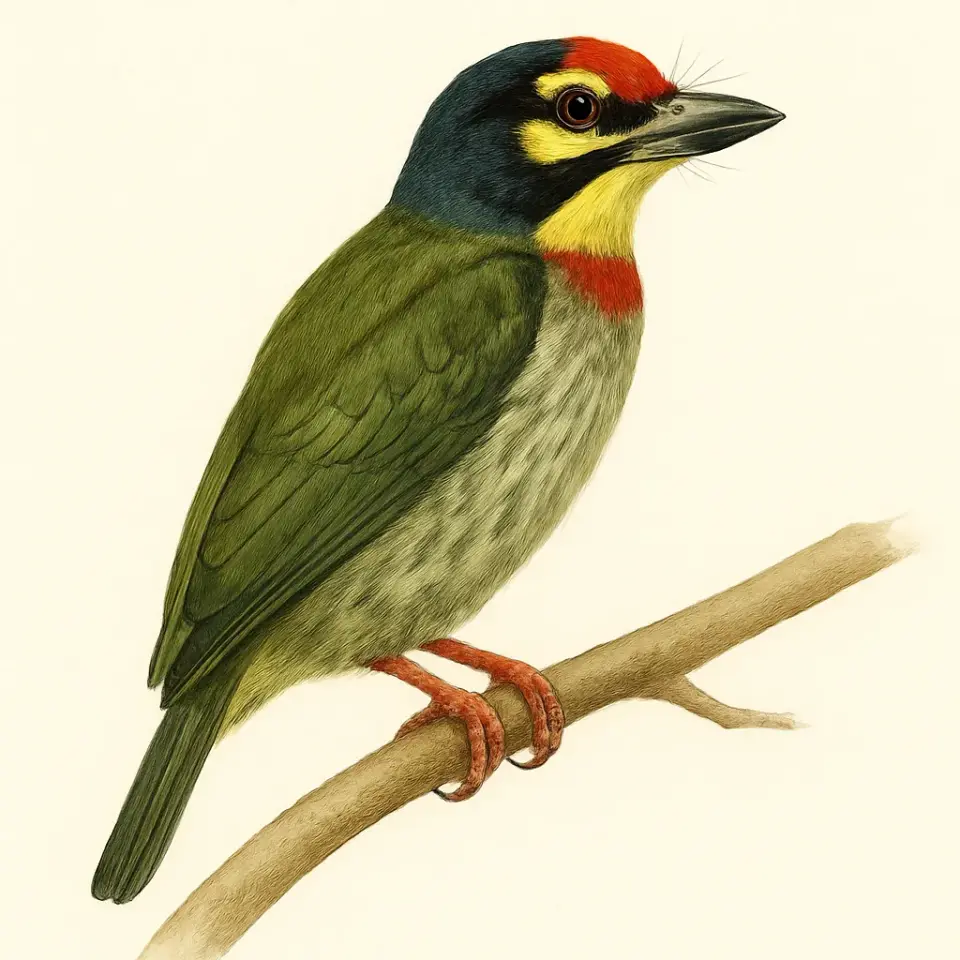
Coppersmith barbet: the small green bird behind the tuk-tuk-tuk call
The coppersmith barbet is a small, stocky green bird with a crimson forehead, much easier to hear than to see. Its call, a metallic tuk-tuk-tuk repeated for minutes at a time, sounds like a coppersmith beating a sheet of metal, which is where the name comes from. It lives across the Indian subcontinent in gardens, groves and city parks wherever there are fig trees, and calls most in the breeding months, roughly February to May.
A small, stocky green bird with a crimson forehead and breast patch and a yellow throat, far easier to hear than to see: its call is a monotonous tuk-tuk-tuk.
How to recognise it
Trace the metallic knocking to a high bare branch and look for a green lump that puffs its throat with every note. It feeds almost entirely on small figs.
Where to see it
Bengaluru
Its tuk-tuk-tuk is one of the constant sounds of a Bengaluru afternoon, and the English name copies it: a coppersmith tapping a bowl. It nests in dead branches, which is one practical argument for leaving standing deadwood in city parks.
 Lalbagh Botanical Garden · Cubbon Park · Bugle Rock Park (often)
How to find and recognise it
Follow the sound. The call starts quietly and settles into an even beat of about two notes a second, and a single bout can run to two hundred notes. Trace it to the top of a tall tree: the bird likes to sit in the morning sun on bare upper branches. With every note a patch of bare skin on its throat puffs out and collapses like a rubber bulb, while the beak stays shut and the head bobs.
- Size: 15–17 cm and 30–53 g.
- Colours: grass-green back, crimson forehead, yellow cheeks and throat, a red patch on the breast (another name is crimson-breasted barbet), and pale underparts streaked with grey and black.
- Flight: straight, with fast wingbeats, from one fruiting tree to the next.
In winter it falls silent and is much harder to find.
Figs, dead wood and nests
The barbet lives on fruit, above all figs: banyan, peepal and other wild figs, plus berries and the odd insect such as a flying termite. It eats between one and a half and three times its own weight in fruit a day, so a fruiting fig can hold several birds at once.
It breeds mainly from February to April in India. Both birds dig the nest hole themselves, on the underside of a narrow branch, usually in dead wood, and the same hole serves as a bedroom at night. That is one practical argument for leaving standing deadwood in city parks.
Where to see it in Bengaluru
Its tuk-tuk-tuk is one of the constant sounds of a Bengaluru afternoon. More garden birds are on the Bengaluru birds page.
Lalbagh Botanical Garden
Common in the fig trees along the main avenues of Lalbagh.
Cubbon Park
Common in the trees of Cubbon Park.
Bugle Rock Park
Seen often in the trees around the rock at Bugle Rock Park in Basavanagudi.
FAQ
Why is it called the coppersmith barbet?
Its call, a loud metallic tuk-tuk-tuk, sounds like a coppersmith hammering a sheet of copper.
When does the coppersmith barbet call?
Mostly in the breeding season, roughly February to May; it is silent in winter.
What does the coppersmith barbet eat?
Mainly figs, including banyan and peepal, plus berries and occasional insects.
Where can I see a coppersmith barbet in Bangalore?
It is common in Lalbagh and Cubbon Park and often seen at Bugle Rock Park. Listen for the call and look at the tops of fig trees.
Is the coppersmith barbet protected in India?
Yes. It is listed in Schedule II of the Wild Life (Protection) Act as amended in 2022, so hunting or trapping it is an offence. The IUCN lists it as Least Concern.
Sources (2)
Facts checked: 8 October 2026. Prices and hours are approximate; check locally.