 India GO
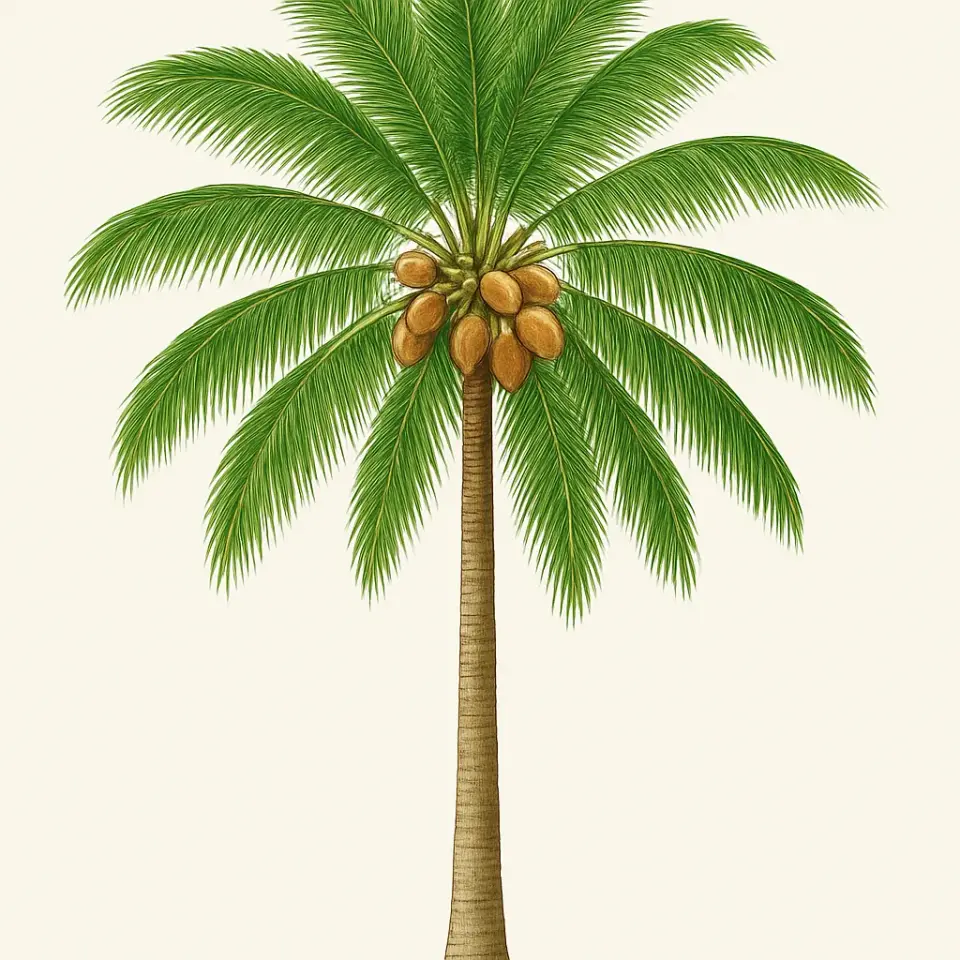
Coconut palm (nariyal): the tree of India's coast
नारियल (nariyal)
The coconut palm (Cocos nucifera), nariyal in Hindi, thengu in Malayalam and thennai in Tamil, draws the line of India's western and southern coast. It is the state tree of Kerala and, since a December 2017 notification, one of Goa's two state trees. Behind the beaches its groves are working farms, and Hindus often break a coconut at the start of a new undertaking.
A tree that supplies roofing, rope, oil and sweetener, and whose fruit is broken at the start of almost any ceremony.
How to recognise it
A leaning grey trunk ringed with old leaf scars and a crown of long feathered fronds. Trunks lean toward the light, which is why coastal groves all tilt seaward.
Where to see it
Goa
Goa reclassified the coconut palm as a tree in law after a public campaign over its removal from the protected list, a rare case of a plant's legal category becoming a political argument.
 Palolem · Agonda · Sahakari Spice Farm
Gokarna
On this coast the coconut is both a temple offering and the household economy, and the palm groves behind the beaches are working plantations rather than scenery.
Kudle Beach · Om Beach · Gokarna Beach
Kochi
Coir, the fibre from the husk, built an entire industry on this coast, and the coconut is broken to open almost any ceremony in Kerala.
Kadamakkudy Islands · Cherai Beach
Mumbai
On Narali Purnima, the full moon of Shravan (usually August), Mumbai's Koli fishing families offer coconuts to the sea and pray for calm water as the new fishing season opens.
Juhu Beach · Juhu Beach Neighborhood · Elephanta Caves
Murudeshwar
Coconut groves behind the beach are the local economy rather than decoration, and coastal Karnataka's temple cooking is built on coconut instead of dairy fat.
Murudeshwar Beach · Apsarakonda Falls & Beach
Udupi
On this coast breaking a coconut is how a building, a boat or a journey is begun. Udupi's vegetarian temple cuisine is built on coconut rather than dairy, and the whole Karavali coast rests on this tree.
Malpe Beach · Uppinakudru Island · Mattu Beach
The tree and the nut
A tall coconut palm reaches up to 30 m, with feathered leaves 4–6 m long. Old leaves break away cleanly, which is why the trunk is smooth apart from its rings of scars. On good soil a tall palm gives around 80 nuts a year.
The green nuts sold from carts for drinking are immature, about six to eight months from flowering, full of water and soft jelly. The brown nut sold in markets is the mature one, 11–13 months old, with hard white flesh. The fibrous husk around the shell is coir; dried flesh is copra, pressed for oil; the sweet sap, tapped from the flower stalk, is drunk fresh or fermented as toddy. A young well-kept palm can give around 300 litres of sap a year.
Where it grows in India
India is one of the three biggest coconut producers in the world, with Indonesia and the Philippines. Most of the crop comes from four southern states: Tamil Nadu, Karnataka, Kerala and Andhra Pradesh. Kerala has the most trees; Tamil Nadu gets the most nuts per hectare.
The palm does not tolerate cold and prefers full sun and plenty of rain. On the coast it is everywhere: the groves behind Agonda beach, Sahakari Spice Farm, the Kadamakkudy islands and Cherai Beach near Kochi, the beaches of Gokarna, Murudeshwar and Udupi, and Juhu in Mumbai. Goa's other trees and flowers are on the Goa trees page.
The palm is not native to India. Genetic studies place its origin in the islands between Southeast Asia and Melanesia, where Austronesian seafarers domesticated it and carried it across the oceans. It reached the subcontinent long ago: the Ramayana and Sri Lankan chronicles show it here before the 1st century BCE.
Why a coconut opens a ritual
In Sanskrit the coconut is narikela, and the tree is sometimes called kalpa vriksha, the tree that gives everything needed for life. In Hindu practice a new beginning, a puja, a wedding or a journey is often opened by cracking a coconut to ask for the gods' blessing, and at weddings it is a symbol of prosperity. Coconuts offered in worship are often decorated with bright metal foil, and Lakshmi, goddess of prosperity, is often shown holding one.
On the Konkan coast the full moon of Shravan is Narali Purnima, when fishing families offer coconuts to the sea as the new season opens. In coastal Karnataka, including Udupi's temple cuisine, cooking is built on coconut rather than dairy fat, and around Kochi the coir made from the husk grew into a whole industry.
A palm that became a political argument in Goa
In January 2016 Goa amended its tree-preservation law so that the coconut palm no longer counted as a tree, which made felling it far easier. The opposition and civil society accused the government of helping real estate and industry at the cost of the environment. In June 2017 the new government promised to undo it. The Goa Preservation of Trees (Amendment) Act of September 2017 put the coconut palm back into the definition of a tree and allowed the state to declare state trees, and a December 2017 notification named two: the coconut palm and the matti.
As a species the palm is not threatened: it is a crop grown across the tropics.
The falling-coconut myth
A popular claim says falling coconuts kill more people every year than sharks do. It is an urban legend: there is no reliable count of deaths from falling coconuts. The people who do get hurt are the climbers: climbing is the most widespread way to harvest coconuts, and it is the more dangerous one, done by skilled workers.
FAQ
What is the state tree of Kerala?
The coconut palm. Goa notified it as one of its two state trees, with matti, in December 2017.
What is the coconut palm called in Hindi?
Nariyal (नारियल). In Malayalam it is thengu, in Tamil thennai, in Kannada tengina mara, and in Sanskrit narikela.
Why do Hindus break a coconut before starting something?
Breaking a coconut at a new beginning is a way of asking for the gods' blessing. Coconuts are also offered in worship and used at Hindu weddings as a symbol of prosperity.
Is the coconut palm native to India?
No. Its origin lies in island Southeast Asia and Melanesia, and seafarers carried it west. It has grown in India for more than two thousand years.
Do falling coconuts really kill more people than sharks?
No, that is an urban legend; there is no reliable count of deaths from falling coconuts. Coconut climbers are the ones at real risk.
Sources (6)
Facts checked: 8 October 2026. Prices and hours are approximate; check locally.