 India GO
Temples in Gokarna
Before Gokarna was a beach town it was a temple town, and it still runs on the temples' clock. The heart is the Mahabaleshwara Temple, where by legend the Atmalinga of Shiva stays fixed to the ground; around it, the morning goes in a set order: a dip at the Koti Teertha tank, Maha Ganapati first, then Mahabaleshwara. The whole round on foot takes under two hours. Darshan is roughly 6:00–12:30 and 17:00–20:00, entry is free, and the dress code is traditional.
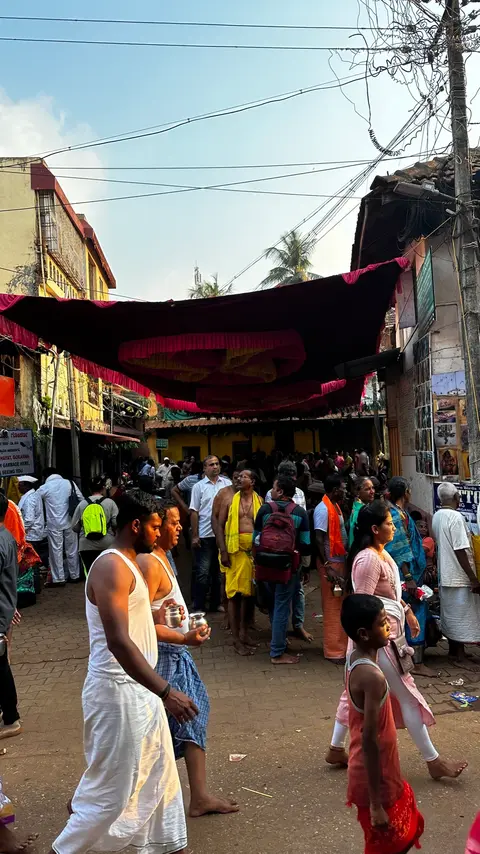
The temples and sacred places
The town's sacred places sit within a few lanes of each other around Car Street and the main beach.
Shri Mahabaleshwara Temple
The main Shiva temple, granite, in the Dravidian style, with a small dark sanctum. The Atmalinga rests on a square pedestal, and through a small opening in it devotees see only its top. Royal patronage is traced at least to the Kadamba kings (4th–6th centuries), and most of the complex was built and extended in the Vijayanagara period. Gokarna is one of Karnataka's seven Muktikshetras (places of liberation), where Hindus perform the last rites for their dead.
Maha Ganapati Temple
A black-stone Ganesha 1.3 metres tall and about fifteen centuries old, in a shrine barely bigger than a room a few steps from Mahabaleshwara. The dent on his head is, by tradition, the blow from Ravana. Pilgrims come here first; entry is free and photographs are not taken inside.
Koti Teertha
A stone tank at the end of the old town's lanes, ringed by small shrines, monasteries and old houses, with a lingam pillar in the middle of the water. The name means a crore (ten million) of springs. Pilgrims bathe here before darshan (the sight of the deity), and priests perform rites for ancestors on the steps. It is about 700 m from the bus stand and most alive early in the morning.
Rama Teertha
A small temple on high ground above the main beach, with one of the widest views of the coast and the town. People come at sunrise or in the hour before sunset simply to sit.
Shiva's Cave and the Yana cave shrine
Near Kudle Beach, a small cave holds a Shivalingam lit only by candles; by legend Shiva emerged here from a cow's ear, which gave Gokarna its name. Inland at Yana, water drips onto a self-formed lingam at the foot of a limestone tower. Both are on the caves of Gokarna page.
The morning round, in order
The order is the town's own, and the lanes follow it.
- Bath at Koti Teertha
Washing before the temple is how the day starts: in the tank, in the sea, or at the washing area by the temple entrance.
- Maha Ganapati
Ganesha is greeted first, at the end of Car Street, before entering the great temple.
- Mahabaleshwara
Then the main temple. Abhisheka (the ritual bathing of the linga) begins at dawn, which is why the early hours are the busiest with priests and pilgrims.
- The smaller shrines
Afterwards the smaller shrines of the town, among them Bhadrakali and Tamra Gauri. Karnataka Tourism describes the Panchalinga Yatra, a circuit of about 3 km traditionally walked barefoot before noon, starting with the bath at Koti Teertha.
Timings, dress and rules
- Timings — Mahabaleshwara is open daily about 6:00–12:30 and 17:00–20:00, with the last arati (lamp offering) at 20:00. Hours shift on festivals and are extended on Shivaratri and on Mondays. Entry is free.
- Dress — Men wear a dhoti or lungi in the inner sanctum and take the shirt off before entering it; women wear a sari, salwar kameez or other traditional dress. Karnataka Tourism says the code is now strictly enforced and that jeans and shorts are not allowed; the temple is a short walk from the sand, so change first. More on the what to wear page.
- Non-Hindus — Non-Hindus are generally allowed into the outer halls but not into the inner sanctum, as at many major South Indian temples. Final say rests with the priests; ask at the temple office.
- Photography — Photography is strictly prohibited inside the temples. Shoes come off at the door, and locals often walk barefoot from the beach to the temple.
Maha Shivaratri and the chariot
At Maha Shivaratri the temple brings out its great wooden chariot and the town hauls it along Car Street, between the Maha Ganapati and Venkataramana temples, behind drum bands; the night itself is spent in worship outside Mahabaleshwara. Gokarna's Rathotsava: 6–9 March 2027 (expected). The town has few rooms, so book about a month ahead and arrive the day before. Kartika Purnima also brings large crowds.
FAQ
What are the Gokarna temple timings?
Mahabaleshwara is open about 6:00–12:30 and 17:00–20:00 every day; on festivals the hours shift, and on Shivaratri the temple stays open longer.
What is the story of Ravana and the Atmalinga?
By legend Ravana won the Atmalinga from Shiva on condition that it would stay wherever it first touched the ground. At Gokarna, Ganesha, disguised as a boy, set it down while Ravana was at his prayers, and Ravana could not lift it again: hence the name Mahabaleshwara, the all-powerful.
Are non-Hindus allowed in Gokarna temple?
Into the outer halls, generally yes; the inner sanctum is usually closed to non-Hindus, at the priests' discretion.
What is the dress code at Gokarna temple?
Traditional: men in a dhoti or lungi, shirt off for the sanctum; women in a sari or salwar kameez. No jeans, shorts or beachwear.
Are phones allowed in Gokarna temple?
Photography is strictly prohibited inside, including selfies near the sanctum, so keep the phone away.
What are the famous temples in Gokarna?
Mahabaleshwara and Maha Ganapati on Car Street, the Koti Teertha tank, Rama Teertha above the main beach and the smaller shrines such as Bhadrakali and Tamra Gauri.
Facts checked: 15 October 2026. Prices and hours are approximate; check locally.
The full catalogue, hidden spots and districts on the map, plus “nearby” mode.
Open in India GO