 India GO
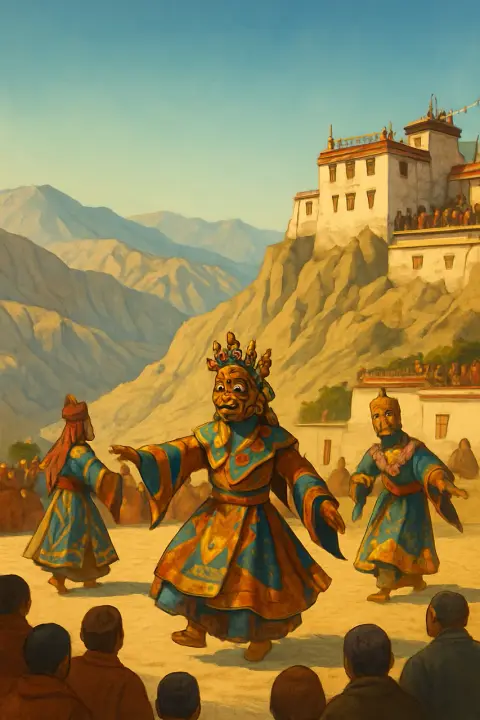
Yuru Kabgyat: masked dances at Lamayuru above the moonland
Masked dancers above a valley of grey eroded ridges that look like the moon
Yuru Kabgyat is the summer masked-dance festival of Lamayuru monastery in Ladakh, 127 km west of Leh on the Srinagar-Leh highway, at 3,510 m. For two days monks dance the cham in the monastery courtyard, and on the second day the dances end with the burning of effigies. Dates: 1–2 July 2027, published in Ladakh Tourism's monastic festival calendar.
Lamayuru monastery and the Ladakh tourism department publish the dates in the monastic festival calendar, usually a year ahead; the Ladakhi almanac can differ from the calculation by a day.
The legend

Drikung history says the Indian scholar Naropa (956–1041) drained the lake that filled the valley and founded the monastery; his cave survives in the main hall.

Lamayuru's oldest temple, Seng-ge-sgang, is credited to Rinchen Zangpo (958–1055), the builder-monk charged by the king with raising 108 gompas.
Twice a year Lamayuru holds masked-dance festivals, and monks from the surrounding gompas gather here to pray together.
Customs
Cham in the courtyard
For two days masked monks dance the cham in the courtyard of one of Ladakh's oldest monasteries, home to about 150 monks.
Burning the effigy
The second day ends with the burning of an effigy, believed to drive away obstacles and misfortune.
Where to celebrate
Lamayuru
Two days of masked cham at Lamayuru, about 125 km west of Leh above the grey eroded ridges called the moonland; on Day 2 the dances end with the burning of effigies.
Two days of cham
Lamayuru belongs to the Drikung Kagyu school of Tibetan Buddhism and is one of the oldest monasteries in Ladakh, with about 150 monks. It holds two masked-dance festivals a year, and for each of them monks from the surrounding gompas (monasteries) gather here to pray together. Yuru Kabgyat is the summer one, two days at the end of the fifth month of the Ladakhi almanac.
On both days the cham, the masked ritual dance, is performed in the monastery courtyard. The dances are part of religious practice, performed by monks. The second day is the main one: the dances end with the burning of effigies, which the Ladakh administration describes as standing for the destruction of the ego and which is believed to drive away obstacles and misfortune.
Around the monastery lies what Ladakh calls the moonland, eroded grey ridges along the highway that can be seen from the village lanes and the road. The monastery's usual entry fee applies in the courtyard.
Naropa's lake
According to Drikung history, the Indian scholar Naropa (956-1041) caused a lake that filled the valley to dry up and founded the monastery; his meditation cave is preserved, behind glass, in the main hall. The oldest surviving temple, Seng-ge-sgang, is attributed to Rinchen Zangpo (958-1055), the builder-monk whom the king charged with raising 108 gompas. Tradition also holds that Lamayuru was once the foremost Bon monastery in Ladakh. The monastery once had five buildings; remains of the four corner ones can still be seen.
Altitude, fees and permits
Lamayuru is a long day trip from Leh, so most of the planning is about Leh.
- Acclimatise in Leh first — Leh is at 3,500 m and Lamayuru at 3,510 m. Ladakh Tourism requires every tourist arriving in Leh to take at least 48 hours of complete rest before travelling to higher areas, and its guidelines keep day 3 for nearby sights at a similar altitude, such as Shanti Stupa and Leh Palace. Arriving in Leh three days before the festival leaves room for this. If you feel unwell, see a doctor: medical facilities are concentrated in Leh, and SNM Hospital there provides emergency oxygen support. More: health in India.
- Getting there — Fly to Leh's Kushok Bakula Rimpochee Airport, or come by road via Srinagar and Kargil or via Manali. From Leh, Lamayuru is about four hours by road and can be done as a day return trip. Alchi, with its old temples, is on the same highway roughly halfway and makes a natural stop.
- Pay the Leh visitor fees — Lamayuru is in Leh district, which charges visitors an environmental (green) fee, a Red Cross Fund contribution and a wildlife fee. They are paid online on the district portal lahdclehpermit.in, or through a local travel agent, which the portal says brings a 10% discount; keep the slip.
- Permits for foreign visitors — The Leh portal says the inner line permit applies only to foreign tourists, and it lists Lamayuru, Khaltse, Skurbuchan and Hanu as one of the circuits foreigners register for. Citizens of Pakistan, Afghanistan and China, and holders of diplomatic, UN, international organisation, official and journalist passports or visas, need a Protected Area Permit from the Government of India for protected areas. The Ladakh administration is reviewing the permit rules for foreign tourists, so check the current position on the portal or with a Leh travel agent before you go.
- Book early — June and July are the peak months for flights to Leh: book about two months ahead. Lamayuru has a handful of guesthouses and the monastery's own rooms; to sleep there, book about six weeks ahead, or stay in Leh and hire a taxi for the day.
- In the courtyard — Do not step onto the dance ground while the dancers are moving, dress modestly for a monastery and ask before photographing monks at prayer.
More monastery festivals in Ladakh
The best-known summer festival is Hemis Tsechu at Hemis monastery near Leh; in winter Leh holds Dosmoche.
FAQ
When is Yuru Kabgyat?
1–2 July 2027. It is held over two days at the end of the fifth month of the Ladakhi almanac, usually in June or early July; Ladakh Tourism publishes the dates in its monastic festival calendar.
How far is Lamayuru from Leh?
127 km west of Leh by the Srinagar-Leh highway, about four hours by road; it can be visited as a day return trip.
What is the altitude of Lamayuru?
The monastery stands at 3,510 m, about the same height as Leh (3,500 m). Ladakh Tourism requires 48 hours of complete rest after arriving in Leh.
Do I need a permit for Lamayuru?
All visitors pay the Leh district fees online at lahdclehpermit.in. Foreign visitors register through the same portal, and some nationalities need a Protected Area Permit from the Government of India; the rules are under review, so check before you go.
What happens on the second day?
The cham dances end with the burning of effigies, which the Ladakh administration describes as standing for the destruction of the ego.
Sources (8)
- Administration of UT Ladakh: Lamayuru, the moonscape
- Ladakh Tourism: Monastic Festival Calendar
- Ladakh Tourism: Advisories (acclimatisation, health)
- Leh District Tourist Management System (fees and permits)
- Leh District Tourist Management System: circuits to visit and PAP rules
- Leh District Tourist Management System: FAQs (inner line and protected area permits)
- Administration of UT Ladakh: Chief Secretary reviews PAP and RAP framework
- Lamayuru Monastery
Facts checked: 22 October 2026. Prices and hours are approximate; check locally.