 India GO
Hemis Tsechu: two days of masked dance at Ladakh's largest monastery
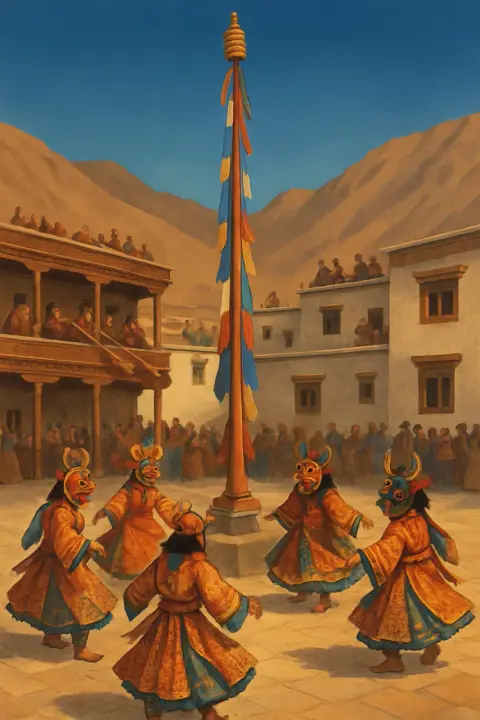
Monks in brocade and carved masks turn slowly to long horns in a stone courtyard
Hemis Tsechu is the two-day festival of Hemis Monastery in Ladakh, the principal seat of the Drukpa Kagyu school of Tibetan Buddhism, about 40 to 45 km from Leh. It falls on the tenth day of the fifth Tibetan month, the birth anniversary of Guru Padmasambhava, and the day after; this usually lands between mid-June and mid-July. Next: 13–14 July 2027. Monks in brocade and carved masks dance the cham in the monastery courtyard, and the Ministry of Tourism lists the festival as free to attend.
The days follow the Tibetan calendar; Hemis monastery and the Ladakh tourism department publish them in the monastic festival calendar about a year ahead, and the administration gazettes the holiday.
The legend
Tibetan biographies tell of a lotus opening on Lake Dhanakosha in the land of Oddiyana, with an eight-year-old boy inside: Padmasambhava, "born from a lotus".
In the 8th century he is invited to Tibet, where he tames the local spirits so that the first monastery, Samye, can be built.

He is believed to have hidden secret texts, terma, to be found centuries later when the time is right.
So on the tenth day of the fifth month, his birthday, the monks of Hemis come out into the courtyard to dance the cham.
Meaning
Hemis
King Sengge Namgyal re-founded this Drukpa monastery in 1672, and its courtyard gallery holds 17th-century paintings of the 84 Mahasiddhas.
Rewalsar
Lake Tso Pema is sacred to Hindus, Sikhs and Buddhists; its origin is credited to the practice of Padmasambhava and the princess Mandarava.
Customs
Cham
Monks in brocade and carved masks turn slowly to the drums: these dances are part of tantric practice.
An image at dawn
In the morning, to drums, cymbals and pipes, an image of the Guru is displayed for veneration on the monastery roof.
The orchestra
The music comes from four pairs of cymbals, big drums, small trumpets and huge horns.
Words of the festival
འཆམ
cham
the masked and costumed ritual dance of Tibetan Buddhism
ཚེས་བཅུ
tsechu
"tenth day": Drukpa festivals held on the tenth day of a lunar month
གཏོར་མ
torma
a figure of flour and butter used in rites and as an offering
ཐང་ཀ
thangka
a painting on cotton or silk, kept rolled up between showings
True or myth
❌ Myth. The story was published in 1894 by the journalist Nicolas Notovitch, and historians regard it as invented.
✅ True. That is the traditional count: nine thousand nine hundred and ninety-nine life stories.
❌ Myth. The festival is annual; once in twelve years, in the Monkey year, a giant thangka of Padmasambhava is unrolled as well.
Where to celebrate
Hemis
Worth the trip
Two days of masked cham in the courtyard of Hemis, 45 km from Leh, on Guru Padmasambhava's birth anniversary; in the Monkey year 2028 the great thangka is unfurled too.
What you see in the courtyard
The day begins on the monastery roof: early in the morning, to drums, cymbals and pipes, an image of the Guru is displayed for veneration. The dances then move into the courtyard in front of the main door, where the head lama presides from beneath a canopy and the orchestra plays: pairs of cymbals, large drums, small trumpets and the long horns.
The cham is a masked ritual dance of the Tantric Vajrayana tradition, performed only in monasteries that follow those teachings. The Ministry of Tourism describes masks of gods, goddesses, dakinis and asuras, and, particular to Hemis, the dance of Guru Padmasambhava and his eight manifestations. The pace is slow and deliberate; the dances are part of religious practice, which is why they are performed by monks and not by a troupe. On both days they run from about 9 am to mid-afternoon.
Once every twelve years, in the Tibetan Monkey year, Hemis also unrolls its great thangka of Padmasambhava, a giant embroidered silk painting, down a wall of the monastery on the second day. The Ministry of Tourism describes the thangka as about 22 feet high.
Why Padmasambhava, and why Hemis
Padmasambhava, Guru Rinpoche, was invited to Tibet in the 8th century, where, tradition says, he subdued the local spirits so that Samye, the first monastery, could be built; the Ministry of Tourism calls him the founder of the Nyingma, the oldest order of Tibetan Buddhism. Tsechu means 'tenth day', and Drukpa monasteries hold their great festivals on the tenth day of a lunar month in his honour.
Hemis itself sits on the Indus side of the valley, south-east of Leh. King Sengge Namgyal re-founded it in 1672, and its courtyard gallery keeps 17th-century paintings of the 84 Mahasiddhas, made with ground mineral pigments. If you come for the festival, give those galleries a look before the crowd fills the steps.
Getting there and acclimatising
Hemis has almost no accommodation, so the plan is to stay in Leh and drive out for the day.
- Arrive in Leh at least three days early
Leh is at about 3,500 m, and altitude sickness is the commonest thing that spoils a Ladakh trip. Rest for the first two days. FCDO advises that insurance should cover altitudes over 2,400 m; see our health guide.
- Fly in, most likely
The Ministry of Tourism gives Leh's Kushok Bakula Rimpochee Airport as about 39 km from Hemis and the nearest convenient railway station as Jammu Tawi, about 670 km away. The roads from Manali and Srinagar take two days.
- Book early
June and July are Ladakh's busiest months: book Leh about three months ahead and the flight about two months ahead.
- Pay the Leh visitor fees
Leh district charges visitors an environmental (green) fee, a Red Cross fund contribution and a wildlife fee, paid online on the official LAHDC Leh portal. Carry the slip.
- Hire a taxi for the day
Take a taxi from Leh for the drive along the Indus, and arrive before 9 am: places on the steps and galleries around the courtyard go early.
In the courtyard
The cham is a religious rite watched by monks, devotees and visitors together; the festival attracts thousands of people.
- Keep the dance ground clear — Stay on the steps and galleries and do not step into the courtyard while the dancers are moving.
- Dress for a monastery — Covered shoulders and knees are the respectful choice. Mornings at this altitude are cold and the sun is strong by midday: layers, a hat and sunscreen.
- Crowds — FCDO notes that stampedes have occurred at some events with large crowds, including religious gatherings, and advises following the advice of the local authorities. Emergency number in India: 112.
FAQ
When is Hemis Tsechu?
Next: 13–14 July 2027. It is the 10th and 11th days of the fifth Tibetan month, usually between mid-June and mid-July; Hemis and the Ladakh tourism department publish the dates in the monastic festival calendar about a year ahead.
Which religion is the Hemis festival associated with?
Tibetan Buddhism. Hemis is the principal seat of the Drukpa Kagyu school, and the festival honours Guru Padmasambhava.
Is there an entry fee for Hemis Tsechu?
The Ministry of Tourism lists the festival as free. Leh district's visitor fees, paid online, are separate.
How far is Hemis from Leh?
About 40 to 45 km south-east of Leh along the Indus. Most visitors go by taxi for the day.
Is the Hemis festival held only every 12 years?
No. It is held every year; only the unrolling of the great thangka of Padmasambhava comes once in twelve years, in the Monkey year.
What else is on in Ladakh around Hemis Tsechu?
The Sindhu Darshan Festival is held in June, and Hemis also hosts the Naropa Festival.
Sources (5)
Facts checked: 22 October 2026. Prices and hours are approximate; check locally.