 India GO
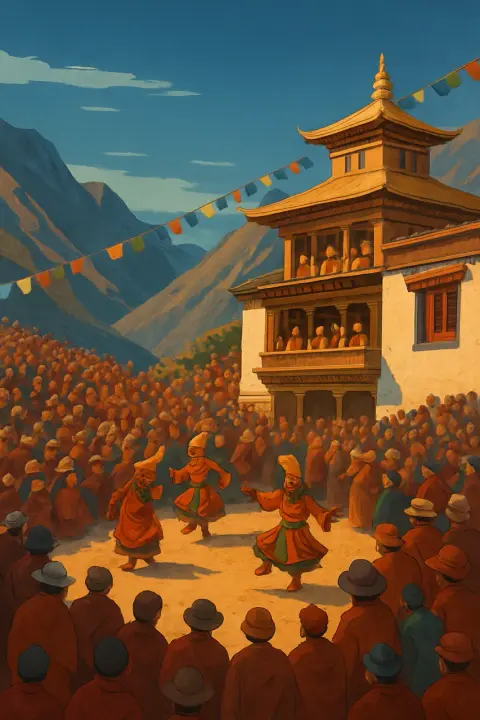
Naropa Festival at Hemis, Ladakh
Once in twelve years, a saint's bone ornaments are worn again
The Naropa Festival honours Naropa, the 11th-century Indian Buddhist master, at Hemis Monastery in Ladakh. Once in twelve years, in September of the Tibetan Monkey year, the head of the Drukpa lineage wears Naropa's six bone ornaments and Buddhists come from across the Himalaya; the last great edition was in 2016. The Drukpa order announces each edition's dates, and none have been announced yet.
The Drukpa order at Hemis announces the dates of each edition; nothing has been announced for 2028 yet.
The legend

Naropa, born in 1016, becomes one of the most learned monks of Nalanda.
His biography says that one day, as he studies, a dakini appears and asks whether he understands the words of the teaching.
He replies that he understands both the words and their meaning, and she bursts into tears: only her brother Tilopa understands the meaning.
Naropa leaves Nalanda, seeks out Tilopa and studies with him for twelve years, passing through twelve hardships.
Tradition says that when he attains enlightenment the dakinis offer him six bone ornaments, and once in twelve years they are brought out at Hemis.
Meaning
Drukpa
The Drukpa lineage's founder, Tsangpa Gyare, is revered as a rebirth of Naropa himself, and the present head of the lineage wears his ornaments for the festival.
Nalanda
Naropa came to Nalanda at 28 and rose to be its abbot before leaving it all behind.
Customs
Six ornaments
The head of the Drukpa lineage comes out in Naropa's six bone ornaments and blesses the crowd.
Empowerment
He gives the Chakrasamvara empowerment, believed to close the doors to rebirth as an animal, a hungry ghost or in hell.
Dragon dance
Artists from Ladakh and Bhutan perform, and Drukpa nuns dance the dragon dance and drum.
Words of the festival
མཁའ་འགྲོ་མ
khandroma
"sky-goer", the Tibetan name for a dakini
གཏུམ་མོ
tummo
the practice of inner heat, at the core of Naropa's six teachings
རྒྱལ་དབང་འབྲུག་པ
Gyalwang Drukpa
the title of the head of the Drukpa lineage, now held by the twelfth Gyalwang Drukpa
True or myth
✅ True. Legend says nine dragons rose from the earth into the sky before its founder Tsangpa Gyare, so the lineage was named Drukpa, "of the dragon".
❌ Myth. They come out once in twelve years; in 2016 that marked Naropa's thousandth birth anniversary.
❌ Myth. He was Indian; his six teachings were carried to Tibet by the translator Marpa, who passed them on to Milarepa.
Where to celebrate
Hemis
Worth the trip
Once every twelve years, in the Monkey year, the head of the Drukpa lineage wears Naropa's six bone ornaments at Hemis; the next great edition is expected in 2028.
What happens at the twelve-year edition
The great Naropa Festival is held at Hemis, the monastery of the Drukpa lineage in Ladakh, about 45 km from Leh. Its centre is a single act: the head of the lineage, the Gyalwang Drukpa, puts on the six bone ornaments that, by tradition, the dakinis gave Naropa at his enlightenment, and blesses the crowd. The ornaments come out only once in twelve years.
At the last great edition, in 2016, the festival marked the thousandth anniversary of Naropa's birth. At the Naro Palace in Hemis the 12th Gyalwang Drukpa wore the ornaments, the fourth time in his life he had done so, and gave the Chakrasamvara empowerment, a tantric initiation that devotees believe closes the doors to rebirth as an animal, a hungry ghost or in hell. Books and devotional songs were released, Ladakhi and Bhutanese artists performed, and Drukpa nuns danced the dragon dance and drummed. Thousands of devotees came, and the festival ran for about a week in September.
Most of it, the display of the ornaments, the teachings and the dances, has been free to attend; some programmes were ticketed.
The annual Naropa Festival
Between the great editions a smaller Naropa Festival has also been held in Ladakh in September. In 2019 it was held in Leh and ran for four days from 16 September, organised by a committee chaired by Thuksey Rinpoche, with school performances and a theme of environmental sustainability in Ladakh and the Himalaya. The reports of these years do not describe a display of the bone ornaments, which stays reserved for the twelve-year edition. If you are in Ladakh in September, ask in Leh whether an annual edition is on.
When is the next great edition
The great festival follows the twelve-year cycle of the Tibetan calendar and falls in the Monkey year, in September; the last was in 2016. The Drukpa order at Hemis announces the dates of each edition, and nothing has been announced yet. When it is, this page will show them.
The Naropa Festival is not the same as the Hemis Tsechu, the monastery's annual summer festival of masked cham dances for Guru Padmasambhava.
Planning a trip to Leh for the festival
For a twelve-year edition the limit is Leh's capacity, not the festival.
- Book early
Book Leh as soon as the Drukpa order announces the dates, ideally six months ahead. There is no railway in Ladakh, so fly in, and book the flight about three months ahead.
- Acclimatise
Leh's district administration asks all visitors arriving in Leh to acclimatise for at least 48 hours, avoid strenuous activity for the first two days, drink plenty of water and avoid alcohol and smoking. Arriving by road does not replace this. FCDO notes that altitude sickness is a risk in parts of India; see our health guide. Allow four nights at the least: three to acclimatise and the main day.
- Pay the visitor fee
Before arriving, pay the Leh district visitor fee (environment fee, Red Cross fund and wildlife fee) online at lahdclehpermit.in.
- Getting to Hemis
Stay in Leh and go to Hemis, about 45 km away, by taxi.
- Check your insurance
Check that your travel insurance covers altitudes over 2,400 m, as FCDO advises for high-altitude trips.
FAQ
What is the Naropa Festival?
A Buddhist festival at Hemis Monastery in Ladakh honouring Naropa, the 11th-century Indian master of Nalanda. At the great edition, once in twelve years, the head of the Drukpa lineage wears Naropa's six bone ornaments.
When is the next Naropa Festival?
The great edition falls in September of the Tibetan Monkey year, once in twelve years; the last was in 2016. The Drukpa order at Hemis announces the dates, and none have been announced yet.
Is the Naropa Festival held every year?
A smaller annual festival has been held in Ladakh in some years, for example over four days in Leh in September 2019. The bone ornaments are shown only at the twelve-year edition.
Is the Naropa Festival the same as the Hemis festival?
No. Hemis Tsechu is the monastery's annual summer festival of masked dances for Guru Padmasambhava. The Naropa Festival honours Naropa and is held in September.
Who was Naropa?
An Indian Buddhist scholar, born in 1016, who rose to be abbot of Nalanda, then left to study for twelve years with Tilopa. His six teachings reached Tibet through the translator Marpa and his disciple Milarepa.
Sources (6)
Facts checked: 22 October 2026. Prices and hours are approximate; check locally.