 India GO
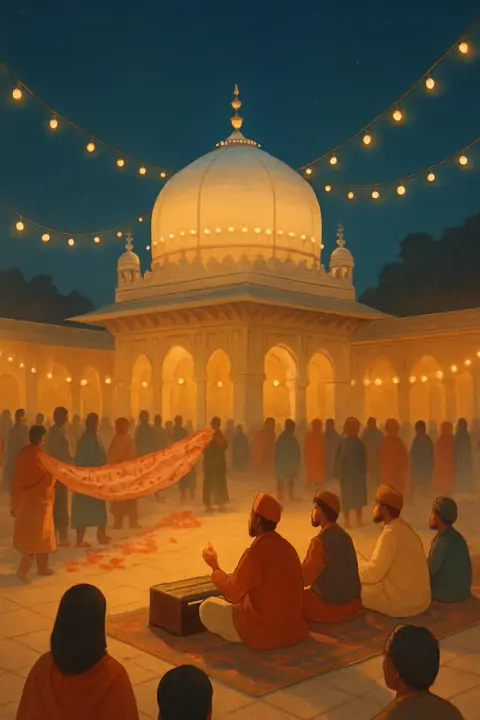
The Urs of Khwaja Moinuddin Chishti at Ajmer Sharif
Rose petals and qawwali until dawn at the tomb of Gharib Nawaz
The Urs is the annual commemoration of the death of Khwaja Moinuddin Chishti, the Sufi saint revered as Gharib Nawaz, held at his dargah in Ajmer from the 1st to the 6th of Rajab, the seventh month of the Islamic calendar. Dates: 11–16 December 2026 (expected); they follow the sighting of the Rajab moon and can shift by a day. Lakhs of pilgrims come for nights of qawwali and the closing Qul on the sixth day. In the words of the Dargah Committee, "kings and the ordinary person are treated alike" here, and for centuries people of every caste, colour, creed and religion have come for the saint's blessings. Entry is free.
The khadims publish the programme months ahead (in July in 2025), but the days follow the sighting of the Rajab moon and can shift by one; the Dargah Committee in Ajmer announces the flag-hoisting a few weeks ahead.
The legend
Moinuddin Chishti, a Persian mystic from Sistan, settles in Ajmer in the early 13th century and roots the Chishti Sufi order in India.
The order is known for love, tolerance and openness, and the saint is reverently called Khwaja Gharib Nawaz.
He dies in 1236, and Sufis call a saint's death anniversary the urs, the "wedding": the day the lover is united with the Beloved, God.
Sultans and emperors came to his tomb: in 1566 Akbar walked here barefoot, praying for sons.
For six nights of the urs qawwali rings over the tomb, and on the sixth morning the Qul prayer closes the festival.
Meaning
Delhi
Qawwali took shape in 13th-century Delhi with the poet Amir Khusrau, a disciple of the Chishti saint Nizamuddin, who fused Persian and Indian music.
Chisht
The order is named after the town of Chisht in Afghanistan and was the first of South Asia's four great Sufi orders.
Customs
Mehfil Khana
The hall for qawwals, built in 1888, opens only for the urs.
The gate of paradise
The silver door called Jannati Darwaza, the gate of paradise, opens only on rare days.
Roses and chadars
Pilgrims bring rose petals and embroidered chadar covers to the tomb.
What people eat
Deg zarda
sweet saffron rice from the giant cauldrons, shared with all
Words of the festival
قوالی
qawwali
Sufi devotional singing; from the Arabic qawl, "utterance"
خواجہ
khwaja
"master", an honorific that is part of the saint's name
دیگ
deg
a giant cauldron; the shrine has two, gifts of Akbar and Jahangir
True or myth
✅ True. The 1568 cauldron, vowed by Akbar after taking Chittor, is built so its rim never gets hot.
❌ Myth. Hindus have long revered the saint too, and they also come to his tomb.
✅ True. Among those buried here are the saint's daughter and Nizam Sikka, the water-carrier who saved Emperor Humayun's life.
Where to celebrate
Ajmer
Worth the trip
For six days at the start of Rajab the shrine of Khwaja Moinuddin Chishti keeps its doors open almost around the clock, the two Mughal cauldrons are cooked and emptied, qawwals sing nightly in the Mehfil Khana, and on…
What the Urs commemorates
Moinuddin Chishti came from Sistan in Persia, settled in Ajmer and rooted the Chishti Sufi order in India; he died in 1236. Sufis call a saint's death anniversary urs, a "wedding": the day the soul is united with God. His shrine has drawn rulers and ordinary pilgrims alike, Muslim and Hindu: the Committee's history records that Akbar came here on foot from Agra, and that the tomb has been rebuilt and added to by sultans and emperors since the 15th century.
The dargah is the only one in India managed under an Act of Parliament, the Dargah Khwaja Saheb Act of 1955, through the Dargah Committee, a statutory body under the Ministry of Minority Affairs. The Committee runs the arrangements for the Urs.
How the Urs unfolds
The programme is published by the dargah each year; the outline below is stable.
| Before 1 Rajab | The Jhanda, the flag ceremony: a procession through the city to the dargah, where members of the Gori family of Bhilwara hoist the flag on the Buland Darwaza. A practice dating to 1944, with a 21-gun salute. |
| 1–6 Rajab, day and night | The shrine stays open almost around the clock. The Jannati Darwaza, the silver "gate of paradise" used only on rare occasions, is opened, and many queue to pass through it. |
| Every night | Mehfil-e-sama, spiritual music, in the Mehfil Khana, the assembly hall built in 1888. The qawwali runs late into the night, and women take part. |
| Through the week | Sweet rice is cooked in the two great degs (cauldrons) in the courtyard and shared out. |
| 6 Rajab: Chhati Sharif | The holiest day, from about 10:00 to 13:30: the khadims read the Shijra, followed by prayers. It ends with the Qul: qawwals sing the Badhaawa at the main entrance with only clapping hands, no instruments, the Fatiha is recited, and a cannon fired at about 13:30 closes the Urs. |
Inside the dargah
There is no paid tier of access anywhere in the shrine.
Nizam Gate
The main outer gate from the bazaar, given in 1911 by Mir Osman Ali Khan, the 7th Nizam of Hyderabad. The flag procession comes through it.
Buland Darwaza
The tall gate to the second courtyard, where the flag is hoisted; the most congested point on flag day.
The tomb
The saint's grave lies in a domed chamber inside a silver railing and a marble screen, always covered with embroidered cloths and fresh roses and jasmine.
The degs
The two cauldrons recall those given by Akbar, enough to cook for 5,000 people, and Jahangir, for 2,500; the present ones are 19th-century replacements holding up to about 4,480 kg of rice.
Etiquette and practicalities
The dargah is a place of prayer, and during the Urs it is very crowded. Follow the police and the Committee's volunteers; general advice is in safety in Ajmer.
- Cover your head — Pilgrims customarily cover their heads inside the shrine, men and women alike, so bring a scarf or cap.
- Shoes off, travel light — Shoes are left outside. During the Urs it is easier to come with as little as possible, and to follow the rules posted at the gates on the day.
- Offerings through the Committee — Donations and deg or langar bookings can be made through the Committee's official site, gharibnawaz.minorityaffairs.gov.in (after registering). The Committee also serves free langar twice a day.
- Qawwali outside the Urs — If your dates miss the Urs, qawwali is sung at the dargah through the year; see qawwali in Ajmer.
Planning: trains, rooms and arrival
The shrine needs no booking; Ajmer does. Around five lakh pilgrims come, and special trains run for the festival.
- Train first
Reserved train tickets open 60 days ahead and Urs-week trains to Ajmer go quickly. See how to get to Ajmer.
- Rooms
Rooms near the dargah are booked months ahead. The Committee runs the Gharib Nawaz guest house and takes bookings on its site; Pushkar, 15 km over the hill, is the usual overflow. See where to stay in Ajmer and Pushkar.
- Arrive before 1 Rajab
Come a day or two before the month begins, so the flag has gone up and the first night's qawwali is within reach; earlier still if you want the flag procession itself.
FAQ
When is the Ajmer Urs?
From 1 to 6 Rajab of the Islamic calendar: 11–16 December 2026 (expected). The days follow the Rajab moon sighting and can shift by one; the date moves about eleven days earlier each year.
What is Chhati Sharif?
The sixth and holiest day of the Urs: 16 December 2026 (expected). Prayers inside the shrine end with the Qul, a song at the main gate accompanied only by clapping, and a cannon shot.
Is there an entry fee for the Ajmer Dargah?
No. Entry to the dargah is free all year, including the Urs, and there is no paid access anywhere inside.
Can non-Muslims visit during the Urs?
Yes. The Dargah Committee describes people of every caste, colour, creed and religion coming for the saint's blessings, and Hindu as well as Muslim kings have been devotees. Visitors customarily cover their heads inside.
Whose dargah is in Ajmer?
The tomb of Khwaja Moinuddin Chishti, called Gharib Nawaz, the Sufi saint who brought the Chishti order to India and died in Ajmer in 1236.
Can women attend the qawwali?
Yes. Women are allowed into the dargah and take part in the nightly mehfil during the Urs.
Sources (5)
Facts checked: 21 October 2026. Prices and hours are approximate; check locally.