 India GO
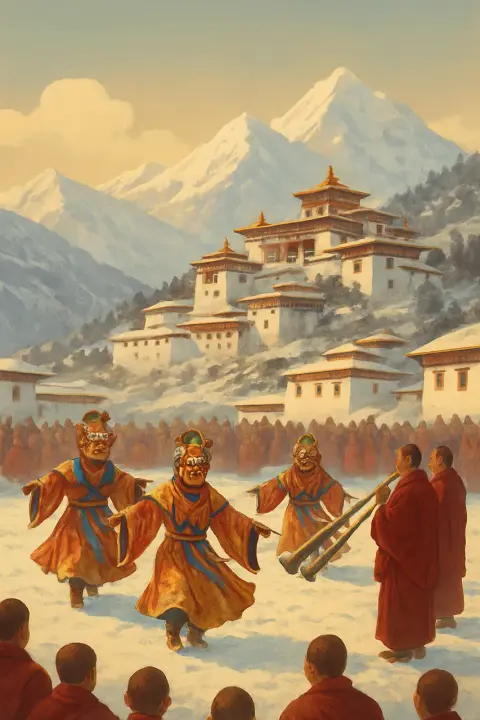
Torgya at Tawang Monastery: three days of masked dances in January
Masked monks turning to drums and cymbals in a winter courtyard
Torgya is a three-day Monpa festival held only at Tawang Monastery in Arunachal Pradesh, on the 28th to 30th days of the eleventh month of the Buddhist lunar calendar. Next: 5–7 January 2027 (expected). Monks dance the cham in masks in the monastery courtyard, and the rites end with the torma, a large offering of barley dough, carried out and given to the fire to turn away harm in the coming year. Viewing is free, but you need a permit to enter Arunachal Pradesh and spare days for a mountain road in midwinter.
Tawang Monastery fixes the days by the Monpa calendar; it and the Tawang district administration announce the preparations about a week ahead.
The legend

Torgya is a Monpa festival held only at Tawang Monastery. Its purpose is to turn away harm, disease and natural disasters from the people in the year ahead.
Sixteen days before, fourteen lamas begin shaping the torma of barley, ghee, milk and molasses for Lama Tsongkhapa, as monks recite scripture to drums.
Torgya means the casting of the torma: the offering is given to the fire, which stands for the destruction of every evil force and a peaceful year.
Customs
Cham in the courtyard
For three days monks in brocade robes and masks of deities and animals dance the cham in the monastery courtyard to drums and cymbals.
The torma procession
The torma is carried by Arpo lamas with bells at their waists, beside two in male and female masks of yak horn, towards a mound of dry bamboo leaves set alight.
The blessing
On the last day the head lama blesses the gathering with a touch on the head, and the lamas tie coloured strips of cloth on their wrists.
What people eat
Tseril
Balls of barley with sugar or molasses, handed out after the prayers.
Where to celebrate
Tawang
Three days of masked cham in the courtyard of Tawang Monastery at about 3,000 m in January, to drums and cymbals, ending with the torma offering carried out and burned.
What happens over the three days
Sixteen days ahead, fourteen lamas of the monastery begin shaping the torma from barley, ghee, milk and molasses, in honour of Lama Tsongkhapa, the founder of the Gelug school to which Tawang belongs. Dry bamboo leaves are built into a temple-shaped mound, the mechang.
On all three days the core of the festival is the cham, a sacred dance performed by selected monks in the monastery courtyard to drums and cymbals. The dancers wear brocade robes and wooden masks of deities, animals and people. Thousands of people from the valley come in their best clothes.
The rite that gives Torgya its name is the casting of the torma. The head lama sets the mechang alight, and the torma is brought out in procession by Arpo lamas with bells at their waists, beside two lamas in male and female masks of yak horn. The head lama touches the torma, and it is given to the flames: a sign that harmful forces are destroyed and the year ahead will be peaceful.
On the last day the head lama blesses the gathering with a touch on the head while lamas tie small strips of coloured cloth on people's wrists, and tseril, sweet balls of barley with sugar or molasses, are handed out after the prayers.
Meaning, the monastery and the Dungyur year
Torgya belongs to the Monpa, the Buddhist people of the Tawang valley, and is held nowhere else. In the monastery's tradition it drives away evil forces and protects people from disease and natural disasters in the year ahead.
The setting is Tawang Monastery, known in Tibetan as Gaden Namgyal Lhatse. It was founded in 1680–1681 by Merak Lama Lodre Gyatso in accordance with the wishes of the 5th Dalai Lama, belongs to the Gelug school and stands at about 3,000 m above the Tawang Chu valley. It is often called the largest Buddhist monastery in India. Besides Torgya, the main Monpa festivals held there include Losar, the Tibetan New Year.
Every third year the festival is celebrated on a much larger scale as Dungyur (Dung-Gyur), when the monks also conduct the Mani Dung Drub ritual. The tourism site gives no cycle of years, so check with the monastery.
Permits for Arunachal Pradesh
Tawang is in Arunachal Pradesh, and every visitor who is not a native of the state needs a permit on top of any visa.
- Indian citizens: an Inner Line Permit (ILP). The state's official portal, eilp.arunachal.gov.in, issues the Tourist eILP online. Arunachal Tourism says the Tourist eILP covers a stay of up to 14 days; for longer stays apply for a provisional ILP. The portal lists the fee at about ₹100 per person.
- Foreign nationals: the whole state is a Protected Area, so you need a Protected Area Permit (PAP) before entry. The same portal has an ePAP section. According to Arunachal Tourism, applications go through an approved local tour operator only (or in person in New Delhi or Itanagar), and foreign tourists pay a royalty of about US$30 per person to the state government.
Rules change, so check the portal before booking; the UK Foreign Office advises applying three months ahead. Visa basics: India visa guide.
Getting to Tawang in January
Torgya falls in the coldest part of the year, and the route crosses the Sela pass at about 4,170 m, which snow can close.
- Fly to Guwahati or Tezpur
Guwahati is the usual gateway, about 543 km from Tawang by road. The district site also lists a state helicopter from Guwahati airport with only about 10 to 12 seats.
- Two days by car
The road runs via Bhalukpong, Bomdila and the Sela tunnel, opened in 2024, usually with a night at Dirang or Bomdila. The district site puts the drive from Guwahati at around 14 to 16 hours. The tunnel has made the road more reliable, but not weatherproof.
- Arrive early, book ahead
Be in Tawang at least two days before the closing day, and hire the car with spare days on both sides. Book rooms about two months ahead; prices rise moderately over the festival.
In the courtyard
Torgya is a religious rite first. Visitors are welcome if they follow a few rules.
- No tickets — The courtyard is open on all three days, and the closing procession can be watched from the monastery grounds.
- Sit where the monks direct — The front rows are kept for monks and elders.
- Never cross the dance ground — The front of the courtyard is the dancers' space for all three days.
FAQ
When is Torgya?
Next: 5–7 January 2027 (expected). The festival runs on the 28th to 30th days of the eleventh month of the Monpa (Tibetan) calendar, which falls in January or early February. Tawang Monastery fixes the days, and the monastery and district announce the preparations about a week ahead.
What is the Torgya festival?
A three-day Monpa Buddhist festival at Tawang Monastery with masked cham dances, ending with a torma offering of barley dough burned to drive away harm and disaster in the coming year.
What are the festivals of Tawang?
The main Monpa festivals at Tawang Monastery include Losar, the Tibetan New Year, Choksar, Ajilamu and Torgya. Every third year Torgya is held on a grand scale as Dungyur.
Do I need a permit to see Torgya?
A: Yes. Indian citizens need an Inner Line Permit, issued online at eilp.arunachal.gov.in (about ₹100); foreign nationals need a Protected Area Permit, applied for through an approved local tour operator, with a royalty of about US$30.
Is there an entry fee for Torgya?
No. The cham in the monastery courtyard and the closing procession are free to watch; the only costs are the permit, the journey and the stay.
How do I get to Tawang for Torgya?
Fly to Guwahati or Tezpur, then drive two days via Bhalukpong, Bomdila and the Sela tunnel, usually overnighting at Dirang or Bomdila. Snow can close the Sela pass in January, so keep spare days.
Sources (12)
- Tawang Tourism: Fairs and festivals
- Government of Arunachal Pradesh: eILP and ePAP portal
- Arunachal Tourism: Protected Area Permit
- Torgya
- Tawang Monastery
- Tawang Tourism: Religious and monastic dances
- MyGov Arunachal Pradesh: Torgya Festival
- Government of Arunachal Pradesh: eILP information, fees and validity
- Tawang Tourism: ILP formalities
- FCDO travel advice for India: entry requirements, access permits
- Tawang Tourism: How to reach
- Sela Tunnel
Facts checked: 22 October 2026. Prices and hours are approximate; check locally.