 India GO
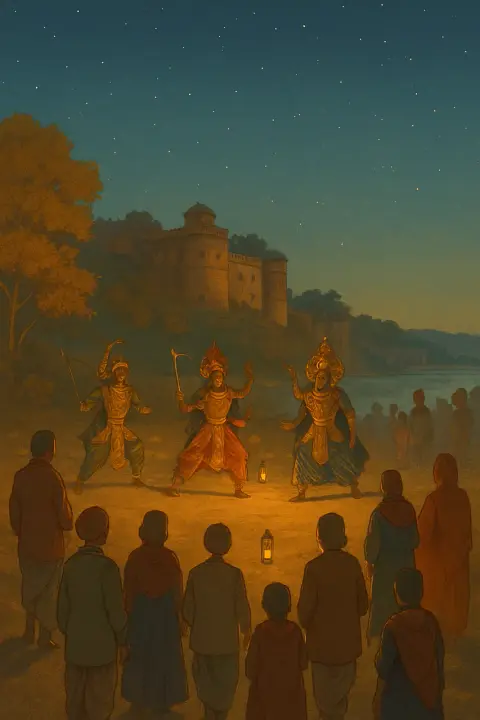
Ramnagar Ramlila: a month of the Ramayana across one town
The audience walks with Rama from Ayodhya to Lanka across one lamplit town
Ramnagar's Ramlila is the Ramayana performed not on a stage but across a whole town. For 31 evenings, under the patronage of the Maharaja of Benares, episodes of Tulsidas's Ramcharitmanas are played at open-air sites around Ramnagar, across the Ganga from Varanasi, and the audience walks with the story from one site to the next. UNESCO, which inscribed Ramlila as intangible heritage of humanity, names Ramnagar among its most representative traditions. Dates: 25 September – 25 October 2026.
The Ramlila follows the calendar of the house of the Maharaja of Benares (the Kashi Naresh); the list of nightly episodes is published in Varanasi when the Lila opens.
The legend

Tradition says Tulsidas's student Megha Bhagat began staging the Ramcharitmanas in 1625. That is how the north Indian Ramlila was born.

One local legend says a Ganga flood once stopped the lila in Varanasi, so it was staged across the river in the village of Chota Mirzapur.
Around 1830 the Maharaja of Benares, Udit Narayan Singh, takes the lila under his patronage together with the family of Pandit Laxmi Narayan Pandey.
The lila used to run ten or twelve days; at court it grew to a whole month, so the entire Manas is recited, prologue to epilogue.

And still today, for 31 evenings in a row, the Kashi Naresh opens each episode, and the town of Ramnagar becomes Ayodhya, Janakpur and Lanka again.
Meaning
The lila's text
Tradition holds that Maharaja Ishwari Prasad had the poet Bharatendu Harishchandra recast the dialogue from Bhojpuri into Khari Boli, fixing it ever since.
Customs
A town for a stage
There is no stage: sites across Ramnagar bear the names of Ramayana places, and each evening the audience walks after the heroes from one to the next.
No microphones
No loudspeakers and no electric light: the actors rely on their own voices, and oil lamps light the sites.
Boy swaroops
Rama, Sita and the brothers are played by boys of 10 to 14, painted with sandalwood and dressed in sequins; they are chosen at auditions before the maharaja.
The Ramayanis
Beside the maharaja sit the Ramayanis, experts in the Manas who chant the text while the actors speak the dialogue.
Aarti and jhanki
Each episode ends with an aarti and cries of "Har Har Mahadev", then the actors freeze into a living tableau, the jhanki.
Roles in the family
Key roles pass down in families: one family held the role of Ravana from 1835 to 1990.
Words of the festival
रामलीला
Ramlila
"Rama's play": a folk staging of Rama's life from the Ramayana
स्वरूप
swaroop
"form": the name for the young actors seen as the gods themselves during the lila
रामायणी
Ramayani
one versed in the Ramayana; in Ramnagar, the chanters of the Manas
व्यास
vyas
the lila's director and prompter; in Ramnagar a hereditary post of the Pandey family
झाँकी
jhanki
"a glimpse": the frozen living tableau at the end of an episode
How to greet
हर हर महादेव
Har Har Mahadev!
Varanasi's cry in praise of Shiva; it greets the Maharaja of Kashi and closes each episode of the lila.
True or myth
❌ Myth. The lila is played without loudspeakers or electric light, by voice alone and by oil lamps.
✅ True. All the swaroops are boys between 10 and 14.
❌ Myth. Most Ramlilas are cut to ten days, but Ramnagar plays for 31 evenings and recites the whole Manas.
Where to celebrate
Varanasi
Across the Ganga from Varanasi, the town of Ramnagar becomes a month-long, lamplit Ramayana, and the audience walks with the story from one part of town to the next.
What makes Ramnagar's Ramlila different
Ramlila, literally Rama's play, is staged across north India in the Dussehra season, and UNESCO inscribed it on its Representative List of the Intangible Cultural Heritage of Humanity in 2008, after proclaiming it in 2005. Most Ramlilas tell the story in ten to twelve days. UNESCO singles out Ramnagar's as one that may last an entire month.
The length is a choice. When Maharaja Udit Narayan Singh took the lila under royal patronage around 1830, together with the family of Pandit Laxmi Narayan Pandey (still its vyas, director and prompter), it grew from about ten days to a full month, so that the whole Ramcharitmanas is recited, prologue and epilogue included. Tradition holds that the dialogue was later recast from Bhojpuri into Khari Boli and has stayed fixed since.
The town itself is the set. Permanent and temporary structures stand for Ayodhya, Janakpur, Chitrakut, Panchavati, Ashoka Vatika and Lanka, about 40 sites over several kilometres. Rama, Sita and the brothers are played by boys, the swaroops, chosen at auditions attended by the maharaja, and some roles pass down in families: one family played Ravana from 1835 to 1990. There are no loudspeakers and no electric light: the sites are lit by torches and Petromax pressure lamps.
How an evening runs
Performances begin around 5 pm; for a recent edition the published schedule gave 5 to 8 pm. The Kashi Naresh, the Maharaja of Benares, opens each episode; at the start of the cycle he leads a pageant on an elephant. Beside him sit the Ramayanis, sadhus and experts in the Manas, who chant the text stanza by stanza while the actors speak the dialogue, and many people in the crowd follow along in their own copy. UNESCO describes the audience as invited to sing and take part in the narration, and the crowd joins in.
When the scene changes place, everyone walks to the next site. Each episode ends with an aarti and a jhanki, a living tableau, to cries of "Har Har Mahadev". Which site the evening uses depends on the episode, so check the nightly list before you cross the river.
Which night to go
Any evening of the month is a real Ramlila, and the whole cycle is free. The list of nightly episodes is published in Varanasi when the lila opens.
Dussehra
Rama's victory over Ravana, played on Dussehra itself in a recent nightly list.
Bharat Milap
Rama's reunion with his brother Bharata, a few days after Dussehra, and the peak of the cycle for many in the crowd. Arrive in Varanasi about three days early and come to the site early for a place.
The coronation and the last night
Rama's coronation comes near the end of the cycle, and the final night is held at Ramnagar Fort, the maharaja's riverside residence.
Getting there and back
Ramnagar is close to Varanasi, but the lila ends after dark, and the return is the part to plan.
- Stay in Varanasi
Book a room in Varanasi about three weeks ahead. The cycle runs through Dussehra into the Diwali travel season, so buy train tickets as soon as sales open, 60 days out.
- Cross the river
Ramnagar is on the east bank of the Ganga, 14–17 km by road from the centre of Varanasi; Ramnagar Fort is about 2 km from Banaras Hindu University over the Ramnagar bridge.
- Arrange the return in advance
Transport back thins out in the evening. Agree a return with your driver before the performance starts.
Watching respectfully
For the people around you this is not theatre but worship: the swaroops are seen as the gods themselves while the lila lasts.
- Listen — There is no amplification, so the actors' voices are all there is. Keep phones silent.
- No flash — The sites are lit by torches and lamps. A flash breaks the scene for everyone.
- Crowds on the big nights — Bharat Milap and the last nights are the peak of the cycle and draw big crowds. UK travel advice notes that stampedes have happened at large religious gatherings in India and asks visitors to follow the advice of the local authorities.
FAQ
When is Ramnagar Ramlila?
Next: 25 September – 25 October 2026. It runs for a month of evenings from Anant Chaturdashi to Sharad Purnima, the full moon of Ashvin, usually from September to late October.
How many days does the Ramnagar Ramlila last?
31 evenings. Most Ramlilas last ten to twelve days; in Ramnagar the whole Ramcharitmanas is recited, which takes a month.
When was the Ramnagar Ramlila started?
In its present form around 1830, when Maharaja Udit Narayan Singh of Benares took it under his patronage. By tradition, the north Indian Ramlila itself goes back to Megha Bhagat, a student of Tulsidas, in the 17th century.
What is special about the Ramnagar Ramlila?
Its length (a full month), the town used as the set, with the audience walking between sites, the maharaja's presence every evening, and the absence of microphones and electric light.
Do I need a ticket?
No. The whole cycle is free, including Bharat Milap and the final nights; come early on those for a place.
Sources (6)
Facts checked: 21 October 2026. Prices and hours are approximate; check locally.