 India GO
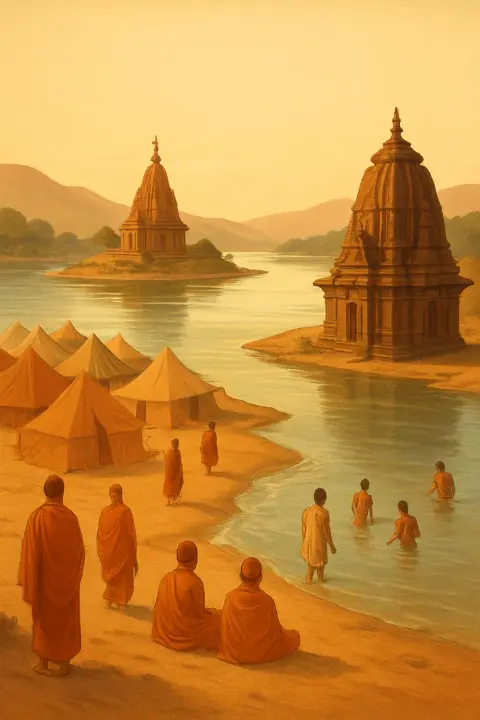
Rajim Kumbh Kalp Mela: Chhattisgarh's fortnight at three rivers
Three rivers, an island Shiva temple and a fortnight of camping on the sand
Rajim Kumbh is Chhattisgarh's own river gathering: about fifteen days from Magha Purnima, the full moon of Magha, to Maha Shivaratri, at the point where the Mahanadi, Pairi and Sondur rivers meet. Pilgrims bathe at the sangam below an 8th-century Vishnu temple, sadhus and families camp on the sand under vow, and the last day brings the akharas' procession and royal bath. Dates: 20 February – 6 March 2027. Rajim is 45 km from Raipur, and everything at the mela is free.
The dates follow the lunar calendar; the Chhattisgarh government notifies the mela in December or January.
The legend
Legend says Vishnu threw a lotus to earth and told Vishvakarma to build a temple where it landed. So the Rajiv Lochan temple arose.
The lotus's five petals became five Shiva temples around Rajim; one of them, Kuleshwarnath, stands on an island in the confluence.

The yearly fair at the meeting of the Mahanadi, Pairi and Sondur grew into the Rajim Kumbh, the fifth Kumbh, with the kalpvas vow as at Prayagraj.
Customs
Bathing at the sangam
The fair opens on Magha Purnima with bathing where the three rivers meet, below the 8th-century Rajiv Lochan temple.
Kalpvas on the sand
For two weeks sadhus, akharas and pilgrims camp on the bank under the kalpvas vow, with a fair, discourses and evening aarti around them.
Maha Shivaratri
On the last day the akharas process down to the sangam for the royal bath, and worship is offered at the island temple of Kuleshwar.
Where to celebrate
Rajim
A fortnight of bathing, camping under vow and evening aarti where the Mahanadi, Pairi and Sondur meet, ending on Maha Shivaratri with the akharas' procession and royal bath.
What happens over the fortnight
The mela opens on Magha Purnima with bathing at the Triveni Sangam, the meeting of the three rivers, on the ghats below the Rajiv Lochan temple. For the next two weeks the bank becomes a camp. Sadhus, akharas (orders of ascetics) and ordinary pilgrims keep kalpvas, the vow of living by the river for the length of the mela, as pilgrims do at the Magh Mela in Prayagraj. Around them run a fair, religious discourses and a cultural stage, and processions carrying images of Vishnu and sometimes Shiva go through the fair ground and the town.
The day has a fixed evening point: the aarti (lamp offering) to the Mahanadi at about 6:30 pm.
The mela ends on Maha Shivaratri. The akharas process down to the sangam for the shahi snan, the royal bath, and worship is offered at the Kuleshwar Mahadev temple, which stands on an island in the middle of the confluence.
The temples at the sangam
Rajim is sometimes called the Prayag of Chhattisgarh for the number of its temples. Two are at the centre of the mela.
Rajiv Lochan temple
The temple the town is named after, dedicated to a four-armed form of Vishnu. An inscription credits it to Vilasatunga of the Nala dynasty and dates it by its script to the 8th century, though some historians place it earlier. It stands in a courtyard with four smaller shrines at the corners, known for its carved doorways and pillars.
Kuleshwar Mahadev temple
The Shiva temple on an island where the three rivers meet. By local legend it is one of five Shiva temples around Rajim that grew from the petals of the lotus Vishnu threw to earth, and it is where the mela closes on Maha Shivaratri.
Why it is called the fifth Kumbh
The great Kumbh Melas rotate between Prayagraj, Haridwar, Ujjain and Nashik. Rajim's gathering is not one of them: it grew out of the yearly Punni mela, the full-moon fair at the Rajiv Lochan temple, and with state support became a Kumbh in its own right, the fifth Kumbh as it is called locally, with the same bathing and kalpvas. Unlike the big four, it is held every year.
Getting there and where to stay
Rajim is easy: a city with an airport and a main-line station 45 km away, and plenty of hotels in it.
- Base yourself in Raipur
Raipur has an airport and is on the Howrah–Mumbai main line. Hotels are plentiful, so booking about a month ahead is enough; the alternative is the mela's own tented camps.
- Raipur to Rajim
45 km by road, via National Highway 30 to Abhanpur and then a smaller road to Rajim. During the mela, special MEMU trains have also run from Raipur to Rajim.
- Arrive the day before
Get to Raipur the day before the day you want: the opening full moon or the closing Shivaratri.
Etiquette and safety
The bath, the temples, the fair, the aarti and the cultural programme are all free. A few rules come with them.
- No alcohol or meat near the mela — Liquor and non-vegetarian food are banned in the vicinity of the mela for its duration. UK travel advice notes that alcohol sales are often banned during major religious festivals in India.
- Keep the river clean — Notices at the site list acts that the Brahma Purana counts as wrong during a Kumbh: bathing with soap, washing clothes or dishes in the river, throwing rubbish into it.
- Shivaratri crowds — The closing day, with the procession and the royal bath, draws large crowds. UK travel advice notes that stampedes have happened at large religious gatherings in India and asks visitors to follow the advice of the local authorities.
Combine it with
Sirpur, the group of Buddhist and Hindu monuments about 90 km away, can be visited from Raipur on another day. In autumn the state's other big festival is Bastar Dussehra.
FAQ
When is Rajim Kumbh?
Next: 20 February – 6 March 2027. It runs every year from Magha Purnima to Maha Shivaratri, usually between late January and early March; the Chhattisgarh government notifies the dates in December or January.
Is Kumbh Mela held every 3 years?
The big four Kumbh Melas, at Prayagraj, Haridwar, Ujjain and Nashik, follow a cycle of about 12 years at each site, with half Kumbhs in between at Prayagraj and Haridwar. Rajim's Kumbh is different: it is held every year.
Where is Rajim and how far is it from Raipur?
Rajim is in Gariaband district of Chhattisgarh, 45 km from Raipur by road, at the confluence of the Mahanadi, Pairi and Sondur rivers.
Which is the main day of Rajim Kumbh?
Two days stand out: the opening bath on Magha Purnima and the closing Maha Shivaratri, with the akharas' procession and the royal bath.
Is there an entry fee?
No. The bath, the temples, the fair, the evening aarti and the cultural programme are free.
Sources (8)
Facts checked: 21 October 2026. Prices and hours are approximate; check locally.