 India GO
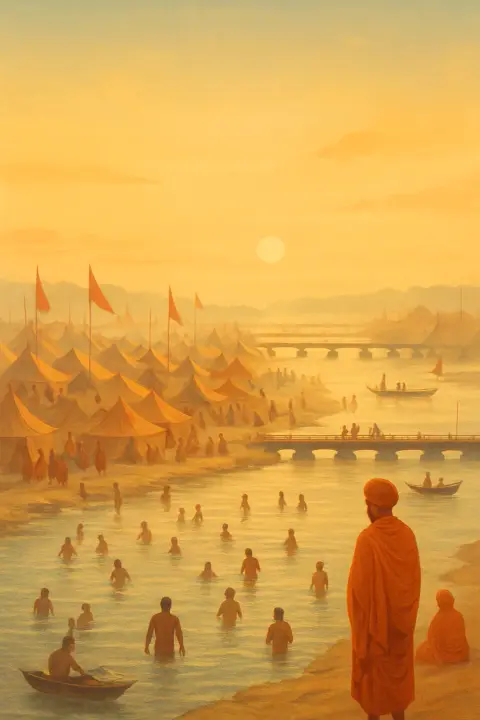
Magh Mela, Prayagraj: the yearly tent city at the Sangam
A city of tents and pontoon bridges pitched on the sand where rivers meet
The Magh Mela is the yearly bathing fair at the Sangam in Prayagraj, where the Ganga and the Yamuna meet and the unseen Saraswati is believed to join them. For the Hindu month of Magha a temporary city of tents and pontoon bridges goes up on the sand, and thousands of kalpvasis live in it under vow. Dates: 14 January – 6 March 2027 (expected); the main bathing day, Mauni Amavasya, falls on 6 February 2027 (expected).
The Prayagraj Mela Authority notifies the bathing dates six to twelve months ahead.
The legend
In the Puranas, Brahma performed a sacrifice where the Ganga, the Yamuna and the mythical Saraswati meet, and named the place Tirtharaj, king of holy sites.

The Matsya Purana praises Prayag's holiness in the month of Magha, and the 16th-century Ain-i-Akbari notes Allahabad is especially holy in Magha.

Chaitanya came here too: his biography says he visited the Magh Mela, with pilgrims so many that the plains could not hold them.
The Magh Mela happens every year. Every twelve years it becomes the Maha Kumbh, and six years after a Kumbh, the Ardh Kumbh.
And every winter a tent city rises again on the sand at the Sangam, where kalpvasis live by the river under vow for the whole of Magha.
Meaning
Uttarkashi
The hills have their own Magh Mela: on Makar Sankranti villages bring their gods' palanquins to Manikarnika Ghat, then dance for a week.
Sikhs
Maghi was one of three gatherings Guru Amar Das called; today Sikhs remember the Forty Martyrs on it, with the largest gathering in Muktsar.
Customs
Kalpvas
Kalpvasis live by the river all month: they bathe at dawn, read scripture, hear discourses and eat simple food without onion or garlic.
Mauni Amavasya
The main bathing day is the new moon of Magha, the "silent" one, which people try to spend in silence.
Out to the confluence
People bathe from the sand ghats, and boats ferry them to where the Ganga and Yamuna meet; the Saraswati is believed to join unseen, from below.
Giving
The mela is also about dana, giving: monks and the poor are fed at community meals, and saints give discourses.
Words of the festival
कल्पवास
kalpvas
"dwelling": a month of life by a holy river under vow
संगम
Sangam
"confluence": where the Ganga, the Yamuna and the unseen Saraswati meet
मौनी अमावस्या
Mauni Amavasya
the "silent new moon" of Magha, the main bathing day
तीर्थराज
Tirtharaj
"king of holy places", the Puranas' name for Prayag
True or myth
❌ Myth. The Magh Mela is held every year; once every twelve years it becomes the Maha Kumbh.
✅ True. It usually lasts a month, but depending on capacity it can be 5, 11 or 21 days.
❌ Myth. Mauni means silent: people try to spend the day in silence.
Where to celebrate
Prayagraj
Every year in Magha a tent city goes up on the sand at the Sangam, kalpvasis live in it under vow, and on Mauni Amavasya 2026 more than 3 crore people bathed by noon.
What the Magh Mela is
In the Puranas, Brahma performed a sacrifice at the meeting of the three rivers and named the place Tirtharaj, "king of holy places". The Matsya Purana praises the holiness of Prayag in the month of Magha, and the 16th-century Ain-i-Akbari notes that Allahabad, as the city was then called, is especially holy in Magha. The biography of the Bengali saint Chaitanya says that when he came to the Magh Mela, the pilgrims were so many the plains could not hold them.
The mela is held every year. It is not a once-in-twelve-years event: in the Kumbh years the same gathering at the same place becomes the Maha Kumbh, every twelve years, or the Ardh ("half") Kumbh, six years after it. In other years it is the Magh Mela, smaller but still vast. The Kumbh Mela page explains the four-city cycle.
The mela opens with the first of its baths, Paush Purnima (the full moon of Pausha) or Makar Sankranti, whichever comes first, and closes on Maha Shivaratri: six to eight weeks from January into February or early March. The Prayagraj Mela Authority, the state body that runs it, notifies the bathing dates six to twelve months ahead.
The bathing days
Six main bathing days (snan parv) are set by the moon and the sun. Makar Sankranti is solar, so in some years it comes before Paush Purnima and in others after it. Mauni Amavasya is the peak.
| Paush Purnima | Full moon of Pausha; in some years the opening bath |
| Makar Sankranti | The Sun enters Capricorn, mid-January; in other years the opening bath |
| Mauni Amavasya | The "silent new moon" of Magha: the main bath, 6 February 2027 (expected) |
| Basant Panchami | Fifth day of the bright half of Magha |
| Maghi Purnima | Full moon of Magha |
| Maha Shivaratri | The closing bath |
What you see at the mela
The mela stands on the sand at the Sangam, in recent years about 800 hectares divided into seven sectors and joined by pontoon bridges across the Ganga. In them are the camps of the akharas (monastic orders of sadhus), the tents of religious organisations and the rows of kalpvasi tents.
Kalpvas, "dwelling", is the core of the Magh Mela: a month of life by the river under vow. Kalpvasis bathe at dawn, read scripture, listen to discourses and eat simple food without onion or garlic. It usually lasts a month, but depending on capacity a kalpvas can be cut to 5, 11 or 21 days.
On a bathing day people go into the water from the sand ghats from before dawn, and boats ferry bathers out to the confluence itself. On Mauni Amavasya many try to keep silence all day, so the Sangam is quieter than its crowds suggest. The mela is also about dana, giving: monks and the poor are fed at community meals, and saints give discourses in the camps. Bathing and walking the sectors are free and open to everyone; in the camps you are a guest, so ask before photographing.
Crowds and safety
On one recent Mauni Amavasya, more than 3 crore (30 million) people had bathed by noon. The UK Foreign Office advises care at large religious gatherings, where stampedes have caused deaths and injuries. If you are not ready for a dense crowd, choose a smaller bathing day or a day between them.
- Arrive two days before the bathing day you choose: on the main days roads close in rings around the Sangam, vehicles stop at parking areas at the edge of the mela and the last stretch is on foot.
- Plan for hours of walking: the sectors are spread over the sand and joined by pontoon bridges.
- Keep documents and money in a body pouch, and agree a meeting point with your group away from the ghats.
- January nights by the river are cold; bring warm layers.
- Emergency number: 112. More in Is India safe? and Emergency numbers.
Planning, getting there and where to stay
A main bathing day needs three or four nights: two before it, the night of the bath, and ideally one after, since the roads stay closed and people bathe from midnight to noon.
- Rooms: about two months ahead
The mela's own tents are the authentic option: UP Tourism's Sangam Tent Colony at Arail, on the far bank of the Yamuna, and private camps. Both fill for the main bathing days, and so do the city's hotels.
- Trains: when booking opens
Trains to Prayagraj Junction, the main station, go on sale 60 days ahead; book on the day the window opens for a main bathing day.
- Flights
Prayagraj airport has limited flights; the larger airports are Varanasi, about 125 km away, and Lucknow, about 200 km. Many visitors combine the mela with Varanasi.
FAQ
When is the Magh Mela in Prayagraj?
14 January – 6 March 2027 (expected), from the first bath (Paush Purnima or Makar Sankranti) to Maha Shivaratri. The main bathing day, Mauni Amavasya, is 6 February 2027 (expected).
Where is the Magh Mela held?
On the sand at the Sangam in Prayagraj, Uttar Pradesh, where the Ganga and the Yamuna meet and the Saraswati is believed to join them unseen.
Is the Magh Mela held every year?
Yes. It is not a twelve-year event: in Kumbh years the same gathering becomes the Maha Kumbh (every twelve years) or the Ardh Kumbh (six years after it).
What is kalpvas?
A month of life by the river under vow: kalpvasis bathe at dawn, read scripture, hear discourses and eat simple food without onion or garlic. It can be shortened to 5, 11 or 21 days.
How do I book a tent at the Magh Mela?
Through UP Tourism's Sangam Tent Colony at Arail or through private camps, about two months ahead for the main bathing days.
Why is Mauni Amavasya the main day?
It is the new moon of Magha, the "silent" one, and the peak bathing day of the mela; many people try to spend it in silence.
Sources (6)
Facts checked: 21 October 2026. Prices and hours are approximate; check locally.